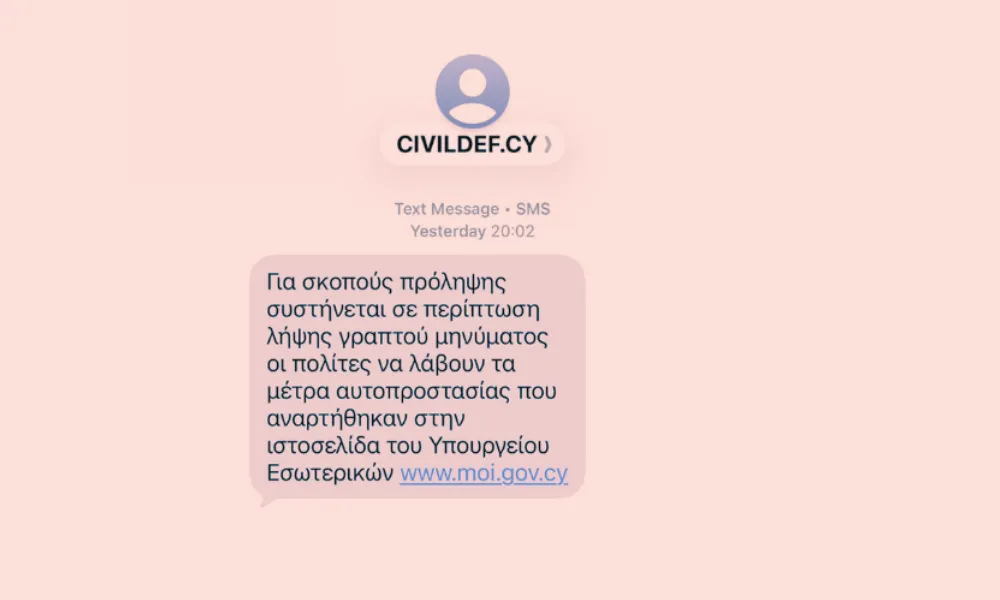



The delayed SMS alerts sent across Cyprus on Wednesday evening were meant to test how quickly authorities could warn the public in an emergency. Instead, the exercise highlighted the structural gaps that have kept the country without a modern public warning system for years.
At 19:00 on March 4, authorities activated a trial campaign to send precautionary messages to mobile phones across the island following heightened regional tensions and security alerts affecting Cyprus since the beginning of March. The test quickly exposed limitations. Some citizens received the message immediately, others waited more than an hour, while many reported receiving only the Greek version or no message at all.
Telecommunications providers confirmed that the alerts were sent using conventional bulk SMS technology. This type of system distributes messages gradually when they are sent simultaneously to very large numbers of users, meaning delivery times can vary widely depending on network capacity.
In practice, the exercise demonstrated the limits of relying on standard messaging infrastructure for emergency communication.
Under EU legislation, alerts are expected to reach all mobile devices in a defined geographical area immediately through technologies such as cell broadcast or location-based SMS. The aim is to ensure that every phone connected to the network in the affected area receives the alert simultaneously.
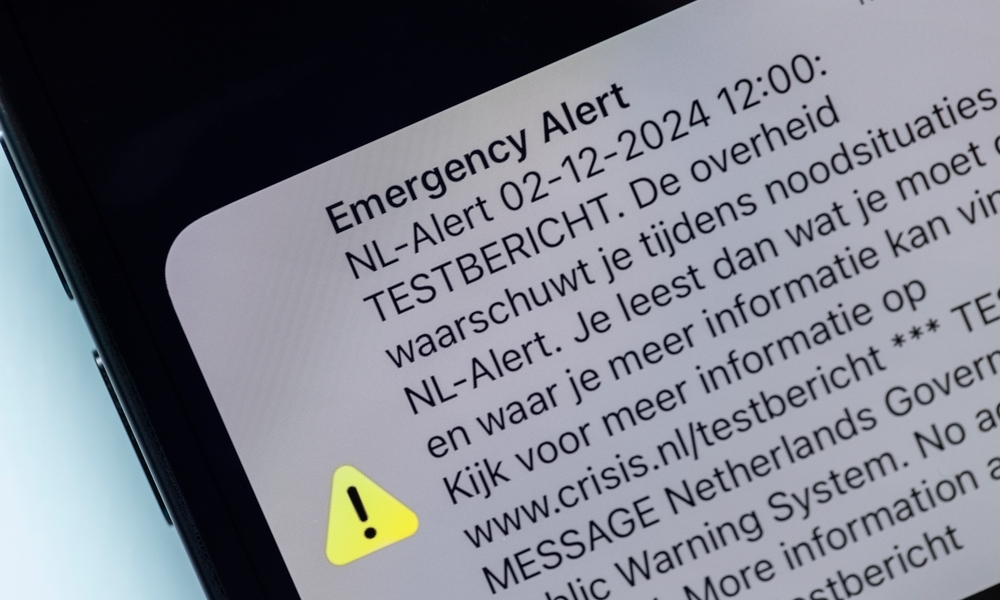
Cyprus does not yet have such a system.
The European Electronic Communications Code required EU member states to implement mobile-based public warning systems capable of sending alerts during emergencies. According to CIReN, the deadline for implementation was June 21, 2022.
Nearly four years later, Cyprus is still in the process of building that infrastructure.
The absence of an operational system became particularly visible during the wildfires that devastated the mountainous region of Limassol from July 23 to July 25 last year. Two people died and around 120 square kilometres of forest and agricultural land were destroyed.
Post-incident reports from Civil Defence and other emergency services confirmed that no national early warning system was available to alert the population during the crisis. According to Civil Defence documentation, residents were warned through improvised methods including loudspeakers, door-to-door visits and local initiatives by community authorities.

Cyprus among weakest performers in Europe
At the same time, another key element of modern emergency communications remains unimplemented. EU legislation required member states to introduce handset-derived caller location technology by December 2020. Known as Advanced Mobile Location, the system automatically transmits the caller’s precise position to emergency services when contacting 112, allowing responders to locate people in distress quickly.
Experts in emergency communications have described the country as lagging behind most EU member states in implementing these systems. According to the European Emergency Number Association, Cyprus remains among the weakest performers in Europe in this area.
Why the system is still not in place
Cyprus failed to meet the EU requirement to implement a mobile Public Warning System by June 2022 and caller-location technology by December 2020.
- The Public Warning System tender launched in 2022 stalled and was cancelled in May 2024 after legal appeals from bidders.
- The project had to be redesigned and re-tendered in December 2024, pushing implementation several years beyond the EU deadline.
- Implementation moved through lengthy procurement and evaluation procedures, delaying deployment.
- The project sits across Civil Defence, the Interior Ministry, the Deputy Ministry of Innovation and telecom providers, complicating coordination and decision-making.
- The Next Generation 112 (NG112) platform and Advanced Mobile Location (AML) technology are still under development.
- Authorities have relied on temporary tools such as bulk SMS, which are not designed for instant nationwide alerts.
Events such as the July 2025 Limassol wildfires revealed that public warning mechanisms still depend on manual or local methods, underscoring the absence of a national automated system.
The project to introduce a Public Warning System was first tendered by Civil Defence in 2022. The process stalled after appeals from bidders, leading to the cancellation of the tender in May 2024. A revised tender was issued only in December 2024 after technical specifications were adjusted to reduce the risk of further legal challenges.
Civil Defence officials have indicated that the project carries a budget of around €7 million and will require approximately eight months to implement once the contract is signed.

A separate project is also planned for the introduction of a New Generation 112 system, which would modernise emergency call handling and integrate features such as Advanced Mobile Location. Officials say the first operational version of that system could be completed within thirteen months of contract signing, with full implementation expected within twenty-seven months.
The timeline means that even under the most optimistic scenario, Cyprus will implement both systems years after the EU deadlines.
Despite these delays, government statements have consistently emphasised the strengthening of civil protection and the upgrading of the 112 emergency system as policy priorities. During annual planning statements in both 2024 and 2025, President Nikos Christodoulides referred to improvements in emergency response capabilities linked to the 112 infrastructure.
In practice, however, the infrastructure itself remains under construction. The technology used was never intended to deliver simultaneous alerts to an entire population. As the telecommunications providers acknowledged, bulk SMS systems distribute messages gradually across networks when traffic volumes are extremely high.
In a time of heightened public insecurity, the state proved once again that its warning systems remain years behind what emergencies demand.