
More than half a century after the last human missions to the Moon, space exploration is once again turning humanity’s attention toward Earth’s natural satellite. As part of preparations for the Artemis II mission, NASA is inviting people around the world to symbolically join the journey by submitting their names to travel aboard the spacecraft that will orbit the Moon.
Through the campaign “Send Your Name with Artemis II”, members of the public can register their names and have them included on a memory card that will fly on the mission’s Orion spacecraft.
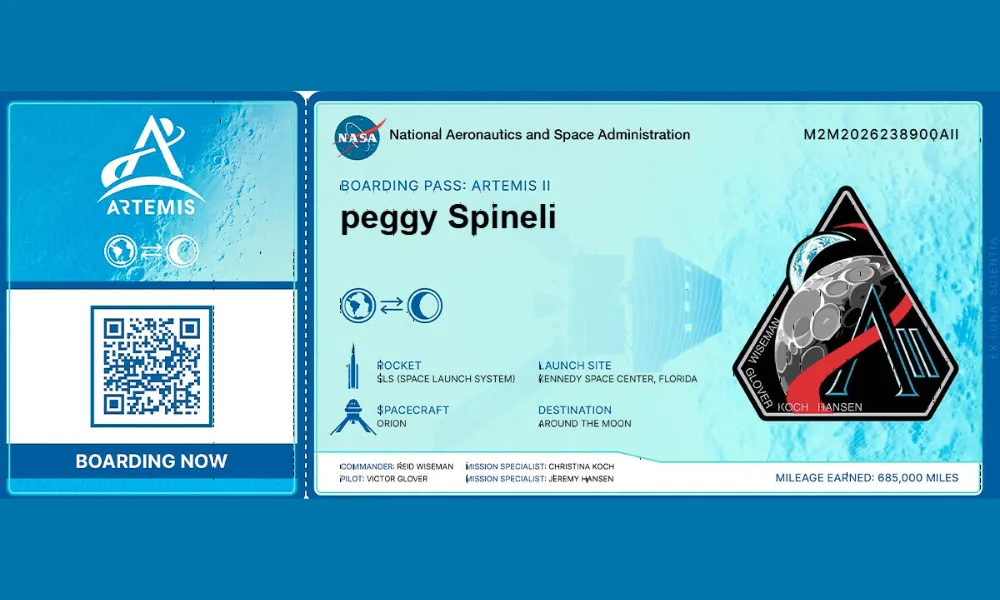
A symbolic “boarding pass” to the Moon
NASA offers participants the opportunity to receive, free of charge, a digital “boarding pass” confirming that their name will travel with the mission.
Anyone who wishes to participate can register their name by 21 June 2026. After completing the submission, participants can download a commemorative boarding pass verifying their inclusion in the flight.
All submitted names will be stored on a memory card that will be added to the official Artemis II flight kit, alongside other mission memorabilia.
Travelling with the Artemis II crew
Thousands of people have already added their names and will symbolically travel alongside the mission’s astronauts: Reid Wiseman, Victor Glover, Christina Koch, and Jeremy Hansen of the Canadian Space Agency (CSA).
A similar campaign was organised during Artemis I, when around 3.4 million people symbolically joined the uncrewed mission that entered lunar orbit in late 2022.
First crewed mission of the Artemis programme
The Artemis II mission will be the first crewed flight of NASA’s Artemis programme and is expected to last approximately ten days.
The primary goal of the mission is to test critical spacecraft systems and technologies that will pave the way for more ambitious lunar missions in the future.
Preparing for humanity’s return to the Moon
The mission will not include a lunar landing. Instead, the Orion spacecraft will follow a trajectory around the Moon to verify that all systems operate as expected before attempting a future return of astronauts to the lunar surface.
At the end of the mission, Orion will re-enter Earth’s atmosphere at high speed before safely splashing down in the Pacific Ocean off the coast of San Diego. A recovery team from NASA and the US Department of Defense will then retrieve the spacecraft and its crew.
We could not resist the invitation. Peggy Spineli has already secured her boarding pass, joining the millions of names that will symbolically travel around the Moon with Artemis II. It may not come with zero gravity or astronaut training, but it is probably the closest most of us will get to a lunar mission.