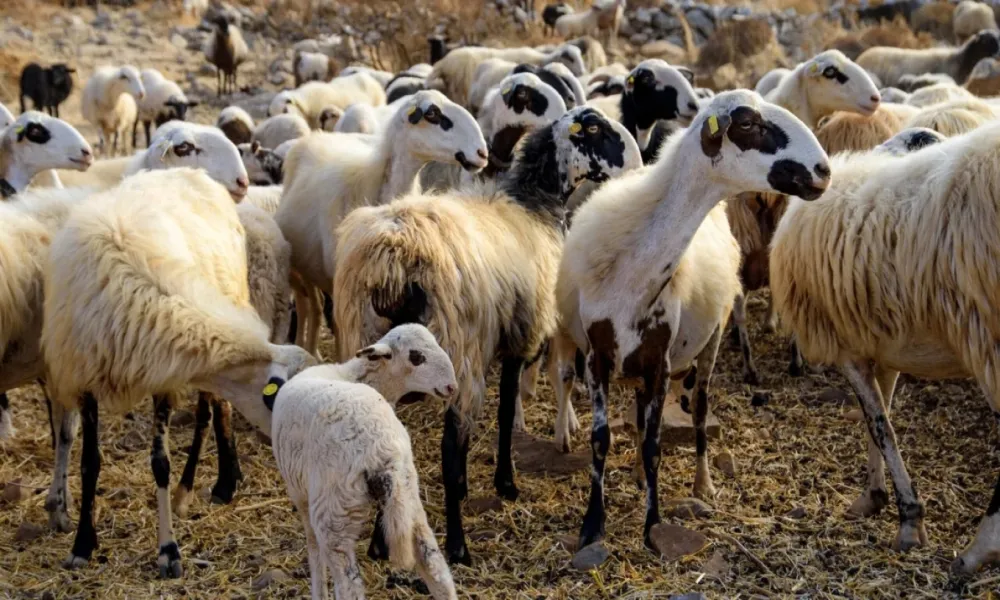
Three new cases of foot-and-mouth disease within the infected zone in Dromolaxia - Meneou, in Larnaca district, emerged following the latest epidemiological investigations, sampling, and laboratory tests, as Sotiria Georgiadou, Senior Veterinary Services Officer said on Thursday, in a briefing on the foot-and-mouth disease situation in Cyprus. When asked to comment how close to the end the problem is, she responded: “No. We are at the tip of the iceberg.”
It should be noted that the new cases involve two sheep herds totaling 240 animals, as well as one cattle herd with approximately 118 animals. She noted that with these new cases, the total number of infected herds stands at 49.
She added that all recommendations from European Commission experts have been implemented, and in this context, the competent authorities are continuing intensive epidemiological investigations, contact tracing, sampling, laboratory testing, as well as culling and vaccination measures. She added that culling continues in Nicosia and Larnaca and that vaccinations have covered 98% of cattle and 72% of sheep and goats, while the second dose has been administered to 30% of the cattle population and 9% of the sheep and goat population.
Regarding animal culls, she said that so far the total stand at around 26,800 sheep and goats and that will soon reach 30,000.
Easter schedule is proceeding as planned
At the same time, arrangements are being made to schedule the slaughter of animals for consumption during the Easter period so that it does not coincide with the culling of animals from infected areas, which takes place every Thursday and Friday, as Georgiadou noted. She added that there is increased activity and pressure to meet market demand, noting that “under normal conditions, demand amounts to approximately 30,000 lambs.”
Despite difficulties, the Veterinary Services assure that there is no issue regarding food safety. “Foot-and-mouth disease does not affect humans, and there is no risk from consuming meat or milk,” she stressed, clarifying at the same time that “infected animals do not end up on the market, and there are strict controls at all stages.”
High vaccination coverage rates
As for vaccinations, coverage rates remain high, with 98% of cattle and 72% of sheep and goats already vaccinated. The second dose has been administered to 30% of cattle and 9% of sheep and goats, while approximately 500,000 additional doses are expected by April 2 to bolster the campaign.
Regarding the effectiveness of the vaccines, she noted that it depends on how each organism reacts and produces antibodies, adding that booster shots will continue until “we are free of the virus, and then we will decide on the next steps.” However, at this time, Cyprus is considered an infected country with the virus present.
At the same time, she said that the payment of the first round of financial aid to affected livestock farmers has begun, clarifying that this support is an advance payment calculated based on the number of animals, while full compensation will follow after the submission and evaluation of financial data. Additionally, compensation will be provided for feed and milk.
Hopes for improvement
Georgiadou was also asked to comment on the issue of the dense concentration of livestock farms, which facilitates the spread of the virus today, noting that efforts are being made to upgrade and better organise the sector. “I hope that this tragedy will serve as an incentive for livestock farmers to upgrade their operations, improve their facilities, implement better management practices, and resume operations under better conditions and with improved hygiene standards,” she said.
She noted that the Veterinary Services, in collaboration with Stavros Malas, Head of the Special Scientific Committee for the reconstruction and upgrading of the livestock sector, and the KIOS Center at the University of Cyprus, are moving forward with upgrading the electronic epidemic monitoring system, which will allow “to view all data in real time—that is, the farms, the samples, our infected and healthy herds, and our tracking records.”
According to the Veterinary Services, the cattle population in the Republic of Cyprus is estimated at 85,000, the sheep and goat population at 490,000, and around 300,000 pigs, with Sotiria Georgiadou reporting that 1.5% of all cattle farms have been infected and around 1.5% of sheep and goat farms, while also agreeing with Stavros Malas’ estimates of a 5.5% impact on the cattle and sheep and goat livestock population.
Thousands of animals, including cattle and sheep, were affected in several livestock units initially in Larnaca and then in Nicosia district, following a food and mouth disease (FMD) outbreak, first reported on February 20. This followed an FMD outbreak in the island’s north last December. Authorities proceed with a nationwide vaccination campaign of animals to contain the virus, while EU rules require all animals in the infected areas to be culled, bringing about a series of repercussions in livestock farming and other agricultural economic activities. Halloumi, Cyprus’ top agricultural export product, has been spared. Experts reiterate that FMD is not dangerous to humans.
CNA