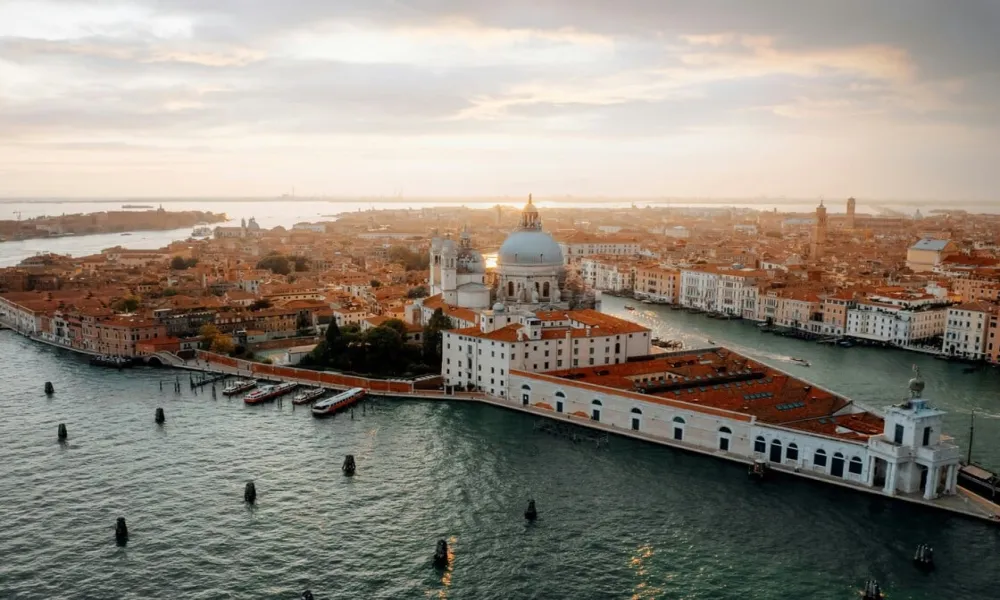
Venice’s long‑awaited flood barriers will only protect the city for a finite time before rising sea levels overwhelm the system, according to new scientific analysis.
A study led by Professor Piero Lionello of the University of Salento assessed how the movable barriers at the three inlets of the Venetian Lagoon would perform under projected sea‑level rise over the next two centuries. The findings indicate that even with upgrades, the current system can function only until water levels rise by roughly four feet. Beyond that point, Venice will be forced to adopt far more disruptive measures.
The research warns that once the threshold is crossed, the city must choose between options that preserve only parts of its historic fabric. Those choices widen in scale but narrow in what they can realistically save.
Strain on a fragile lagoon
Venice sits within a UNESCO World Heritage site where the lagoon and city are treated as a single cultural and environmental entity. That balance weakens when the barriers remain closed for longer periods. Reduced seawater exchange affects water quality, marine life and port activity, while flooding events have become more severe. Recent studies link several extreme high‑water episodes to shifting weather patterns.
Each closure protects buildings in the short term but gradually undermines the lagoon ecosystem that defines Venice’s identity.
Four paths for a sinking city
The study outlines four long‑term strategies: continued adaptation, a ring of protective dikes, a sealed lagoon, or eventual retreat.
Researchers use adaptation tipping points to identify when each strategy becomes necessary. One early tipping point appears at around 1.6 feet of sea‑level rise, when ring dikes or a closed lagoon may be required. Delaying decisions reduces the possibility of a smoother transition.
Ring dikes would encircle the historic centre and nearby islands, separating them from the wider lagoon. Pumps and new drainage systems would be needed to manage rainfall, and construction costs could range from about 540 million to 4.9 billion dollars. While this would protect homes and monuments, it would weaken Venice’s daily relationship with the water.
A sealed lagoon would transform the area into a managed coastal lake behind permanent dams and higher outer defences. This could protect the city through roughly 33 feet of sea‑level rise, far beyond the capacity of today’s barriers. A more extreme version, a super levee, could extend protection further. However, the price could exceed 32 billion dollars and the lagoon ecosystem would not survive in its current form.
Retreat as a last resort
Retreat becomes a realistic option only under very high sea‑level scenarios. Once water levels rise beyond about 15 feet, relocating monuments inland and abandoning parts of the city may be the only viable solution. This could cost up to 108 billion dollars and would dismantle the urban setting that gives Venice its character. What survives would be fragments rather than the city as it is known today.
Time, cost and uncertainty
Venice’s existing barriers cost about 6.5 billion dollars, and each alternative is significantly more expensive. Major engineering projects can take decades to complete, meaning planning must begin long before the situation becomes critical.
Lower global emissions could slow long‑term sea‑level rise, while weak climate action would accelerate the need for costly interventions. Waiting for clarity carries its own risks, as the city may run out of time before it runs out of options.
Professor Robert J. Nicholls of the University of East Anglia, a co‑author of the study, said there is no single optimal strategy. Each option protects some aspects of Venice while sacrificing others, from heritage and housing to ecosystems and daily life.
A warning for coastlines worldwide
Although Venice draws global attention, the study notes that the underlying challenge affects low‑lying coastal settlements everywhere. Many can adapt for a time, but evidence shows that all such defences eventually reach their limits.
For Venice, the analysis provides a clearer picture of the choices ahead: extend the current barriers, build new defences, or ultimately abandon parts of the city. What happens next will depend on emissions trajectories, financial capacity, engineering decisions and public consent. The most difficult question is what Venice is willing to lose in order to preserve what remains.
The study appears in the journal Scientific Reports.
Source: earth.com