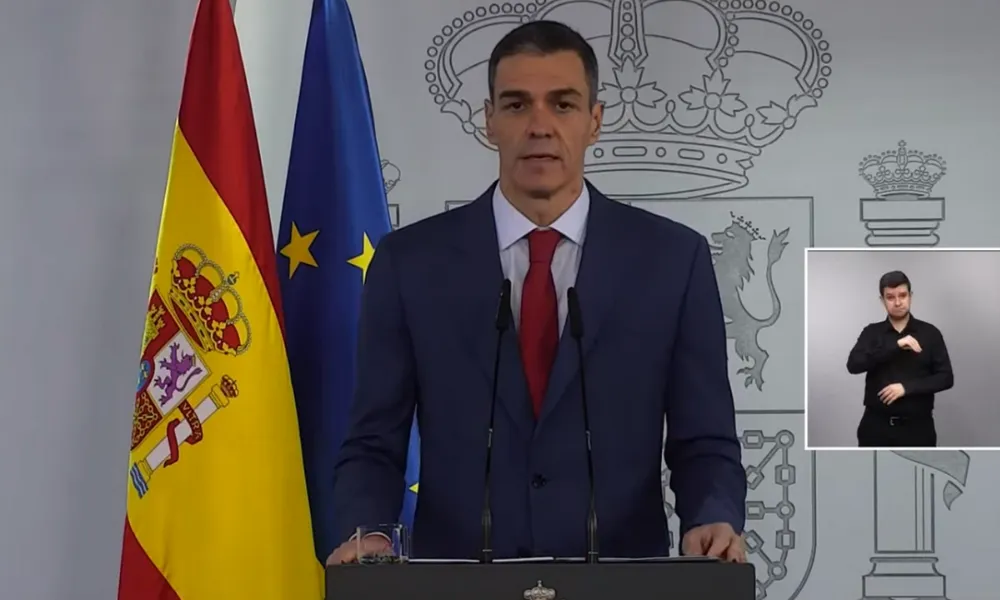

In international politics admiration rarely travels quickly. Leaders usually earn respect abroad through years of diplomacy, long negotiations, and carefully constructed alliances. Yet sometimes a single political moment triggers something far more emotional and spontaneous. That is what happened in Türkiye in early March 2026, when Spanish Prime Minister Pedro Sánchez suddenly became one of the most admired foreign leaders among Turkish social media users. What began as a reaction to a geopolitical decision soon turned into a lighthearted cultural phenomenon widely described as “Sánchez mania.”
The spark came from Madrid but the emotional response emerged thousands of kilometers away. When the United States reportedly sought access to Spanish military bases for operations linked to the escalating confrontation with Iran, Sánchez refused. Spain’s facilities in Rota and Morón would not be used for military strikes. His government framed the decision as a principled stand against expanding the conflict and emphasized that Spain did not want to become part of another Middle Eastern war. The statement itself was diplomatic and measured. But the symbolism of a European leader openly resisting Washington’s military pressure resonated strongly with audiences in Türkiye.
An act of political courage
Turkish public opinion has long been sensitive to wars in the Middle East and to the role of external powers in those conflicts. Sánchez’s stance therefore struck an emotional chord. Many Turks interpreted his refusal not simply as a policy decision but as an act of political courage. The fact that he had earlier criticized Israel’s military operations in Gaza and supported recognition of Palestine reinforced the image of a European leader willing to challenge dominant Western narratives. For a society that closely follows regional conflicts and debates about international justice, this position carried significant moral appeal.
What happened next illustrated how quickly political events can evolve into cultural expressions in the age of social media. Turkish users on platforms such as X began sharing messages praising Spain and its prime minister. At first these posts were mostly serious comments applauding his anti war stance. Within hours, however, the tone shifted toward humor and creativity. Memes, jokes, and playful tributes began circulating widely, transforming a diplomatic disagreement into a lively online celebration of Spanish Turkish friendship.
One of the most widely shared images featured the familiar figure of the Turkish “flag waving uncle,” a character that appears frequently in internet humor. In this version the uncle proudly saluted the Spanish flag while standing beside the Turkish one, symbolizing what many users described as a new Mediterranean friendship. Another viral post jokingly promised that Spanish tourists visiting Türkiye would receive free hair transplants as a gesture of gratitude. The humor was unmistakably Turkish, mixing hospitality, irony, and self parody.
Paella filled with döner
Food quickly became part of the conversation as well. Some users imagined hybrid dishes combining two Mediterranean culinary traditions. Paella filled with döner meat appeared in one meme. Another proposed a fictional restaurant serving kebab alongside Spanish tapas. Music lovers joined the fun by imagining flamenco dancers performing to the sound of the Turkish saz. None of these ideas were meant seriously, yet they reflected a spontaneous cultural curiosity that went beyond politics.
What made the phenomenon particularly striking was how it crossed Türkiye’s normally sharp political divisions. Turkish politics is often polarized, with strong ideological differences separating conservatives, nationalists, secularists, and the political left. Yet admiration for Sánchez appeared across almost all of these groups. Supporters of the government praised him for defending Palestinians and resisting what they perceived as Western military intervention. Secular nationalists admired the independence of his foreign policy stance. Left wing activists appreciated his socialist background and his criticism of war.
Even opposition politicians joined the online conversation. Özgür Özel publicly expressed solidarity with Sánchez in social media posts, reinforcing the sense that admiration for the Spanish leader had become a rare cross ideological moment. For a brief period, political labels seemed to matter less than the shared perception that Sánchez represented a voice of restraint during a time of growing global tension.
Spanish media soon began noticing the unusual wave of admiration coming from Türkiye. Television programs and newspapers reported with a mixture of curiosity and amusement that Turkish social media had suddenly become filled with praise for Spain. Commentators described the phenomenon as an example of how digital culture can transform foreign policy into a form of popular entertainment. The idea that thousands of Turkish users were producing memes celebrating a Spanish prime minister was unexpected enough to attract attention in Madrid.
The moment reached a symbolic peak when Sánchez himself acknowledged the enthusiasm. During a political rally he posed for a photograph with a Turkish flag held by supporters in the crowd. The image spread rapidly across Turkish social media platforms and further fueled the sense of a friendly exchange between the two societies. Many Turkish users interpreted the gesture as a warm acknowledgment of their spontaneous support.
Behind the humor and the memes there may also be a deeper cultural resonance between the two Mediterranean societies. Both Spain and Türkiye occupy a geographical and historical crossroads between Europe and the wider Mediterranean world. Both cultures carry echoes of centuries of interaction among different religions, languages, and traditions. For many Turks, Spain evokes memories of Andalusia and the historical coexistence of Muslim, Christian, and Jewish communities on the Iberian Peninsula. Spanish culture, with its passionate music, strong family traditions, and Mediterranean temperament, often feels strangely familiar to Turkish audiences.
Saying no to war is enough to win hearts
Of course not everyone has embraced the enthusiasm without reservations. Some critics note that social media trends can exaggerate political admiration and overlook complex realities. Others point out that Spain itself faces internal debates about regional autonomy and national identity, issues that resonate differently in Türkiye’s own political discussions. Still, even skeptics acknowledge that the phenomenon reflects something meaningful about contemporary political communication.
In an era dominated by geopolitical tension and constant news of conflict, Sánchez mania offered a rare moment of lightness. It showed how quickly international politics can move beyond official statements and become part of everyday culture. Memes, jokes, and playful gestures sometimes travel faster and connect people more effectively than formal diplomacy.
Whether the phenomenon will last is uncertain. Social media enthusiasm often fades as quickly as it appears. Yet for a few weeks in March 2026, an unusual bridge emerged between Türkiye and Spain. Through humor, admiration, and a shared Mediterranean sensibility, thousands of people discovered an unexpected connection with a leader who, for a moment, seemed to embody the simple message that resonated across Turkish social media: sometimes saying no to war is enough to win hearts far beyond your own country.