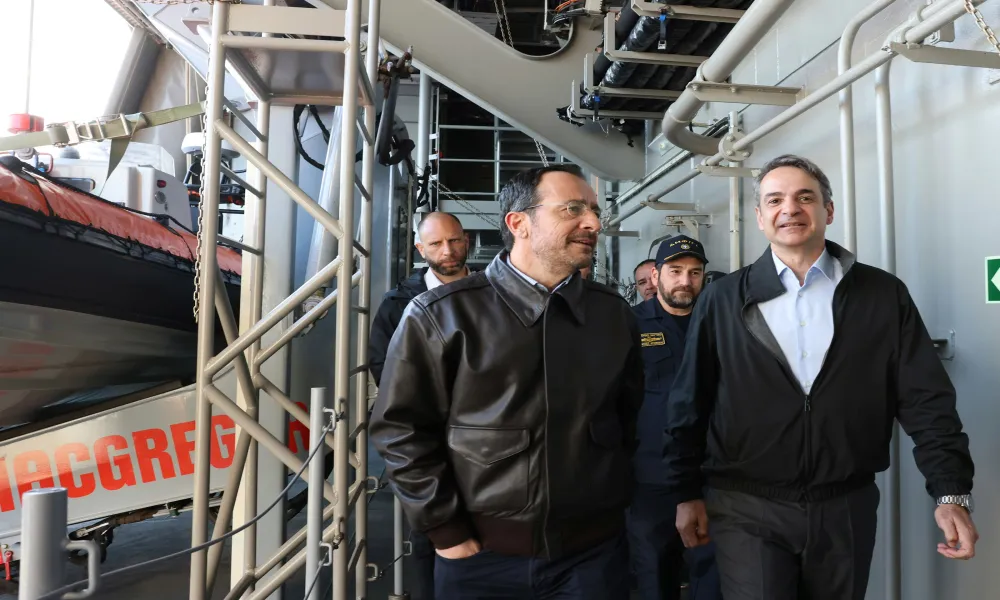



The dispatch of warships by several European countries to waters around Cyprus following the drone strike on the British base at RAF Akrotiri functioned as an immediate political and military signal of solidarity toward a European Union member state located on the frontline of a regional crisis.
In particular, countries from southern Europe responded to the appeal of President Nikos Christodoulides by sending naval units to the area. The image carries obvious symbolic and political significance. It conveys the message that Cyprus is not alone at a time of intense geopolitical instability in the eastern Mediterranean. Yet this mobilisation also highlights two serious problems.
First, it exposes a long-standing weakness in the European Union’s foreign and defence policy. Second, the exaggerations of the Cypriot government risk creating damaging economic side effects.
Individual initiatives
The support shown toward Cyprus came through individual initiatives by member states rather than through a unified institutional mechanism of the European Union, such as the European Council.
The deployment of naval vessels, primarily by Greece and France, certainly has practical value. It provides an immediate deterrent presence and sends a message of political support.
At the same time, however, it remains a fragmented response. Had assistance to Cyprus been decided institutionally through the European Council or through the activation of mechanisms within the EU’s common foreign and security policy, the signal would have carried far greater weight. It would have represented a collective European decision confirming in practice that the security of one member state is considered the security of the entire Union.
This discussion is directly linked to Article 42.7 of the Treaty on European Union, the so called mutual defence clause, which stipulates that member states must assist a country that comes under attack.
Although this clause was invoked in the past by France following the terrorist attacks in Paris in 2015, its implementation still depends largely on political decisions by individual states rather than on an automatic European mechanism.
The question that emerges therefore goes beyond the current crisis. It concerns whether the European Union is ready to transform solidarity from a political declaration into a functional institutional and operational mechanism.
For Cyprus, situated on one of the most sensitive geopolitical frontiers of the Union, the answer carries particular significance. The real test of European cohesion lies not in declarations but in the way the Union responds when a member state faces a crisis affecting its security.
Solidarity from a safe distance?
Some observers argue that the European solidarity expressed toward Cyprus after the drone incident represents a gesture made largely from a position of safety. Critics describe it as a form of “low-cost solidarity”.
In other words, a move with political symbolism but limited real risk.
Sending ships to a region where multiple Western naval forces are already present does not create direct confrontation with a specific adversary nor does it require difficult political decisions.
At the same time, the deployment effectively forms a second line of support for the fleet sent to the Mediterranean by Donald Trump to protect Israel.
Economic side effects
There is also another, more complex dimension.
The drone incident, serious as it may be, does not necessarily constitute a strategic threat of such magnitude as to justify the image of a large scale military mobilisation around the island.
When a relatively limited incident is transformed communicatively by President Christodoulides into a major geopolitical episode, Cyprus inevitably appears as a country at the centre of a conflict, even if in reality it is not one of its principal actors.
Managing such incidents requires delicate balance. On one hand, the government has a duty to safeguard national security and mobilise international partners when it perceives a risk of destabilisation. On the other, exaggerated reactions or overly dramatic assessments can create chain reactions, particularly in the economic sphere.
The Cypriot economy is especially sensitive to perceptions of instability. The country relies heavily on sectors such as tourism, services, shipping and international investment.
When the image projected abroad is that of a country on the brink of military involvement, markets, investors and travellers tend to react with caution. Experience from previous crises shows that market psychology is often influenced more by perceived risk than by the actual level of danger.
At the same time, an overly militarised public discourse risks trapping Cyprus in a role that does not serve its strategic interests.
Traditionally, the country seeks to function as a bridge between Europe and the Middle East, a place for diplomatic contacts and humanitarian missions. The image of an island surrounded by warships, even if intended as a gesture of solidarity, could gradually shift that perception.
Solidarity elsewhere
Many argue that the real test of European solidarity should also appear in other areas.
One example is the electricity interconnection project linking Cyprus, Greece and Israel, the Great Sea Interconnector.
This project is of strategic importance to the EU because it would end the energy isolation of Cyprus, currently the only EU member state not connected to the European electricity grid. The project, however, faces obstruction from Turkey.
A similar argument extends to the Cyprus problem itself. For decades there has been debate over whether the European Union treats the Turkish occupation primarily as a European issue or mainly as a bilateral matter between Cyprus and Turkey.
The accession of the Republic of Cyprus to the EU in 2004 created expectations that the Cyprus problem would gain a stronger European dimension.
To some extent this did occur. The prospect of EU membership encouraged Turkish Cypriots to mobilise in favour of reunification and led Turkey to support the Annan Plan.
Greek Cypriots, however, expected a different outcome. They expected that EU membership would subsequently compel Turkey to comply with their positions.
The limits of European policy
At present, the European Union still functions primarily as a union of states rather than as a unified strategic power. It was not created to wage wars, as some voices in Cyprus claim, but following the Second World War to eliminate war as a means of resolving disputes.
Under current conditions, however, and given the growing divergence between US and European interests, the EU may eventually need to move toward a fully institutionalised mechanism of collective action.
Not to be underestimated
The argument that today’s European solidarity toward Cyprus is expressed to some extent “from a safe distance” is not without basis. At the same time, the importance of symbolic and political gestures of support should not be underestimated.
The deeper challenge for the European Union is clearer. If it wishes to function as a geopolitical actor, something understood by countries such as France and by the European Commission judging from the statements of Ursula von der Leyen, it will need to transform solidarity from an occasional political stance into a structured strategic instrument.
For countries such as Cyprus, as well as the Baltic and Scandinavian states that form the Union’s geopolitical frontlines in the Middle East and northern Europe and face unpredictable and sometimes aggressive neighbours, this evolution is not merely theoretical.
It is a matter of security and ultimately of European cohesion.