Olive Pits
The Hug That Embarrassed Starmer
“The hug that embarrassed Starmer”, wrote the British press after the warm embrace between Emmanuel Macron and Nikos Christodoulides at Paphos airport. The moment contrasted with the rather cold state of Cyprus–UK relations following London’s failure to inform Nicosia about the Iranian drone strike on the Akrotiri bases on March 2.
Of course, international relations and trust are not built with hugs and kisses. They are built on solid alliances and mutual interests. Macron, through his visit to Paphos and the arrival of the aircraft carrier Charles de Gaulle, gained points domestically but more importantly strengthened France’s profile as a leading European power supporting the EU’s cohesion as an autonomous strategic force.
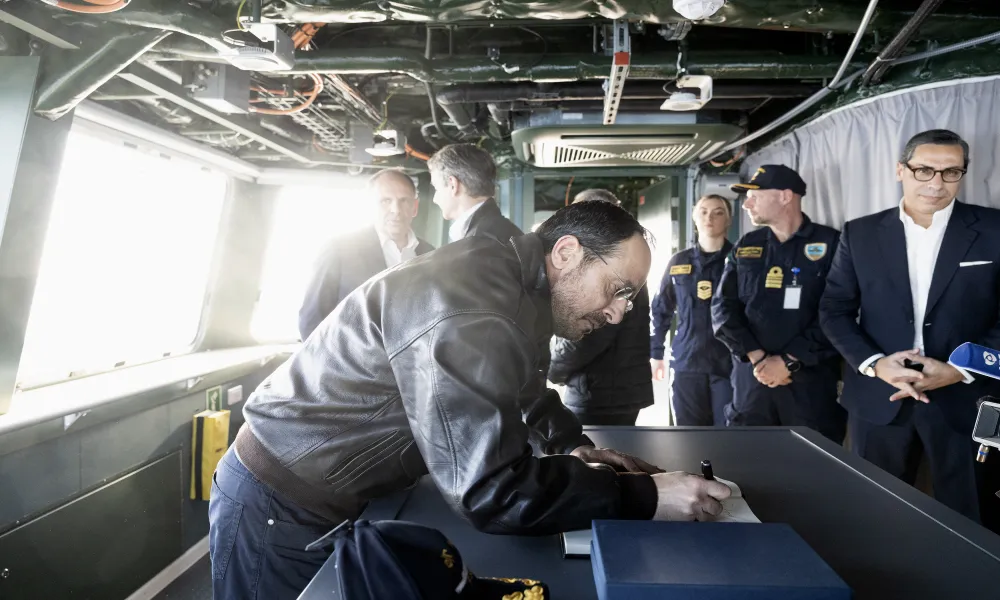
Kyriakos Mitsotakis followed a similar logic. At first he reportedly lost his temper over Nikos Dendias’ decision to send frigates to Cyprus. When he saw polling numbers rising dramatically in his favour and the awkward silence of Antonis Samaras and Kostas Karamanlis, he boarded the plane and came to Cyprus. Some are even advising him to call early elections.
Frigates, F-16s and the Coffee Shop Generals
When a single drone fell on the Akrotiri bases, Mitsotakis sent two frigates and four F-16s. Some in Cyprus now say that if this was the response to one drone, imagine what will happen when the GSI electricity cable begins to be laid and Turkey decides to react. What will Athens send then? Our question is simpler. Since the frigates were already here, why did Nexans not begin the seabed survey to move forward with laying the cable? Instead, ADMYE and Nexans reportedly went to conduct tests in Sicily.
Meanwhile some ELAM supporters argue that if Turkey dared to intervene, the two Greek frigates would sink the Turkish fleet just as the battleship Averof did in the Balkan wars of 1912. And with the Patriot battery that Dendias installed in Karpathos, no Turkish aircraft would be able to fly. After the arrival of such a large and capable European fleet in Cyprus, voters in the island’s coffee shops now ask why the liberation of Cyprus has not already begun. We also wonder why President Christodoulides has not thought of such simple things.
Mountain Air and Ministerial Rumours
Rumours are circulating that the President intends to reshuffle Agriculture Minister Maria Panayiotou. In the mountains, it seems, not only clean air circulates but also names for ministerial positions. The latest name being discussed is that of the Commissioner for the Development of Mountain Communities, Charalambos Christofinas, who is said to be under consideration for the portfolio.
The Green Dress Incident in Paris
It was not Philippa Karsera’s fault. How could she have known that wearing green at French cultural events is considered unlucky? She wore a green suit to attend events organised by the Cypriot presidency at the Louvre Museum and the National Library in Paris. When some French guests noticed the colour, reactions were less than enthusiastic. Among the most cautious, it seems, was Brigitte Macron. The First Lady initially struggled to understand what was happening until someone explained the superstition. In France there is a long-standing belief linking the colour green to bad luck in theatre and certain cultural settings.
One explanation goes back to the playwright Molière, who collapsed on stage in 1673 while performing Le Malade imaginaire while wearing green. He died shortly afterwards. Another explanation is more practical. In earlier centuries green dyes often contained arsenic or other toxic substances that could poison actors.
Over time the superstition entered popular culture and in some circles extended to women’s dresses as well. Mrs Karsera learned this the hard way when some French hosts reacted as if they had encountered something contagious.
A Government That Lives for Social Media
For months the government presented Cyprus as part of a strategic alliance with Israel and as a country hosting British, French and American military forces. It also projected the image of a regional axis with Greece and Israel that excluded Turkey from the Eastern Mediterranean. When the drone strike happened, however, emergency meetings were suddenly called to protect the tourism sector. We are talking about the most amateur government Cyprus has ever had. They seem to live for a social media like and a short statement on the evening news.
Fellas Enters the Election Equation
More than 650 people attended the opening of Michalis Fellas’ campaign headquarters in Limassol. The event resembled a political rally rather than a typical campaign office inauguration. The crowd was described by attendees as a “sea of people”, a phrase also used by House President and DISY leader Annita Demetriou during her speech. Former DISY president Averof Neophytou and deputy leader Efthymios Diplaros were present, while several figures from the broader political and local government landscape also spoke.
Particularly notable was the intervention of former MP Angelos Votsis, who comes from a different political background but openly declared his support. The message of cross-party appeal was repeated by Demetriou. The image of the evening reflects a simple reality. Michalis Fellas is entering the electoral equation as a serious player with clear ambitions to broaden his political base.
The GSI Cable and Odysseas’ Advice
If what Odysseas claims is correct, that Nexans and ADMYE conducted test seabed surveys in Sicily in order to record expenses and prepare potential legal claims worth millions against the Republic of Cyprus, perhaps the process should be reversed.
Instead of telling them they will not receive the €25 million, perhaps it would be better to give them the money and then initiate legal action ourselves if they fail to complete the project. Two birds with one stone. In this way you test whether ADMYE is telling the truth and you also satisfy Nikolas, who insists that the GSI project must be completed.
Odysseas, who during his time as Auditor General saw no major projects completed because everyone was allegedly a crook, now says that months are passing while ADMYE’s legal arguments grow stronger and the government remains indecisive. If he eventually comes to power, will he find honest entrepreneurs to work with or will he send them all before the Anti-Corruption Authority?
Tal Dilian and the Predator Question
Tal Dilian, the man with the famous surveillance van and the Predator software, recently commented on his legal troubles in Greece.
“We provide surveillance technology only to governments and law enforcement authorities”, he said.
In Greece he was convicted and initially sentenced to 126 years and eight months in prison. The sentence was later merged into an eight-year term that could be bought out. In Cyprus an investigation also took place, yet no punishment followed. Dilian himself explained why in an interview. Some people simply prefer not to understand. According to him, the systems were sold to the state and the police. If he had been convicted, perhaps others would have had to go to prison as well.
In Defence of Classics
Some commentators on social media mocked Agriculture Minister Maria Panayiotou, claiming she is unqualified because she studied archaeology and philology. Competence or incompetence has nothing to do with whether someone studied economics or classical studies.
Many influential business leaders actually studied classics. Michael Moritz, former chairman of Sequoia Capital and one of the most influential figures in Silicon Valley, studied History and Classics at Oxford. Tim O’Reilly, a leading figure in technology publishing and conferences, holds a degree in Classics from Harvard. Christopher Pappas, founder of The Chefs’ Warehouse, studied Classics and Government. Alexa Hirschfeld, co-founder of Paperless Post, also studied classics at Harvard.
Sir Howard Davies, chairman of NatWest Group, studied Classics at Oxford, while former US Defense Secretary William Cohen studied Classics at Bowdoin College. So perhaps critics should find something else to say about Maria. Many CEOs and ministers come from classical studies. These disciplines cultivate strategic thinking, rhetoric, understanding of power and institutions, and the ability to make complex judgments.