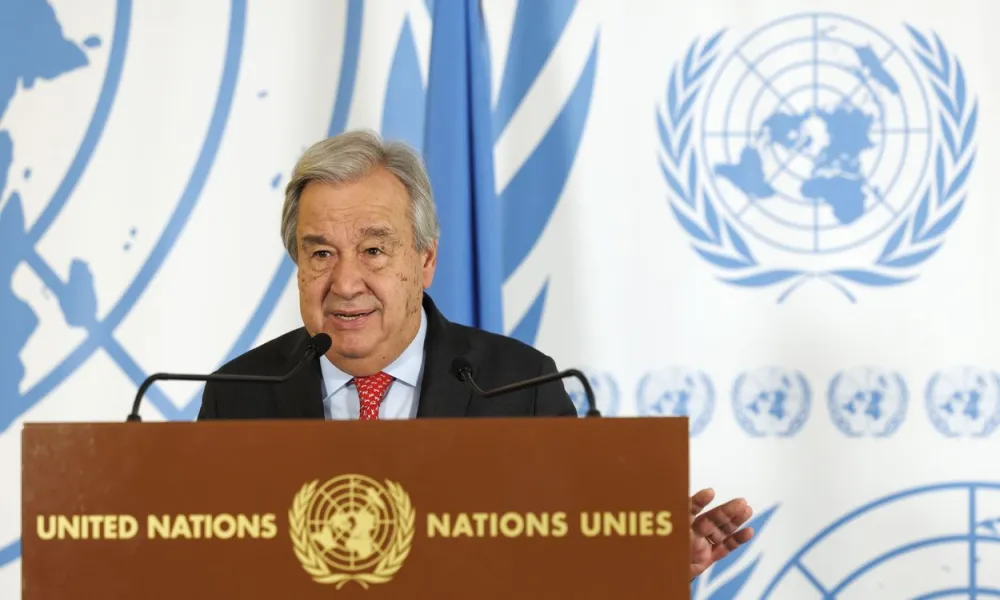
Greek Cypriot leader Nikos Christodoulides once again reiterated his call for an immediate return to negotiations, while both UN Secretary-General António Guterres and the Turkish Cypriot side emphasized that “tangible steps” to rebuild trust must come first. The outcome of the Brussels meeting underlined a familiar reality: urgency is shared, but the path forward remains fundamentally contested.
A shared goal, different readings
Meeting in Brussels on the margins of the European Council summit, Christodoulides and Guterres agreed on the need to achieve “substantive progress” on the Cyprus issue before the end of the Secretary-General’s term later this year. The Greek Cypriot leader described the talks as “very substantive and very productive,” stressing that both sides are aligned on focusing on the “essence” of the problem.
“I am truly pleased because we have a common goal with the Secretary-General,” Christodoulides said, emphasizing that meaningful progress within the remaining months of Guterres’s mandate is both necessary and achievable.
He went further, stating that “developments should be expected soon,” framing the meeting as part of a broader diplomatic momentum that includes Guterres’s recent contacts in Türkiye and his parallel engagements with European Union leaders in Brussels.
However, while the notion of “substantive progress” is shared, its interpretation differs significantly between the parties.
UN emphasis: Trust before process
The United Nations readout struck a notably more cautious tone than the political messaging from the Greek Cypriot side. While acknowledging a “constructive atmosphere,” the statement placed clear emphasis on the need for “tangible steps” to rebuild trust and create a climate conducive to renewed negotiations.
This is not a new formulation, but its repetition at this stage is significant. It reflects an implicit recognition within the UN system that the failure of past processes was not merely procedural but rooted in a deeper lack of confidence between the sides.
The confirmation that Personal Envoy María Ángela Holguín will soon submit a new report following her shuttle diplomacy suggests that the UN is still in a preparatory phase, rather than on the verge of launching a formal negotiation track.
In other words, despite political rhetoric about momentum, the UN appears to be signaling that groundwork remains incomplete.
Turkish Cypriot position: “This time must be different”
From a Turkish Cypriot perspective, the Brussels meeting did little to alter the core dynamics of the dispute.
Turkish Cypriot leader Tufan Erhürman, who met Guterres in New York last month, has consistently argued that repeating past approaches will not yield different results. His message has been clear: the problem is not the absence of dialogue, but the absence of a framework capable of delivering a sustainable outcome.
“What matters is not meetings for the sake of meetings, but a process that leads to a solution,” Erhürman has stressed since taking office.
Within this context, he has outlined a four-point methodology: recognition of the political equality of the Turkish Cypriot side, a time-bound negotiation process, preservation of previously achieved convergences, and a (United Nations) commitment that Turkish Cypriots will not face renewed isolation in the event of another breakdown.
For Erhürman and many in the north, these are not preconditions, but safeguards against repeating a cycle of inconclusive negotiations followed by collapse.
Crans-Montana: Continuity or dead end?
At the heart of the divergence lies a fundamental disagreement over the relevance of the 2017 Crans-Montana talks.
Christodoulides continues to advocate for resuming negotiations from where they left off, presenting this as a logical continuation of an already advanced process. This approach is also tied to his support for an expanded “5+1” format involving the two sides, the UN and the three guarantor powers.
Turkish Cypriots, however, increasingly view Crans-Montana as a closed chapter. From their perspective, returning to that framework without addressing its structural shortcomings risks reproducing the same outcome.
This is why Erhürman’s approach emphasizes not continuity, but recalibration.
The disagreement is therefore not merely tactical, but conceptual: one side sees unfinished business, the other sees a failed model.
The European Union factor
Another key element in Christodoulides’s messaging is the role of the European Union. He stressed that the EU can play a “substantial role” in advancing progress, pointing to Guterres’s meetings with EU leadership as evidence of growing alignment.
For the Greek Cypriot side, EU involvement is both natural and advantageous, given the island’s membership status.
For Turkish Cypriots, however, this raises longstanding concerns about neutrality and balance. The Greek Cypriot administration participates fully in EU institutions, while the Turkish Cypriots remain outside the Union’s legal framework due to the unresolved nature of the Cyprus issue.
This asymmetry is seen in the north as a structural imbalance that complicates the prospect of fair negotiations.
Expanding security questions: A premature debate?
Beyond the immediate diplomatic choreography, emerging security debates risk adding new layers of complexity to an already intractable dispute. Questions surrounding the future of the British sovereign base areas, as well as the prospect of Cyprus engaging more directly with NATO structures, even with Greece’s support, could introduce additional points of friction between the sides. For Turkish Cypriots and Ankara, such developments are closely tied to long-standing concerns about balance, guarantees and the security architecture established in 1960. Introducing these issues into an already fragile process, before a political settlement is reached, may further entrench positions rather than facilitate convergence.
In that sense, these matters, along with a range of other unresolved questions, are widely seen as issues that can only be meaningfully addressed once and if a comprehensive Cyprus settlement is achieved, regardless of its eventual form. Attempting to pre-negotiate or unilaterally advance such strategic questions risks complicating a process that has already defied more than half a century of international peacemaking efforts. For now, they remain part of a broader set of potential post-settlement arrangements, rather than building blocks for restarting negotiations.
Actions on the ground and the trust deficit
Beyond diplomatic language, developments on the ground continue to shape perceptions.
Turkish Cypriot officials have criticized the Greek Cypriot administration’s unilateral energy and security agreements with international actors, arguing that such moves contradict the spirit of partnership required for a comprehensive settlement.
From this perspective, trust cannot be rebuilt through statements alone. It must be reflected in concrete actions that acknowledge the presence and rights of both sides on the island.
The UN’s emphasis on “tangible steps” resonates strongly with this view, even if it stops short of assigning responsibility.
A narrowing window of opportunity
Guterres’s reference to achieving progress before the end of his term introduces a political timeline, but not a formal deadline. Christodoulides confirmed that no specific timeframe has been agreed beyond making effective use of the remaining months.
This creates a paradox. There is a sense of urgency, but no agreed roadmap.
At the same time, the broader geopolitical environment is becoming more volatile. The Eastern Mediterranean is increasingly linked to wider regional tensions, including conflicts involving major powers. In this context, Cyprus is gaining strategic relevance, but also facing heightened risks.
Between movement and meaning
The Brussels meeting reflects a familiar pattern in the Cyprus issue: renewed diplomatic engagement, carefully calibrated optimism, and persistent structural disagreement.
Christodoulides speaks of imminent developments and political will. Guterres speaks of substantive progress within a limited timeframe. Erhürman speaks of the need to change the rules of the game before stepping onto the field.
All three positions acknowledge the need for progress. What remains unresolved is what kind of progress is possible, and under what conditions.
For Turkish Cypriots, the distinction is critical. Movement without a change in framework risks becoming another cycle of process without result.
As the Secretary-General enters the final phase of his tenure, the Cyprus issue once again stands at a crossroads. Whether this moment leads to genuine progress or another repetition of the past will depend not on the frequency of meetings, but on whether the underlying assumptions of the process can finally be reconciled.