
How reuse, innovation and European funding help SMEs cut costs, build resilience and reach new green markets.
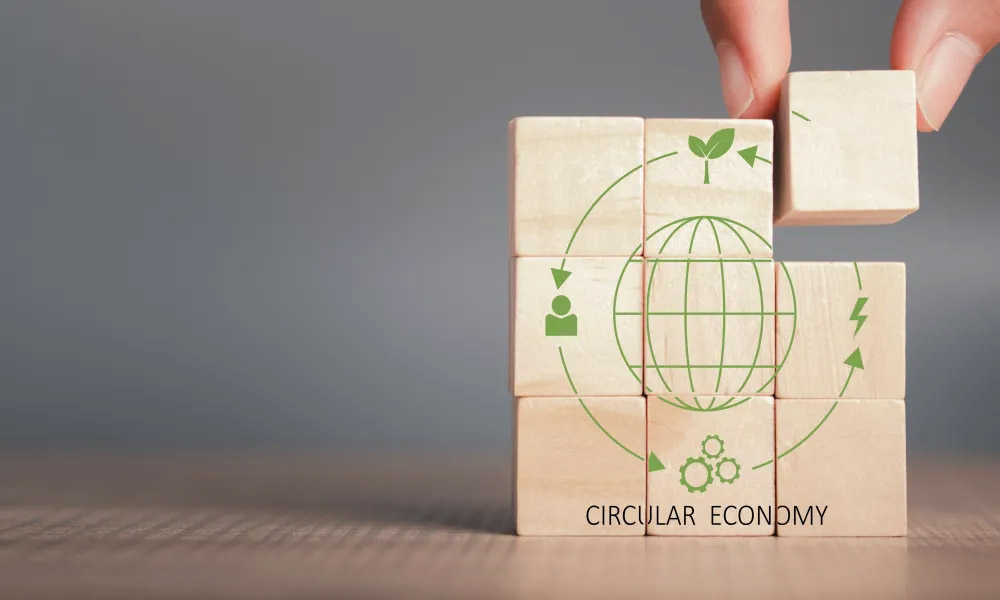
In Eleni’s small ceramics workshop in Nicosia, clay plates collected from local restaurants are transformed into new jewellery and decorative objects. Eleni is not an eco-activist. She is an entrepreneur who discovered the circular economy. It is a model in which nothing is thrown away, everything is reused, and costs fall while profits increase. For small businesses like hers, the circular economy is not a trend. It is a strategy for survival and growth.
Production costs kept to a minimum
The biggest victory is the saving on materials. Studies show that SMEs adopting circular practices reduce raw material costs by 20–30%, as they use recycled or reusable materials instead of expensive new ones. A bakery that turns crumbs into animal feed, or a café that sells used capsules as plant pots, no longer pays for waste. Instead, it turns waste into revenue. Across the EU, this translates into savings of €600 billion annually for businesses, with around 8% going directly into profits.
New markets and loyal customers
The circular economy opens the door to rapidly expanding “green” markets. Millennial and Gen Z consumers, who represent around 60% of the market, prefer companies with zero-waste strategies and are willing to pay up to 20% more for products produced through sustainable practices. Small businesses such as craft workshops offering repair services, for example clothing mending, are building loyal customer bases.
Resilience in times of crisis
In periods of rising raw material prices, the circular approach acts as a shield. Businesses can secure a stable supply of materials through internal recycling, reducing dependence on volatile markets. For example, a Cypriot winery can reuse grape press residue – a mixture of grape skins, seeds, stems and remaining juice – as fertiliser, achieving zero cost and continuous production.
Subsidies and access to capital
The European Union offers significant funding opportunities for start-ups operating in the circular economy through a network of instruments such as COSME and Horizon Europe, combined with specialised investment funds. At the centre of these initiatives is a financing package reaching €300 million, aimed at supporting the development and scaling of innovative businesses.
A key role is played by the European Circular Bioeconomy Fund, which mobilises capital of around €300 million with the support of European institutions and investors. The fund focuses primarily on companies that have already moved beyond the initial development stage and are seeking to expand their activities in the market, addressing a critical funding gap between research and commercial deployment.
Investments are directed towards areas such as waste valorisation, the development of biomaterials and the creation of sustainable alternative raw materials, sectors that form key pillars of the European strategy for the green transition.
At the same time, the COSME programme operates as a support mechanism for small and medium-sized enterprises, providing access to financial tools such as loans and guarantees, as well as guidance services and support for entering new markets. Although it does not offer direct funding for research, it plays a decisive role in improving startups’ access to capital.
Horizon Europe, for its part, is the EU’s main instrument for funding innovation, supporting projects that extend from the research stage to pilot implementation. Within this framework, particular emphasis is placed on the development of technologies that promote recycling, reuse and sustainable resource management.
The European approach is based on the creation of an integrated “funding chain” covering all stages of business development, from the idea and research phase to market entry and further expansion. Complementary tools such as the LIFE programme and bioeconomy initiatives further strengthen the available funding framework.
Cablenet’s contribution: a digital backbone for circular solutions
At a time when digital transformation is a key axis of business development, Cablenet is emerging as one of the main providers of infrastructure and services supporting this transition in Cyprus. With more than 9,000 business customers, the company has developed a broad range of solutions that address modern connectivity, IT and security needs.
A central element of Cablenet’s presence is its extensive network infrastructure, which covers more than 280,000 premises across the country. Investment in fibre-optic networks and high-capacity systems forms the foundation for delivering highly reliable and high-speed services, which are critical for business continuity and digital competitiveness.
At the core of the company’s services are connectivity and communication solutions. From high-speed internet with low latency to advanced telephony services such as SIP trunks and hosted PBX, businesses can create flexible and scalable operational models. At the same time, specialised services such as MPLS/IP-VPN and dedicated internet serve organisations with increased security and data management requirements.
Cablenet is also investing strongly in ICT and IoT, integrating solutions ranging from networking and cybersecurity to machine-to-machine applications and automation. Cloud services, whether public or private, combined with capabilities such as virtual data centres, Microsoft 365 and artificial intelligence solutions, allow businesses to reduce operating costs and increase flexibility.
Particular emphasis is also placed on security, an area of growing importance. Cablenet offers comprehensive cybersecurity solutions including protection against DDoS attacks, endpoint security, DNS security and advanced threat monitoring tools, safeguarding the integrity of business data.
Managed services also represent an important pillar, allowing businesses to outsource the management of critical infrastructure such as networks, WiFi, firewalls and SD-WAN to specialised teams, freeing up resources for strategic activities.
At the same time, a multi-layered technical support system with 24-hour monitoring and specialised engineering teams enhances service reliability. In the event of critical incidents, a level-three response team is activated immediately, ensuring rapid recovery and limiting operational impact.
Through this integrated ecosystem of services and infrastructure, Cablenet creates the conditions for the development of circular digital solutions, where connectivity, data, security and computing power operate in a complementary way. In a constantly evolving business environment, the digital backbone it provides becomes a crucial factor for sustainability and growth within the Cypriot economy.
Job creation and innovation
The circular economy generates highly specialised jobs, including recycling managers, product designers and logistics professionals for reverse supply chains. These systems manage the return of products, materials or waste from consumers back to producers or processing points, instead of following the conventional route from production to consumption. In the EU, around 700,000 new jobs are expected to be created by 2030, with SMEs playing a leading role due to their flexibility. At the same time, the circular economy encourages innovation through new materials, digital waste tracking and the use of artificial intelligence to optimise production cycles.
Practical steps to get started
Material audit: Map what you discard and how it can be reused.
Partnerships: Find partners to share logistics, for example restaurants and craft workshops.
Certifications such as Zero Waste or Cradle to Cradle can also open doors to new markets.
For small businesses, the circular economy can be translated into simple terms: lower costs, higher revenues, resilience and access to capital. In the era of climate crisis and expensive raw materials, it is not an option. It is the next step of the principle that the main capital of a business is the entrepreneur themselves.
Strengthening organisations and professionals remains a priority for Cablenet in supporting the adoption of strategies that shape a modern ecosystem.
As long-term success is built on knowledge and continuous development, we share practical ideas and tools that support the growth of responsible, sustainable and innovative entrepreneurship, encouraging transparency, efficiency and social contribution, while creating a strong and competitive business environment.