A medieval single-aisled barrel-vaulted church and an early Byzantine pottery workshop have been brought to light at Kophinou Agios Herakleios and Menogeia–Limnes in Larnaca district, the Department of Antiquities has announced.
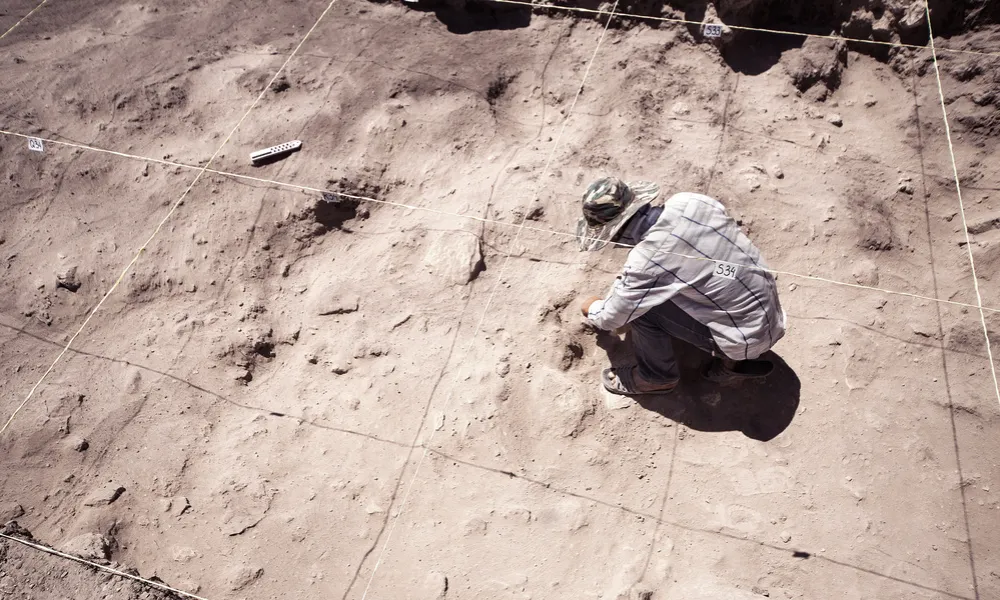
The finds come from this year’s excavation season of the Archaeological Research Unit and the Archaeological Summer Field School of the University of Cyprus’ Department of History and Archaeology. The project, titled “Settled and Sacred Landscapes of Cyprus” (SeSaLaC), ran from 1 to 31 July 2025 under the direction of Associate Professor Athanasios Vionis and Dr Doria Nicolaou.
At the site of Kophinou Agios Herakleios, excavation focused south and east of the ruined chapel of Agios Herakleios, also known as the “martyrion”. Archaeologists confirmed that the single-aisled barrel-vaulted church uncovered in 2025 belongs to a later medieval phase constructed over an earlier three-aisled basilica, probably dating to the early 7th century AD.
The later church was supported by three arches with buttresses. Within the collapse layers, the team identified remains of frescoes and stone fragments that point to the decorative programme and liturgical use of its interior.
Burial in stone larnax and evidence of a rural cemetery
Another significant find was a burial inside a stone larnax, located on the exterior of the south wall of the martyrion and dated to the early Byzantine period. The human skeleton was found in situ.
New trenches south of the martyrion brought to light two parallel walls which are thought to have formed part of the narthex of the original early Byzantine basilica. A hearth and a mortar base to the west and south in the same trenches indicate later uses of the space in the Late Middle Ages, possibly linked to domestic or ancillary activities around the church.
Ceramic material from the collapse layer of the single-aisled church east of the martyrion dates from the late 14th to the mid-16th century. Combined with evidence from the first excavation season in 2024, the results show continuous use of the site from the 6th to the 16th century, with successive phases of ritual and burial activity.
According to the Department of Antiquities, the excavation documents for the first time in Cyprus an organised cemetery around a basilica in the rural countryside, probably founded in the 6th or 7th century AD.
Early Byzantine pottery workshop at Menogeia
At Menogeia–Limnes, the excavation turned to a trial trench in an area identified as a pottery workshop dated to the 5th to 7th centuries AD. The site was already known for a dense concentration of pottery wasters, unfired clay and combustion residues.
Archaeologists uncovered a structure with a circular notch carved into the natural rock, probably associated with a nearby kiln. The finds include numerous overfired or distorted potsherds, charcoal, as well as fragments of glass and metal, confirming the function of the site as a rural industrial centre in the Early Byzantine period.
Filling gaps in Cyprus’s Byzantine “Dark Ages”
The Department of Antiquities said that excavations at both Kophinou and Menogeia illuminate key aspects of life in rural Cyprus from the Early Byzantine period through to the Late Middle Ages. The sites reveal continuous use of the Xeros valley landscape for residential, ritual and production purposes.
This new data helps bridge the archaeological gap of the so-called “Dark Ages” of Byzantine Cyprus and contributes to a better understanding of the region’s economic and social organisation.
Source: CNA