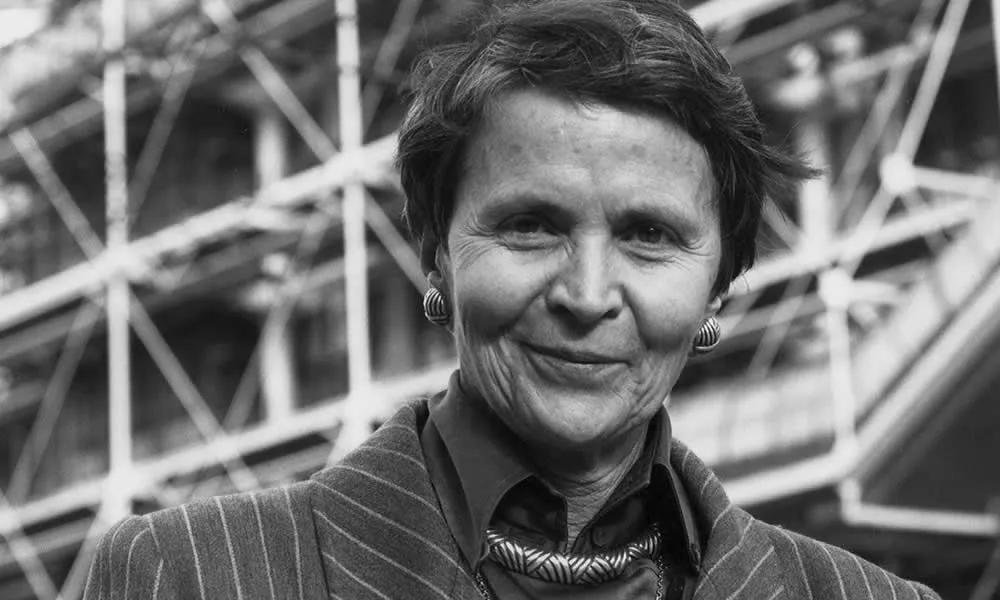
Hélène Glykatzi‑Ahrweiler, the internationally acclaimed Greek historian and Byzantinist, passed away today, February 16, at the age of 99. She would have celebrated her 100th birthday this August.
She was the first female rector at the University of Paris (Sorbonne) and left behind a rich body of scholarly work on Byzantine history. She was honored with numerous awards in France, Greece, and across Europe, including the Grand Cross of the National Order of Merit in France.
Throughout her life, she maintained close ties with Cyprus, participating in conferences and cultural initiatives and she was honored many times.
“I am both Athenian and Parisian,” she once said, reflecting her life split between Athens and Paris. Born on August 29, 1926, in Vyronas, Greece, to a refugee family, she studied history and archaeology at the University of Athens. During the German Occupation, she joined EPON (Greek Resistance youth organization) and later served as secretary to Queen Frederica due to her fluency in English and French. She moved to Paris in 1953 to continue her studies, earning her doctorate in 1960 and a Docteur des Lettres in 1966.
Her career spanned decades of academic and public service: she served as research director at France’s CNRS, professor of Byzantine History at the Sorbonne, visiting professor at Harvard University, president of Paris I University, rector of the University of Paris system, and held leadership roles in cultural and scientific organizations across Europe.
On her leadership style, she told biographer Anna Grimani: “I never send secretaries or assistants ahead of me. I always go first, ‘face to face,’ as my father told me.”
Hélène Glykatzi‑Ahrweiler’s personal life was equally remarkable. She was married to Jacques Ahrweiler, a French army officer, and they had one daughter, Marie-Elene. Reflecting on her late husband, she said, “His loss left a huge void and unbearable loneliness.”
Even in her final years, she remained intellectually active. Her last book, From Me, These… (2023), recounts conversations about her childhood, the Occupation, life in France, Byzantine and modern Greek history, and her views on humanity and education. In it, she reflected on the universality of human experience:
“We are all one, without borders. We must remember that no one is an island, and this global awareness shapes our shared responsibility for the future.”
Her passing marks the loss of a pioneering scholar who bridged Greece, Cyprus, and Europe through history, culture, and education.
She said:
“If I were to give one piece of advice to young people, it would be to have a dream and chase it with your feet on the ground and your eyes on the sky.”
“Innocence means trusting others, whoever they may be, but also trusting yourself. Innocence is shaken when trust is abused.”
“The only true scientific virtue is to distinguish the essential from the trivial, so that you can then explain and demonstrate it.”
“Every generation is new, and lost paradises belong to the elders.”
“Education is the only antidote to crisis, and it begins at home.”
“Success without happiness is not success.”
“Enough! Greeks are as wonderful as all other people.”
“Greece did not experience the Enlightenment. Who is to blame? I will say: the Church.”
“True loss occurs when women hide their years and lose their memories.”
“Self-knowledge is the ability to know where you can go.”