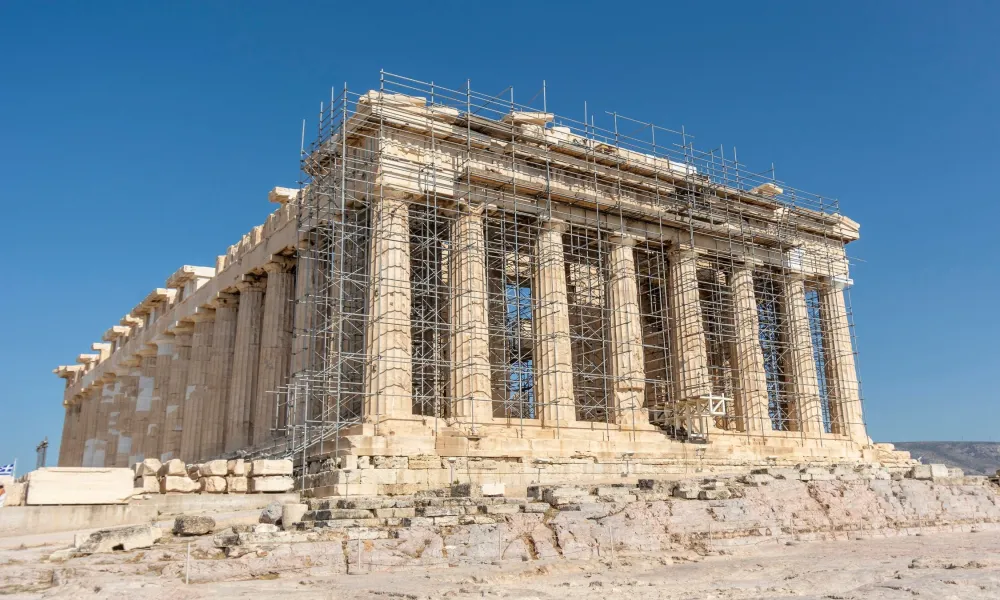

One of the most enduring explanations for the design of the Parthenon may be based on a centuries-old misconception, according to new research by an Oxford University mathematician.
For generations, scholars have praised the architects of the ancient Greek temple for incorporating subtle curves and refinements intended to counteract optical illusions that supposedly would have made the building appear distorted. The theory has been widely repeated in architectural literature and popular accounts of the monument.
However, Professor Alain Goriely argues that many of the optical effects the Parthenon's features were supposedly designed to correct either do not exist or are so slight as to be virtually undetectable.
Revisiting a 2,000-year-old assumption
In a recent study, Goriely traced the origins of the theory to Vitruvius, the Roman architect and engineer who wrote about the Parthenon roughly four centuries after its construction. His account became highly influential and was repeatedly cited by later writers, eventually becoming accepted wisdom in discussions of classical architecture.
According to Goriely, modern retellings, including those generated by artificial intelligence systems, continue to present these explanations as established fact despite the lack of convincing evidence.
The question of the curved base
One of the most frequently cited examples concerns the temple's base, known as the stylobate.
Measurements show that the stylobate is not perfectly flat. Instead, it rises slightly towards the centre, forming a gentle curve of around six centimetres. Traditional explanations, based largely on Vitruvius' writings, claim this curvature was introduced to prevent the base from appearing to sag in the middle when viewed from a distance.
Goriely's analysis found little evidence to support this interpretation.
One theory suggests that long horizontal lines naturally appear to droop, but he found no convincing proof that such an illusion exists. Another explanation relies on the Hering illusion, a visual effect in which straight lines can appear curved when intersected by other lines. Yet Goriely argues that the Parthenon's columns are positioned at angles that would make the effect negligible, while there is no clear evidence that the illusion operates in the same way in three-dimensional structures.
Column bulges also questioned
The study likewise challenges traditional explanations for entasis, the slight outward bulge visible in the Parthenon's columns.
Conventional accounts suggest that the curvature was introduced to prevent the columns from appearing thinner in the middle. Goriely found no evidence that observers perceive such narrowing and notes that the bulge itself measures only around 18 millimetres, making it difficult to detect under normal viewing conditions.
Alternative explanations
Rather than serving as optical corrections, the architectural features may have had practical or aesthetic purposes.
The gentle curvature of the stylobate could have helped prevent the accumulation of rainwater, while subtly curved columns may simply have appeared more natural and visually pleasing to ancient Greek builders and observers.
Goriely suggests that these explanations are at least as plausible as the long-standing optical illusion theory.
Why the theory survived
The researcher argues that the enduring reputation of ancient Greece as a civilisation of exceptional ingenuity may have helped preserve the belief for centuries.
His study concludes with an unusual invitation to readers: to step outside, observe their surroundings and test such claims for themselves rather than accepting traditional explanations unquestioningly.
Commenting on the research, Professor Frank Salmon of the University of Cambridge noted that many historians of classical architecture have long approached Vitruvius' explanations with caution, particularly because he wrote centuries after the Parthenon's construction and because many earlier Greek architectural texts he referenced have since been lost.
The findings reopen a debate over whether some of the Parthenon's most celebrated design features were sophisticated visual corrections or simply elegant architectural choices that later generations sought to explain through the lens of optical science.
Source: Guardian