
A large and emotionally charged painting by Yoshitomo Nara, the artist known for childlike figures that convey a sense of unease, is heading to auction in New York this month through the auction house Fair Warning. The work is estimated to sell for between $10 million and $15 million.
A departure from his earlier figures
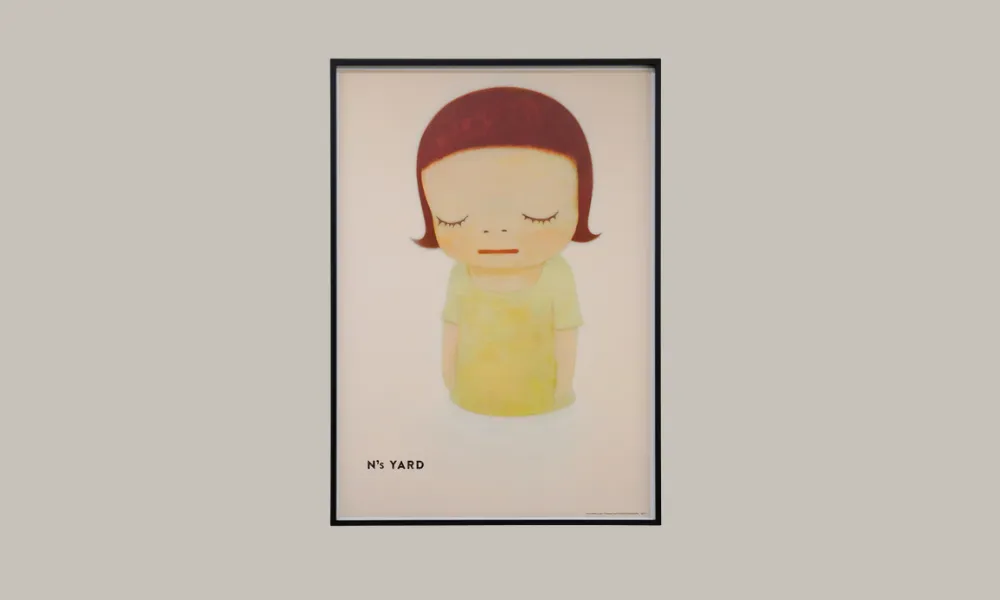
The figure at the centre of In the Milky Lake / Thinking One (2011) differs from Nara’s earlier work, which featured children behaving provocatively. Here, the female figure does not grimace, smirk or sleep. She stands with her head bowed and eyes closed, her expression combining resignation and disappointment.
The figure appears to float, her knees gradually fading into an off-white background, creating an image of melancholy that seems out of proportion with her age.
Painted after the Tōhoku earthquake
The emotional weight of the work may be explained by the circumstances in which it was made. It was painted in the aftermath of the 2011 Tōhoku earthquake, which caused widespread destruction in the region of north-eastern Japan where Nara grew up. It was the only large-scale painting he completed that year. The artist later compared the destruction caused by the earthquake, the tsunami and the Fukushima nuclear accident to the aftermath of a war.
“This is ground zero for the most introspective and contemplative period of his work,” Fair Warning founder Loïc Gouzer said by phone. He revealed that he had been trying to acquire the painting for a decade.
“Nara used to be wrongly seen as a commercial artist, perhaps because his subject matter of children seemed innocent. In reality, his works have far greater depth than people think,” he added.
One of his largest canvases
Measuring 102 by 71 inches (around 259 by 180 centimetres), it is one of Nara’s largest paintings and has been in a private collection since it was completed. Over the past decade it has been included in all of the artist’s major retrospectives, among them the large exhibition organised by the Los Angeles County Museum of Art (LACMA) in 2021.
Ahead of the auction on 19 November, the painting will be on view from 6 November in a temporary exhibition space in New York’s Chelsea district. The space will also include a Japanese tea ceremony room.
Record prices and a cooling market
Nara’s auction record is held by Knife Behind Back (2000), sold by Sotheby’s in Hong Kong in 2019 for HK$196 million ($24.9 million). This is the highest price ever paid at auction for a work by a Japanese artist.
So far in 2026, 224 works by Nara have been offered at auction, bringing in a total of $52 million, a figure similar to 2025. This is a decline from the peak years of his market, from 2019 to 2023, when annual sales of his work averaged $99 million.
The most expensive Nara sold in 2026 was Nothing About It (2016), which shows a girl with a slightly defiant expression against a yellowish background. It was sold in March by Seoul Auction for 15 billion South Korean won ($9.8 million).
“We are not chasing publicity, but quality. The conversation around the market is one thing, but good art speaks for itself,” Mr Gouzer said.
He added that there is now a new generation of collectors, both younger and older, who needed time to understand the artist’s significance. “Nara’s record will be broken. I don’t know whether it will happen with this painting, but it will happen soon,” he said.
New shows in Washington and New York
The sale of In the Milky Lake / Thinking One through Fair Warning coincides with two other significant developments for the artist in the United States.
In Washington, Nara will open the redesigned sculpture garden of the Hirshhorn Museum, presenting three monumental works in painted aluminium.
In November, he will also present new work at David Zwirner gallery in New York. The exhibition marks his first collaboration with the gallery since leaving Pace, and his first solo show in the city in almost a decade.
About Fair Warning
Since it was founded in 2020, Fair Warning has sought to shake up the art market. This autumn it expanded into haute couture. The sale of 23 pieces, including items from Naomi Campbell’s personal collection, totalled $3.2 million, well above the initial estimates.
Who is Yoshitomo Nara
Yoshitomo Nara was born on 5 December 1959 in Hirosaki, in Aomori Prefecture in northern Japan. He completed a bachelor’s degree in 1985 and a master’s degree in 1987 at the Aichi Prefectural University of Fine Arts and Music.
In 1988 he moved to Germany to study at the Kunstakademie Düsseldorf, where his teachers included the painters A.R. Penck and Michael Buthe. After graduating, he worked from Cologne, and in 2000 he returned to Japan. From there he has continued to make work and exhibit around the world.
His work and recurring themes
Nara is best known for his paintings of big-eyed children, though his practice also covers drawing, photography, sculpture and installation. His years in Germany, and his encounter with German Neo-Expressionism, shaped his visual language.
An early key work, The Girl with the Knife in Her Hand (1991), now belongs to the San Francisco Museum of Modern Art. It shows an apparently innocent girl holding a small knife. That tension between innocence and menace became a defining feature of his work.
Major institutions have staged his exhibitions, including:
- Asia Society Museum, New York, with Nobody’s Fool (2010)
- Yokohama Museum of Art, with A Bit Like You and Me (2012)
- LACMA, Los Angeles (2021)
- Guggenheim Museum Bilbao and Museum Frieder Burda in Baden-Baden (2024)
- Hayward Gallery, London (2025), in an exhibition co-organised with the Guggenheim Museum Bilbao and the Museum Frieder Burda
His home prefecture remains central to his work. The Aomori Museum of Art holds more than 170 of his works. Public pieces in the region include Yoroshiku Girl on an exterior wall of the Towada Art Center and A to Z Memorial Dog at the Hirosaki Museum of Contemporary Art.
Sotheby’s has described the works Nara produced after the 2011 earthquake as marking an emotional shift in his art. In these works, the milky lake recurs as a motif. Christie’s has described this water imagery as an analogy for healing, deliverance and rebirth, linked to the artist’s anti-war views.
With information from artnet