
The United States, made up of 50 states, is a federal republic. According to the drafters of the 1787 Constitution, it was built to prevent any single individual or social group from gaining excessive control over power. Because the country is so large, the founding fathers relied on a range of institutions that share power between them.
Three levels and three branches
Power is divided across three levels: the federal government, the state governments and local governments. At national level, the government is in turn divided into three branches: the legislative, the executive and the judicial.
Each branch has distinct responsibilities. In certain cases, however, each can also limit the others, through a complex system of checks and balances.
The legislative branch
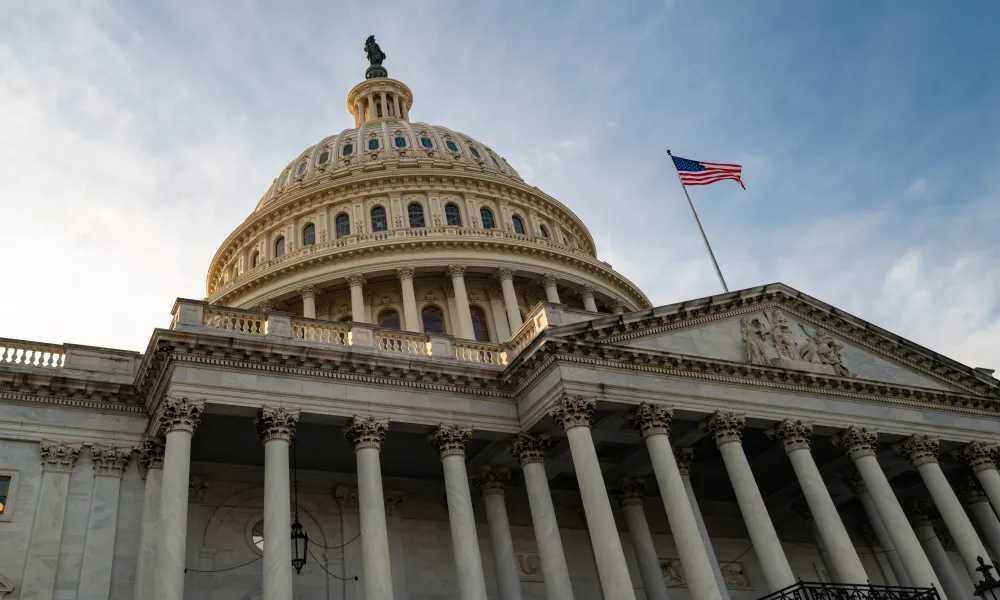
The legislative branch is housed in the Capitol, the seat of the US Congress. It was established by Article 1 of the Constitution and is responsible for passing new national laws and amending existing ones.
Under the Constitution, this task falls to Congress. Congress is made up of two chambers: the Senate and the House of Representatives. Seats in both are being decided in today’s US midterm elections. Members of both chambers are elected directly by voters in the states they represent.
- The House of Representatives has 435 members, elected every two years. Each state elects a number of representatives in proportion to its population.
- The Senate follows the principle of equal representation. Each state elects two of the 100 senators, for a six-year term.
The founding fathers sought to check the power of the majority by giving smaller states extra representation. For the same reason, they gave senators longer terms, so that they would be less exposed to popular pressure.
The executive branch
The executive branch is responsible for implementing laws in the United States. It is made up of the president, the vice president, the cabinet and a number of independent agencies.
The president heads the executive branch and must “take care that the laws be faithfully executed” and “preserve, protect and defend” the Constitution.
To carry out this role, the president oversees a vast network of departments and agencies. It has grown over time and now employs around four million people.
The judicial branch
The judicial branch is responsible for interpreting the laws passed by Congress. It is made up of the Supreme Court and lower federal courts. When interpreting laws, the courts may conclude that a law, whether federal or state, is not consistent with the Constitution.
Because they can declare laws unconstitutional, the courts play an important role in defining the law of the land.
What Congress does
Congress has broad powers. These include control over taxation and spending at national level, and the power to coin money and declare war. Its main duty is to draft, debate and pass bills before they are sent to the president.
Bills concerning public finances can be drafted only by Congress, but they need the approval of both chambers before being put to a vote.
Oversight of the executive
Another important responsibility of Congress is oversight of the executive branch. Congressional committees review the work of government, checking whether it is carried out efficiently and transparently.
As part of this work, congressional committees can summon senior officials to hearings and request financial audits of executive agencies. Congress can also question witnesses on matters of public interest.
How the president can check Congress
- The president can veto a bill passed by Congress
- The president can call special sessions and adjourn Congress when the two chambers cannot agree on adjournment
- The president can temporarily appoint senior officials without Senate approval if the Senate is in recess
- Congress cannot reduce the president’s pay while he is in office
How the judiciary can check Congress
- The courts can declare a law unconstitutional
- Congress cannot reduce judges’ salaries while they are serving
- The Chief Justice of the Supreme Court presides over impeachment trials
With information from the BBC