
I was about 17 or 18 or 19 when Die Hard finally reached us in Cyprus, where new releases arrived well after the rest of the world had moved on. By then, we’d already found another way in. Pirate VHS tapes were everywhere, fuzzy picture, warped sound, tracking lines rolling across the screen, but none of that mattered. I plugged in a battered cassette purely because of one name on the box: Bruce Willis.
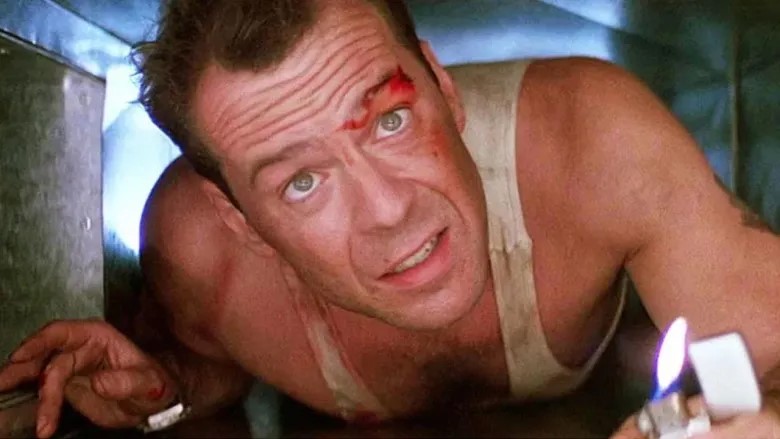
“Die Hard” put ordinary dude Willis in the category of Schwarzenegger and Stallone.
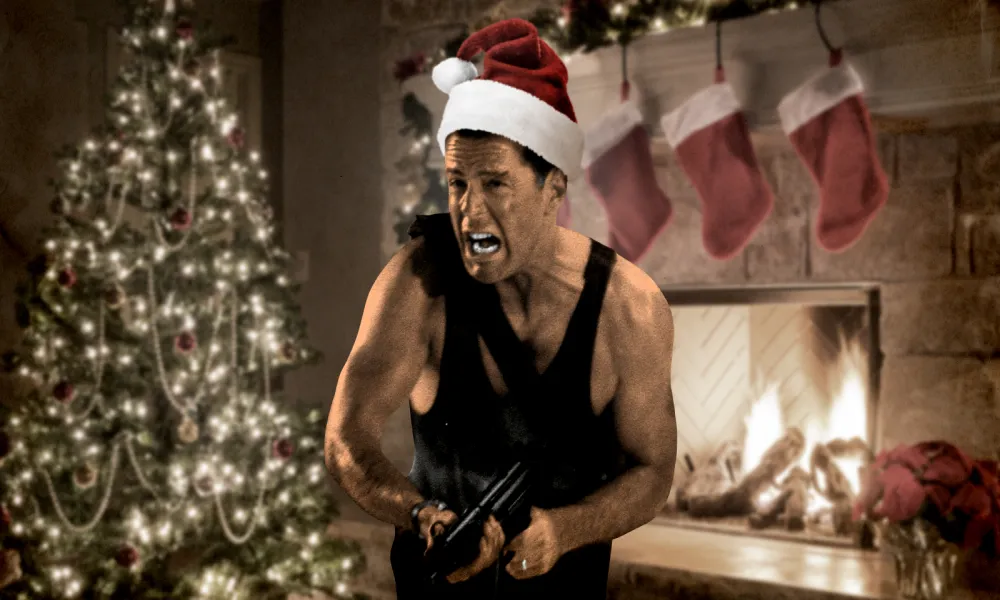
Few films inspire a yearly sofa debate quite like Die Hard (1988): Is it a Christmas movie or not? For me (cinephile) the argument is settled. John McTiernan’s explosive thriller isn’t merely set at Christmas, it uses Christmas as a structural and thematic engine. From the opening notes of “Winter Wonderland” to the snow-like fallout of shattered glass and office paper, the holiday setting is baked into the film’s DNA.
What elevates Die Hard beyond action spectacle is its immaculate classical filmmaking. McTiernan’s direction is precise and spatially coherent, turning Nakatomi Plaza into a cinematic playground of vertical movement and escalating tension. Every crawlspace, elevator shaft, and stairwell is clearly mapped, allowing the audience to feel the stakes of John McClane’s isolation. This clarity is a hallmark of late-80s studio craftsmanship, muscular, efficient, and invisible.
Alan Rickman’s Hans Gruber remains one of cinema’s great antagonists: urbane, witty, and sharply costumed, a villain whose European polish clashes perfectly with Bruce Willis’s blue-collar American hero. Their duel is as much ideological as physical, corporate greed versus personal reconciliation, cynicism versus family.
Crucially, Die Hard is about reunion. McClane’s fight is motivated not by heroism, but by a desire to save his marriage. Strip away the gunfire, and what remains is a Christmas story about fractured relationships, humility, and coming home changed. That final embrace, underscored by “Let It Snow,” seals its festive credentials.
It’s loud, it’s sharp, and it’s unexpectedly tender, a Christmas film that proves tinsel and terrorists aren’t mutually exclusive.
So yes, keep the mince pies close, but for this one, you’ll want a bowl of popcorn too.