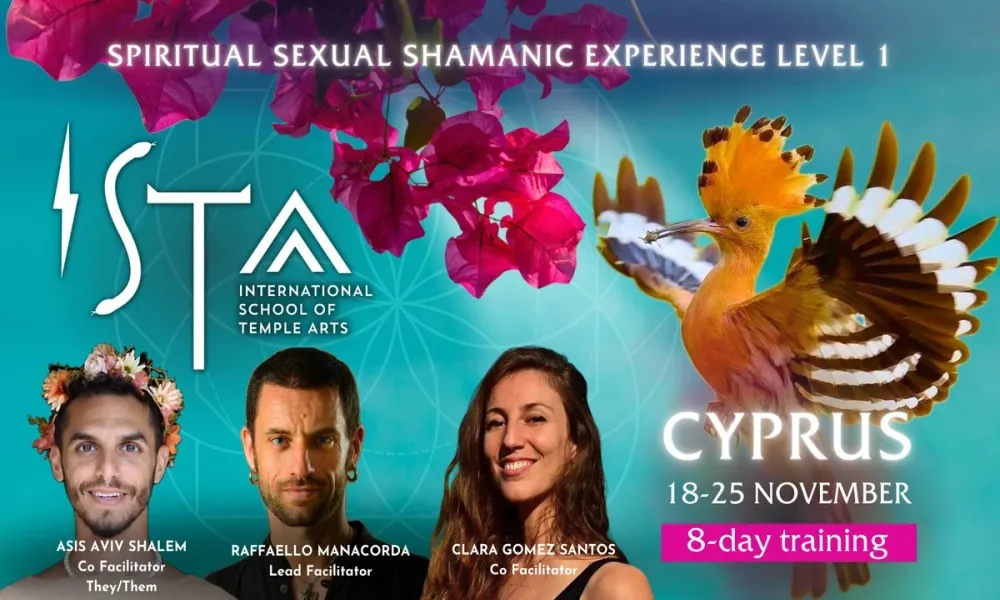

The International School of Temple Arts (ISTA) is in Cyprus, at a beach hotel to be exact on the western side of the island. Golden sands, lovely coves and calm shallow waters, promising magic, transformation, and deep connection. From November 12–16, the organisation held its first international ISTA Festival here at a well-known hotel, billed as ‘Five Days of Magic by the Sea’.
The sold-out festival drew a full house of attendees seeking transformation by the sea, offering ecstatic music, dance, rituals, workshops, and the chance to meet and train with the global ISTA community. Immediately after, a Level 1 training, the Spiritual Sexual Shamanic Experience (SSSex), began and runs until November 25, also fully sold out.
Promotional material features exploring self-love, boundaries, emotional release, shadow work, voice dialogue, breathwork, shamanic tools, and sexual clearing rituals. The organisation promises participants the chance to reconnect with themselves, access their inner power, and “come back to love.”
In Cyprus, a small society where news travels fast, the arrival of ISTA to the Paphos region has been met with curiosity, confusion, and humour. Local publications poked fun at a “mysterious sexuality festival” by the sea. But an email sent to Politis to the point by a concerned source painted a different picture: the email spoke of an organisation subject to serious allegations worldwide, including reports of sexual coercion, psychological manipulation, trauma, and cult dynamics under the guise of ‘sacred sexuality’ and ‘spiritual healing.’
The email cited international media on victims’ testimonies, and ISTA practices including pressuring participants into sexual acts and controversial rituals, with law enforcement interventions in the US and Thailand.
Cult experts
In Israel, ISTA’s events drew strong criticism from the Israeli Center for Cult Victims, and cult experts such as Dr. Steven Hassan have warned against the organisation’s methods. ISTA’s full response is available on its website.
Dr. Hassan is a mental-health professional with more than 45 years of experience studying authoritarian influence, according to Psychiatric Times. He founded the Freedom of Mind Resource Center, authored several leading books on cult dynamics, and developed widely used models such as the BITE Model and the Influence Continuum.
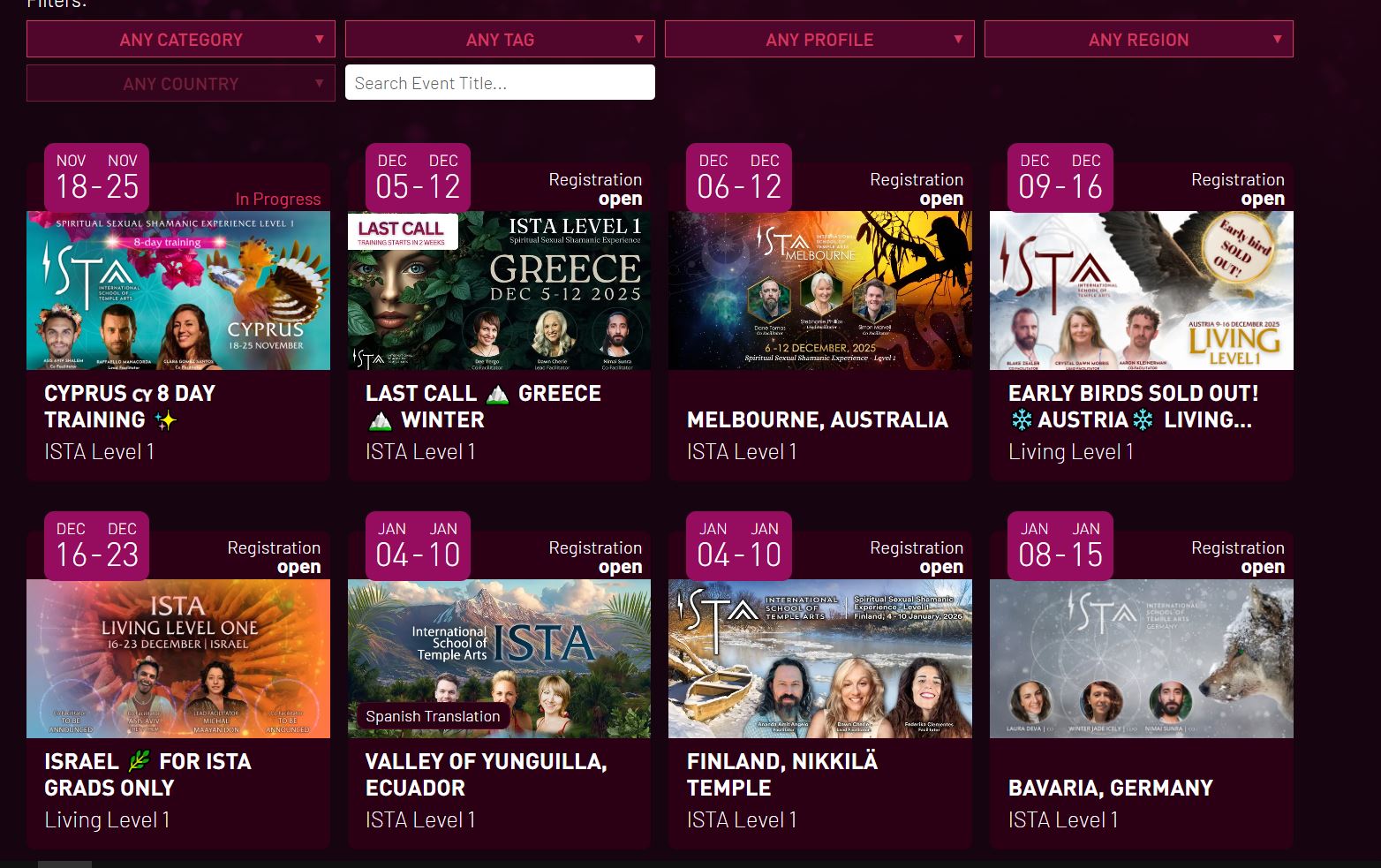
with a claimed 15,000 participants worldwide.
ISTA says it consulted reputable sources on cult dynamics when preparing its response to the Center’s accusations, which led it to reference Dr. Hassan’s work. It added links to his materials on its website and invited him to a podcast with a $150 honorarium. According to ISTA, Dr. Hassan later released a video portraying this as an attempt to “buy him off,” which the organisation says misrepresented its intentions.
ISTA states that it has completed a two-year review of its values and standards and remains open to constructive dialogue. It hopes Dr. Hassan may reconsider participating in a future conversation on cult terminology and its application.
Politis to the point contacted Cara Cordoni, a former ISTA participant who says that she experienced manipulation and deceptive practices during trainings.
When she discovered reports of harm spanning years and dozens of countries, she co-founded survivor advocacy group 3SC and spent 30 hours attempting mediated accountability with ISTA leadership. After that process failed to produce change, she has been speaking publicly. "The pattern of harm is clear. People deserve to know the history of complaints before they walk in the door seeking healing and transformation.
What is ISTA
The International School of Temple Arts grew out of Sedona Temple, founded by Robert "Baba Dez" Nichols in 2002. Sedona Temple was raided by law enforcement in 2011. ISTA is considered one of the largest neo-Tantra organisations, with a claimed 15,000 participants worldwide. Week-long festivals and training events continue to attract participants seeking personal growth, sexual liberation, and spiritual connection. However, former participants who describe themselves as ‘survivors’ warn that the intensity of the environment, coupled with unclear boundaries and the potential for manipulation, raises serious questions about safety and informed consent.
The experience of Cara Cordoni
Cara Cordoni, a former participant, shared her account with Politis, highlighting the risks inherent in ISTA’s model. She emphasises that the aim is to raise awareness, and help people who felt victimized. Cordoni argues that its important that people, who can be very vulnerable and seek healing know what they sign up for.
“The model is not safe and the people running it are not safe in my opinion. The promises of transformation can hide harm,” she told the Point.
“It was right after COVID and a breakup, and I was looking for transformation”, Cordoni says. “I wanted to heal and connect, and I thought this was a reputable spiritual training.” But, she insists that what she had encountered was a model that normalised deception and manipulation.
 .
.
Cordoni admits she ignored the red flags. She recalls that there was an early agreement, allowing teachers to engage in sexual activity with students. This is unacceptable, she says, as it creates a power imbalance, but they insisted that it is something happening everywhere so it’s better to do it openly rather than hide it.
“It is still a teacher-student relationship. The power is there, even if they tell you it is all consensual,” she notes.
According to Cordoni, the training is physically and emotionally intense. And for her, this meant workshops over six or more days with disrupted sleep, creating emotional highs and lows akin to manic experiences.
“I agreed to exercises that left me vulnerable. You are paired randomly with another participant, given tasks meant to push your boundaries”.
And when she raised concerns in a feedback session? “I was told I wasn't taking responsibility, that I was acting like a victim. I felt isolated”.
Yet, there was the constant lure of progressing to the next level and deeper spiritual access.
Cordoni highlights that ISTA’s format is one of large-group awareness trainings (LGATs) that cause what psychologist John Hunter, PhD, describes as the “dopaminergic defence “creating dopamine-driven highs and emotional vulnerability. There were moments of screaming, crying, and emotional release. But after the pressure is off, it can feel like “transformation”, a high, hypomania, mania and some people even experience psychosis, she explains.
She adds that the training includes rituals that can be deeply confronting and potentially traumatic. There were exercises framed as death and resurrection, rituals that involved animals, and other activities that pushed people far outside their comfort zone.
“Imagine if you are a vegan and unexpectedly you are asked to participate in slaughtering an animal. Some people had real trauma reactions,” Cordoni adds.
She argues that the organisation tells you everything you experience is your responsibility, but in practice, it is manipulation disguised as empowerment.
Allegations
Outside Cyprus, former participants have filed complaints in multiple countries. In the UK, Lithuania, and Israel, police reports have been submitted regarding coercion and sexual misconduct. Facebook groups document hundreds of complaints about consent violations and emotional abuse.
3SC (Safer Sex-Positive and Spiritual Communities), a survivor advocacy group co-founded by Lalita Díaz and Cara Cordoni. 3SC evolved from a Facebook Group called Issues with ISTA and Highden which had 600 members at it’s peak. 3SC collected over 50 reports of harm from ISTA and Highden events between 2008-2022, documenting patterns of sexual coercion, boundary violations, and organizational protection of accused perpetrators. The FB group and collected reports show patterns that go beyond isolated incidents.
“Some people who get lured in are benevolent, but the top levels exhibit manipulative behaviour,” says Cordoni, adding that even when participants try to negotiate or express concerns, there is a culture of 'gaslighting' and deniability.
ISTA is also connected to Highden Temple, a New Zealand-based organization founded by Bruce Lyon, who served as ISTA's lead faculty and Level 2 curriculum designer. Financial transfers between the organizations have been documented. In September 2024, former ISTA founder Dez publicly alleged that Highden was connected with rape, trauma, and suicide, though Lyon denies these allegations.
A predator inside us
New York Magazine made an investigation following allegations made by Lina, a 32-year-old from Berlin, whose experience highlights the risks inherent in high-control neo-Tantra organisations that blend spirituality, sexuality, and power. Reportedly ISTA’s founder Robert “Baba Dez” Nichols, had begun his work at the Sedona Temple in Arizona in 2002, a ranch-style nonprofit offering rituals and “sex magic” workshops. The Temple and Nichols’ teachings, which framed sex with teachers as potentially healing, laid the groundwork for ISTA’s philosophy. According to the same report the Sedona Temple itself attracted controversy: a 2011 police raid on suspicion of prostitution led to the arrest of the operations manager (no charges against Nichols), and the Temple remained a site of sexualized rituals and sacred-sexuality teachings, documented in the 2010 film Sex Magic.
Lina loved ISTA’s Level 1 training, but during Level 2 in Fethiye, Turkey, a ritual meant to explore shadow desires turned traumatic. During a “sacrifice” exercise, blindfolded and instructed to surrender, Lina reports that a man pushed her down and forced himself on her. She recalled, “I froze”, unable to reconcile what was happening with ISTA’s teachings. When she approached senior teacher Michal Maayan Don, Don told her, “We all have predators inside us,” framing the assault as part of the spiritual process. Lina left the retreat traumatized, later describing ISTA as “a paradise for rapists.”
After returning to Berlin, Lina developed PTSD, depression, chronic anxiety, and acute stress, feeling unsafe around men, even her father, and largely unable to work or engage socially. She began cult-recovery therapy, reflecting, “I was empty”, and withdrew from sacred sexuality entirely.
Her story joined dozens shared in online survivor groups like Tantra Not Trauma and Issues With ISTA & Highden Temple, later collected by 3SC (Safer Sex-Positive & Spiritual Communities). By late 2022, 3SC had gathered 51 reports of abuse, including 30 sexual or physical consent violations, largely implicating ISTA faculty.
Reflecting on her experience, she told NYM that the whole spiritual-sacred spin was totally unnecessary: “It is embarrassing remembering the nonsense I used to believe”.
ISTA response
Politis to the point contacted ISTA for the allegations and a PR officer suggested in an email that there is an individual with whom ISTA is currently engaged in active litigation for circulating negative emails. She suggested to check replies online. Regarding Lina’s testimony, on the website, ISTA acknowledges Lina’s distress and apologised for delays in addressing her complaint.
In this response, ISTA (nine responses from November 2024 to March 2025) that the experience occurred within verbally agreed-upon boundaries and that their procedures are designed to support participants, including recognising freeze responses. ISTA stated they take all participant concerns seriously, are reviewing procedures to minimize harm, and are committed to improving clarity and safety in ceremonies and training.
Venues
Hosting ISTA events in Cyprus raises ethical and legal questions. International allegations of coercion, sexual abuse, and unclear consent intersect with Cypriot laws that prohibit sexual acts obtained through manipulation or abuse of authority.
A Cyprus Police Press Officer told Politis that the authorities were not aware of the events, but there is a responsibility by organisers as well as venues to ensure events on their premises do not expose participants to harm. He also pointed out that it is not allowed to slaughter animals anywhere. Civil liability, criminal complicity, and breaches of hospitality licensing regulations could arise if participants are coerced or harmed during activities.
For Cyprus, the arrival of ISTA serves as a microcosm of these global debates. The controversy around ISTA underscores a broader conversation about neo-Tantra, sacred sexuality, and high-control spiritual organisations. Supporters highlight empowerment, self-exploration, and community-building, while critics point to coercion, blurred boundaries, and psychological risk. Advocacy groups continue to document patterns of harm, seeking accountability and reform.
For prospective participants, the warnings are clear: informed consent, personal responsibility, and awareness of power dynamics are critical for navigating this controversial global network. And let the Cypriot experience at least be a wonderful week by the sea.