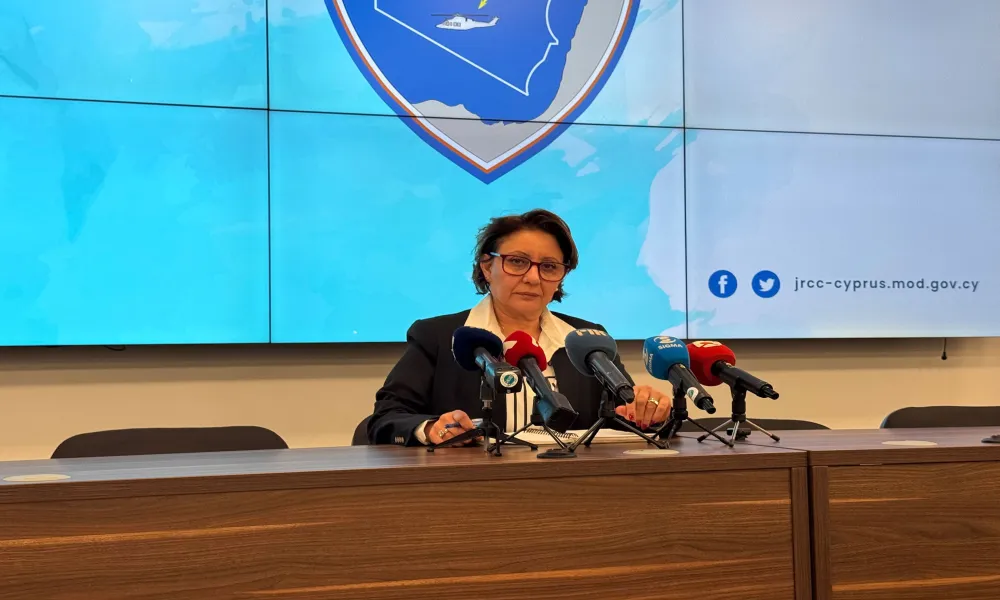
Three experts from the European Commission are expected to arrive in Cyprus by Wednesday following a foot-and-mouth disease outbreak, to take stock of the situation, as Senior Veterinary Officer Sotiria Georgiadou said in statements to CNA. "Today and tomorrow, we are expecting our colleagues, experts from the European Commission, to arrive in Cyprus to discuss the issue" and decisions will be taken accordingly, she said.
Asked to comment on why the veterinary services did not proceed with early animals' vaccination in December when a case was reported in the island's north, she said that until February, the Republic of Cyprus was considered as a region free of the virus, in line with World Organisation for Animal Health (WOAH) provisions. Based the international organisation's rules, once a country is considered to be free of the virus, it does not proceed with vaccinations.
The Veterinary Services, she added, had taken other measures such as spraying roadblocks, informing livestock farmers, and taking samples.
No restrictions on exports
Regarding vaccines, the spokesperson for the Veterinary Services said that an order for around half a million vaccines had been placed. She also said that vaccines are a solution to contain the spread of the virus and prevent it from spreading to other areas, which could have an impact on Cypriot products.
Georgiadou noted, moreover, that at the moment, the situation is stable. "There are 11 cases, one primary case regarding cattle in Livadia and the remaining 10 affecting sheep and goat farms in Livadia, Oroklini, Troullous, and Aradippou" while the infected area is confined within the initial 10 km surveillance zone that was established when the first cases appeared in Livadia and Oroklini, she said.
She added that the culling of cows began yesterday and continues today, while the culling of the first sheep and goats in Oroklini is also being organised. A total of 13,000 animals are expected to be culled in the coming days.
"This process will take a few days. The animals will be assessed so that the farmers and producers can be compensated, and animal welfare provisions will be strictly adhered to," she noted, adding that the process takes into account the safety and health of the personnel handling the culling, the mental health of the farmers, disinfection issues, etc.
Regarding the extent to which product exports have been affected, she said that there are currently no local restrictions for Cyprus and that major countries to which Cyprus exports, such as Canada, Great Britain, and Australia, have not reacted.
Countil the losses...soon
Regarding the loss in production, she noted that the current situation shows losses, but for the time being, it is manageable.
Commenting on the economic impact, Sotiria Georgiadou said that the financial loss has not yet been estimated. "We are making an assessment to present it to parliament so that the correct procedures for compensating livestock farmers can be followed," she said.
When asked about the point of transmission of the virus, she said that the virus' transmission is both airborne and through products and vehicles.
She also noted that the foot-and-mouth disease virus has recently been recorded in Slovakia and Hungary, as well as in wild cattle in Germany. It is also endemic in parts of Asia, and the measures to contain the virus have remained the same since its first occurrence, due to the way it spreads, its virulence, and the losses it causes in livestock and production.
CNA