
The Asian premiere of The Sound of Shanghai, a monumental audiovisual work composed and directed by internationally acclaimed Cypriot composer Marios Joannou Elia, has been met with enthusiastic praise from audiences and extensive coverage in China's leading media outlets.
Speaking to Politis, Elia described the artistic process behind the project:
"Every city has its own voice. For three months, I listened to Shanghai."
The composer said the work emerged from an extended period of immersion in the city's soundscape and cultural identity.
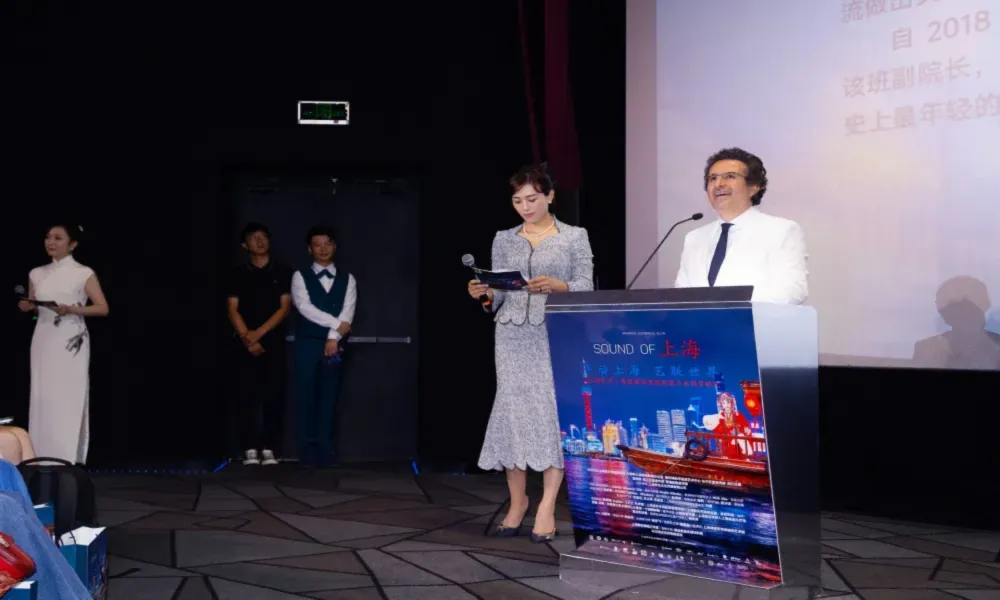
The official premiere took place on 27 June at the Tianshan Cinema in Shanghai's Hongqiao Art Center, presented in Dolby Atmos to a packed audience.
The production combines original music, authentic urban sounds and cinematic imagery into a single immersive artistic experience.
A few days before the premiere, the work was also presented to a full house at Huiyin Theatre, where Elia discussed the philosophy, concept and creative process behind the project.
A photographic exhibition dedicated to the production was also hosted in the ancient town of Sijing, featuring behind-the-scenes images documenting its creation.
An opera centred on a city
Elia describes The Sound of Shanghai as an "opera of a cosmopolis," in which the protagonist is not a person but the city itself.
Without spoken dialogue, the narrative unfolds entirely through original music, environmental sounds and visual storytelling.
Shanghai is portrayed through:
- Kunqu opera
- Traditional Chinese musical instruments
- Tea ceremonies
- The art of the qipao
- Shadow theatre
- Traditional markets
- Temples
- Historic and modern architecture
- The constant rhythm of contemporary urban life
According to the composer, the work began with a short musical motif from Kunqu opera, which became the foundation for a large-scale composition featuring:
- Chinese and European orchestral instruments
- Guzheng orchestras
- Ruan ensembles
- A jazz trio
The result, he said, reflects a creative dialogue between cultural heritage and modern urban identity.
Eighteen months of production
The project took 18 months to complete and involved:
- 250 performers
- More than 30 artistic, academic, cultural and technological institutions
- Filming at 90 locations
- 6,574 audiovisual recordings
- 718 separate audio channels
- 19,431 photographs
One of the production's most innovative elements was the incorporation of electroencephalogram (EEG) recordings of the composer's brain activity.
The measurements were taken at the beginning and end of his three-month stay in Shanghai and later transformed into sound material reflecting the impact of his immersion in the city's environment and sonic identity.
Major Chinese collaboration
The project was produced under the guidance of the Department of Intangible Cultural Heritage of the Shanghai Municipal Administration of Culture and Tourism in collaboration with leading Chinese cultural and academic institutions, including:
- The Shanghai Conservatory of Music
- The National Chinese Orchestra
- The Central Laboratory of Music Therapy and Artificial Intelligence
A key role was also played by executive producer Zhao Jinyu, China's national ambassador for the promotion of Kunqu opera.
Cinematography and editing were handled by Kostis Nikolas, while sound production was led by Nikolas Elia in collaboration with Iverson Zhende Xu and Full Dimension, which was responsible for spatial sound design and audio rendering.
Strong critical response
According to Elia, the Asian premiere attracted substantial attention from Chinese media, including coverage by:
- SMG
- KNews
- Xinmin Evening News
- Shanghai Observer
- Jiefang Daily
- China News Service
- Forbes China
In a detailed review, cultural critic Wang Bojun described The Sound of Shanghai as:
"A cultural journey that transcends historical time and national borders,"
adding that the work transforms sound into the dramatic and spiritual core of the narrative and becomes:
"A letter to global culture."
Acclaimed Chinese director Teng Junjie also praised the production, calling it "inventive and distinctive".
He highlighted its artistic vision, cinematography, editing, colour palette and interaction between movement and stillness, saying these elements create authentic audiovisual experiences.
Teng further commended Elia's ability to discover music in sounds that often go unnoticed, from the movement of a fan to the rhythm of a small teapot, describing the composer's creative perspective as radically original.
The Sound of Shanghai is the third instalment in Elia's international series exploring the acoustic identities of cities, following The Sound of Vladivostok and The Sound of Kyoto, further reinforcing the global profile of the Cypriot composer and his ongoing search for new forms of musical storytelling.