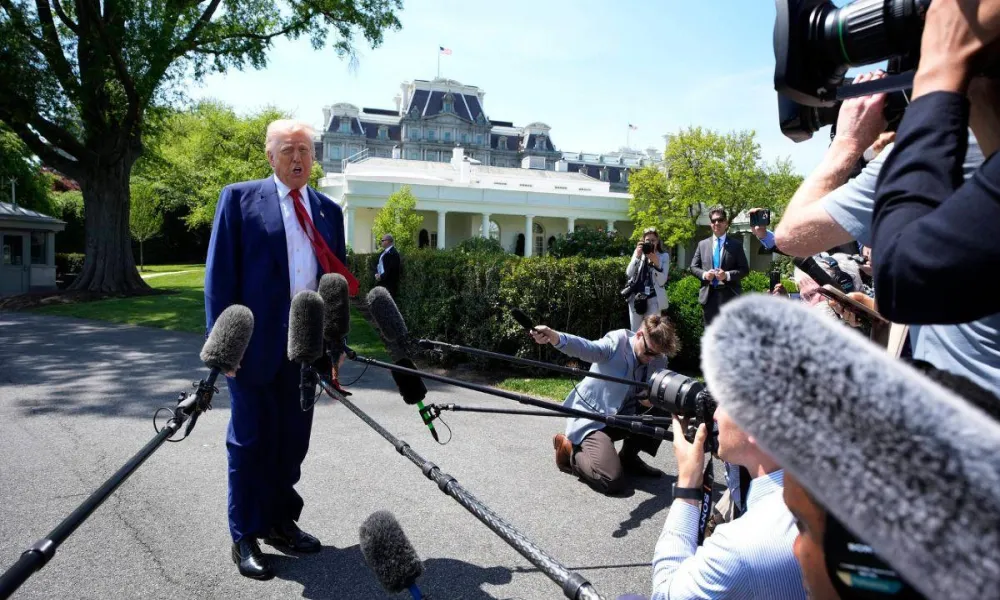

Four of the largest American television networks have suspended pool coverage of President Donald Trump, in an unprecedented show of solidarity with CNN after it was barred from the White House along with MS Now and Politico.
What triggered the ban
Mr Trump announced on Truth Social on Friday that he was banning the three outlets, citing what he called their "constant 'reporting' FAKE NEWS." The decision reportedly caught many White House aides off guard, with current and former staff telling NBC News they had no advance knowledge of the move. Journalists from the three outlets said their teams were barred from entering White House grounds over the weekend despite holding valid press credentials.
Networks refuse to fill the gap
Under the decades-old White House press pool system, CNN, NBC, ABC, CBS and Fox rotate responsibility for filming the president's public appearances and share the resulting footage with news organisations worldwide. When it was CNN's turn to provide pool coverage of Mr Trump's departure for the United Nations in New York on Monday, the network was excluded, and none of the other four networks stepped in to replace it. Fox spokesperson Brian Boyton, who organises the pool rotation, said the crew responsible for filming the president throughout the day would not cover events within its remit "from today," confirming no replacement pool would be arranged. NBC, ABC, CBS, CNN and Fox News said in a joint statement that the public has a vital interest in receiving accurate, independent information about its government. Other pool coverage, including of Congress and events outside Washington, is continuing as normal.
Lawsuit filed under the First Amendment
CNN, MS Now and Politico have filed an emergency lawsuit before a federal judge in the District of Columbia, arguing the ban violates the First Amendment to the US Constitution. A hearing and the presentation of legal arguments from the US government could take place within the current week.
What the First Amendment protects
The First Amendment, part of the US Bill of Rights, prohibits the government from abridging freedom of speech or of the press, among other protections. In the context of White House access, legal experts note that while a president is not constitutionally required to grant any specific journalist access to White House grounds, courts have long held that once a journalist has been admitted, they cannot then be excluded because the administration dislikes their coverage. That distinction, sometimes called "viewpoint discrimination," has been found in past rulings, including a 1977 US Court of Appeals decision, to violate journalists' free speech rights.
Part of a broader pattern, experts say
Jameel Jaffer, a First Amendment expert, described the ban as representative of a broader pattern by the Trump administration, pointing to past attempts to remove the Associated Press from the White House press pool and restrictions on journalists' access at the Pentagon. He said the pattern reflects an effort to intimidate the press and discourage critical reporting on the president's policies. Former President Barack Obama, speaking separately at a university event, questioned how such a ban targeting a single network would have been received under his own administration.
Attacks on female journalists draw separate criticism
The ban comes against the backdrop of a series of personal attacks by Mr Trump on female journalists in recent months, which press freedom groups say form a distinct and troubling pattern. According to tracking by Axios, Mr Trump has made demeaning remarks about female reporters at least 13 times since November 2025.
Documented incidents include Mr Trump telling Bloomberg's Catherine Lucey to be "quiet, piggy" after she asked about files related to Jeffrey Epstein, calling New York Times reporter Maggie Haberman "an unattractive person both inside and out," and describing ABC's Rachel Scott as "one of the worst reporters" after she questioned him at the Lincoln Memorial. He has also clashed with CNN's Kaitlan Collins, CBS's Nancy Cordes and Washington Post reporter Natalie Allison in similar exchanges.
The International Women's Media Foundation has said the remarks reflect a pattern of targeting and harassing women journalists, warning that such public attacks can expose reporters to further online abuse. The White House has at times defended the remarks as candid; Press Secretary Karoline Leavitt previously described one such comment as "very frank and honest."
Source: NBC News, CNN, NPR, CNBC, Axios, Newsweek, IWMF