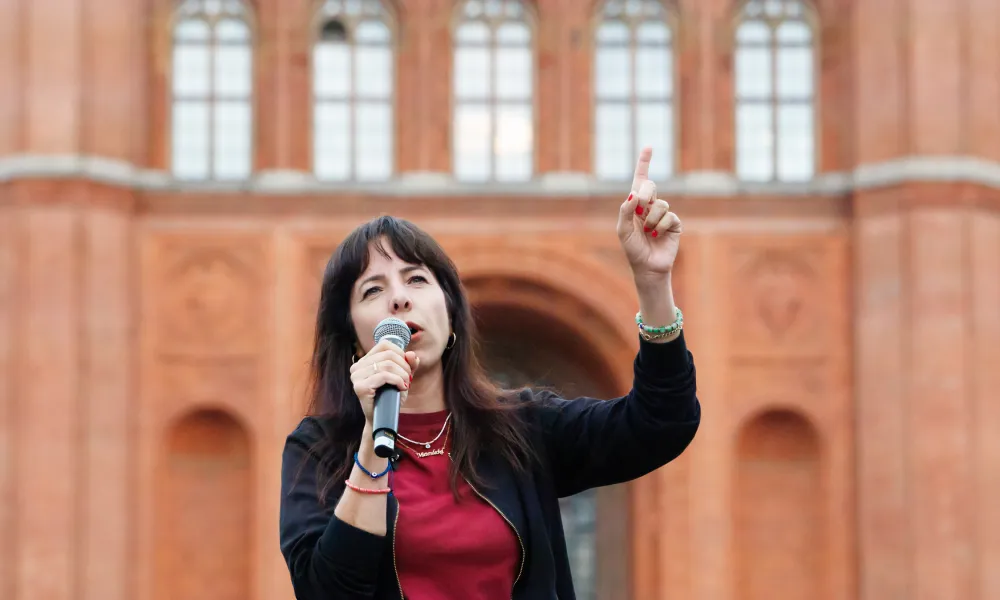

Elif Eralp, a politician who until a few years ago occupied a relatively low-profile position in Berlin politics, has emerged as a major figure in Germany after leading Die Linke to first place in the capital’s state election on 20 September.
Die Linke secured 25.3%, ahead of the Christian Democratic Union (CDU) on 19%, the Alternative for Germany (AfD) on 16% and the Social Democratic Party (SPD) on 12.1%.
If Eralp succeeds in forming a governing coalition, she could become the first governing mayor of Berlin with Turkish roots and the first from Die Linke.
Victory at the ballot box does not, however, automatically secure the mayoralty. Eralp must first assemble a majority in the Berlin House of Representatives, with potential coalition arrangements now at the centre of negotiations. The SPD and Greens have left open the possibility of talks with Die Linke.
Daughter of political refugees from Turkey
Eralp’s personal history is closely intertwined with migration and politics.
Born in Munich in 1981, she is the daughter of socialist and trade unionist parents who fled Turkey following the 1980 military coup, fearing political persecution. Her mother was pregnant with her when the family arrived in Germany.
After completing the asylum process, the family initially settled in Dortmund, where Eralp’s father worked as a doctor, before she later grew up in Hamburg.
Eralp has described politics as a presence throughout her childhood. She accompanied her parents to demonstrations from a young age and later became involved in the anti-nuclear movement.
From law to politics
Eralp studied law in Hamburg, with areas of focus including criminology, and completed the two state examinations required to enter the legal profession in Germany.
In 2010, she moved to Berlin and began working as a legal policy adviser to Die Linke’s parliamentary group in the Bundestag.
Despite working with the parliamentary group, Eralp did not formally join Die Linke until 2017.
She has linked her decision to join the party to the entry of the far-right AfD into the Bundestag that year.
A year later, she was elected to the leadership of Die Linke’s Berlin organisation.
Eralp has been a member of the Berlin House of Representatives since November 2021 and has served as deputy chair of Die Linke’s parliamentary group since 2024.
Her political work has focused particularly on migration policy, tackling discrimination, housing and urban development.
She is married and has two children.
Housing crisis at heart of campaign
Eralp’s election campaign focused heavily on one of the most pressing issues facing Berlin residents: housing costs and rising rents.
Among her proposals was a cap on rents for homes owned by public companies and implementation of the result of Berlin’s 2021 housing referendum, in which 58% of voters backed a proposal to socialise large housing portfolios owned by private companies.
The proposal could affect approximately 220,000 homes, although critics have pointed to the potentially significant cost to public finances.
The policy is therefore expected to become one of the most difficult issues in negotiations to form Berlin’s next governing coalition.
Comparisons with Zohran Mamdani
During the election campaign, Eralp repeatedly drew parallels between her political strategy and that of New York Mayor Zohran Mamdani.
Her campaign emphasised direct engagement with voters, door-to-door canvassing and social media, while some campaign material was also produced in Turkish.
Eralp argued that if a left-wing politician could win in New York, a similar political breakthrough could be achieved in Berlin, placing the creation of a more affordable city at the centre of her campaign.
From refugee family to potential Berlin leader
Eralp’s political rise also carries considerable symbolic significance.
More than four decades after her parents arrived in Germany as political refugees from Turkey, their daughter is now in a position to compete for the leadership of the German capital.
Whether she ultimately enters Berlin’s Red City Hall as governing mayor will now depend on the outcome of coalition negotiations.
Source: Reuters, Tagesspiegel, the Berlin House of Representatives and Anadolu Agency