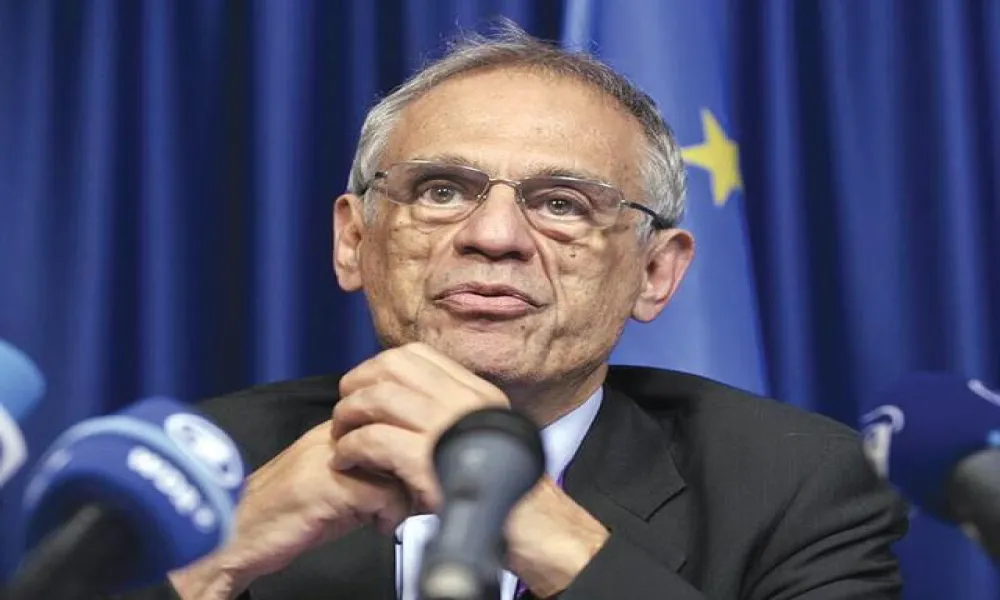
Mistakes by supervisory authorities and the government of former president Demetris Christofias led Cyprus into the severe economic crisis that preceded the 2013 deposit “haircut”, according to economist and former finance minister Michalis Sarris.
In an interview with Politis marking 13 years since the bail-in, Sarris reflects on the events leading up to the decision, the negotiations at the Eurogroup, and the stance taken by Cyprus’s parliament.
Everything that could go wrong, went wrong
Asked how Cyprus ended up imposing losses on depositors, Sarris described the crisis as “a perfect storm”, noting that “everything that could go wrong, did go wrong”.
Following Cyprus’s entry into the eurozone, he explained, the country benefited significantly—but failed to account for the risks. The banking sector expanded rapidly, with deposits and lending surging. Between 2000 and 2010, deposits multiplied, driven largely by foreign inflows as investors anticipated euro adoption and greater financial stability.
However, after 2008—amid the global financial crisis—Cyprus “lost its way” fiscally, Sarris said. He noted that the outgoing government of Tassos Papadopoulos had left behind a strong fiscal surplus and reduced public debt from around 70% to below 50%. He attributed subsequent fiscal slippage not only to the global downturn but also to the policies of the Christofias administration, stressing that national policy should have adapted to changing conditions.
The contentious Russian loan
Sarris argued that earlier corrective measures could have resulted in a far milder support programme as early as 2011 or even mid-2012. He also criticised the lack of cooperation with European institutions at the time, describing it as neither open nor sincere.
He added that the €2.5 billion Russian loan ultimately delayed necessary action, as it reduced the urgency for reforms. Cyprus had developed close ties with Russia—historically, ideologically, and financially—which contributed to reliance on Russian funding.
Sarris also blamed inadequate supervision, excessive lending—particularly in the construction sector—and risky investment decisions by banks, especially their exposure to Greek government bonds despite clear warning signs. “Banks were not properly supervised and were allowed to make unwise investments, which proved very costly,” he said, adding that warning signals had appeared much earlier but were ignored.
'No longer welcome'
He further described as a mistake parliament’s rejection of an initial compromise involving a horizontal haircut—6.75% on deposits under €100,000 and 9.9% above that threshold—arguing that at the time Cyprus was isolated within the European Union and had “zero credibility”.
Reflecting on his resignation in April 2013, Sarris said that following the appointment of the Pikis investigative committee, it became clear that political distance was needed between the bail-in decision and the government. As a technocrat rather than a party figure, he felt his position had become untenable.
“You understand without being told,” he said. “I felt my presence was no longer particularly welcome.”
Addressing those affected by the bail-in, Sarris said the initial Eurogroup agreement had been a better solution, but was rejected by elected representatives. He stressed that the roots of the crisis lay much earlier and described the outcome as unavoidable, though unfairly borne by a limited group. He expressed hope that compensation could still be considered where possible.
Looking ahead, Sarris acknowledged that banks have made significant progress under stricter supervision but said further improvements are needed, particularly in reducing non-interest charges. He suggested the Central Bank should signal expectations informally regarding bank practices, even if it cannot directly intervene.
He also raised concerns about high salaries in the banking sector, arguing that linking pay more closely to productivity would improve efficiency and customer service.
The full interview can be seen in Greek in the podcast "Eyes on the Economy" (Ματιά στην Οικονομία).