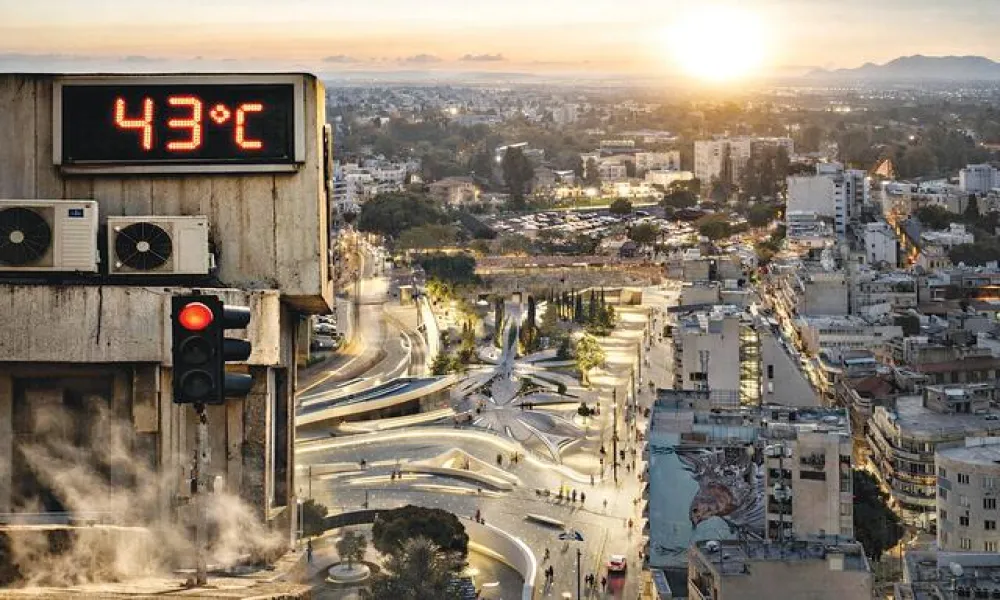
Urban heat islands are increasingly affecting quality of life in cities, as climate change and ongoing urbanisation intensify the problem.
“The large volume of concrete, asphalt and the lack of green space result in higher temperatures inside the city than outside,” said MP Charalambos Theopemptou, speaking to Politis, describing a phenomenon most citizens experience without necessarily naming it.
As Dr Paris Fokaides, professor at the School of Engineering at Frederick University, explains, “the urban heat island is a microclimatic phenomenon in which air and surface temperatures in urban areas are consistently higher than in neighbouring suburban or rural zones,” placing a scientific framework around an increasingly familiar experience.
Heat in Cypriot cities is no longer simply a seasonal issue, nor solely a consequence of climate change. It is also the result of specific choices in how cities have been built and developed. The phenomenon, as documented by the United States Environmental Protection Agency, is linked to the absorption and re-emission of heat by built surfaces such as roads and buildings, which replace natural landscapes and limit natural cooling through vegetation.
Trapped heat
Globally, according to the World Resources Institute, the number of days with temperatures above 35°C has increased by 25% since the 1990s. Heat is also unevenly distributed within cities, with more vulnerable areas experiencing higher temperatures.
This highlights that extreme heat is not only an environmental issue but also a social one, as it affects communities differently depending on infrastructure and living conditions.
In Nicosia and other Cypriot cities, this pattern is becoming increasingly evident. Neighbourhoods with greenery and shade maintain lower temperatures, while areas dominated by concrete and asphalt act as heat hotspots. The differences are especially noticeable in the evening and at night, when heat absorbed during the day remains trapped in the urban environment.
Cape Town example
The case of Cape Town illustrates both the intensity and inequality of the phenomenon. Measurements taken in 2024 showed temperatures in the densely built city centre reaching 41.6°C, while greener areas did not exceed 25°C, according to the World Resources Institute.
Significant variations were also observed between neighbourhoods, with poorer areas often considerably hotter than wealthier ones. This turns heat into an issue of inequality, as residents in areas with less greenery and weaker infrastructure are more exposed to extreme temperatures.
A vicious cycle
Nicosia is no exception. The contrast between green areas and densely built zones is clear. Parks and open spaces act as cooling pockets, while other areas record significantly higher temperatures, confirming that urban form directly affects the microclimate.
The capital’s inland location exacerbates the problem. With prolonged periods of high temperatures, the need for cooling is constant.
“To live comfortably under these conditions, air conditioning is necessary, and the higher the external temperature, the higher the energy consumption,” said MP Theopemptou.
Delays in adopting effective insulation measures, combined with high temperatures and long summers, contribute to rising levels of energy poverty, as households struggle to meet increased cooling demands.
The result is a vicious cycle: higher temperatures drive increased energy use, which in turn places further strain on the environment, worsening the problem.
Microclimatic Pressures
Dr Fokaides explains that the phenomenon stems from changes in the city’s energy balance, due to widespread coverage by impermeable, heat-retaining materials, reduced evapotranspiration, limited shading, and additional human-generated heat from transport, buildings and technical systems.
In Cyprus, urban heat islands are often more intense due to the dry, hot climate, limited vegetation and low forest coverage in urban areas — among the lowest in Europe.
With summer approaching and temperatures expected to rise further, the issue also takes on a strong energy dimension, increasing demand for cooling, placing pressure on the electricity system and driving up energy costs, particularly in a country heavily dependent on energy imports.
Research and solutions
According to Dr Fokaides, two major studies on urban heat islands have been conducted in Cyprus, in 2010 and 2023.
The earlier study focused on recording, observing and mapping the phenomenon. By 2023, advances in scientific tools — including geospatial systems, digital twins, big data and artificial intelligence — have made it possible to develop predictive models and support decision-making for targeted interventions.
These include the placement of green infrastructure, the use of “cool” materials with lower solar absorption, and the implementation of green roofs.
Such combined environmental and urban planning approaches are already being applied in cities like Los Angeles, with measurable reductions in temperatures in heat-prone areas.
Tokyo has installed more than 200 kilometres of “cool pavements” — surfaces designed to reflect solar radiation — with plans to expand to 245 kilometres by 2030.
Singapore, meanwhile, stands out for its environmental planning, with more than 40% green coverage in its urban fabric and a goal of ensuring all residents live within a 10-minute radius of a park. It has also significantly reduced car traffic, helping to lower both heat and emissions.
Other cities are incorporating water features such as fountains and artificial lakes to enhance cooling, while “cool roofs” — which reflect 60–90% of solar radiation — are also being adopted to reduce heat absorption in buildings.
This article was originally published on the Greek-language Politis website.