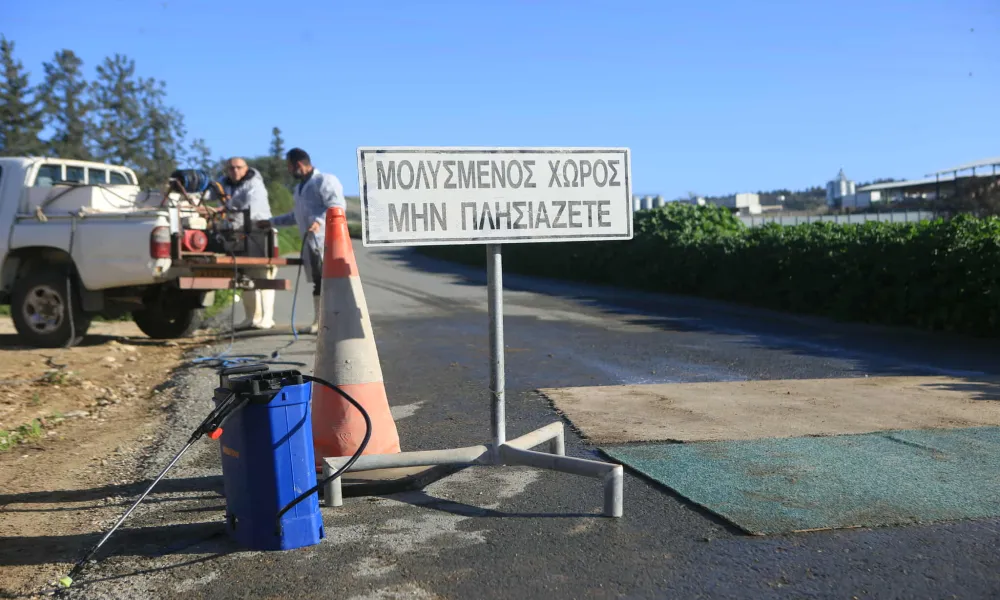
Foot-and-mouth disease (FMD) is taking on worrying proportions, with authorities now seeking to determine what went wrong in pig farming after the virus spread rapidly and reached a major pig unit in western Nicosia.
The number of livestock units infected with FMD has now reached triple figures, according to the latest announcement by the Veterinary Services of the Ministry of Agriculture, Rural Development and Environment. Based on the latest data, the total number of infected livestock units has now reached 101.
Specifically, infections involve 13 cattle units (nine in Larnaca and four in Nicosia); 86 sheep and goat units (62 in Larnaca and 24 in Nicosia); and two pig units in western Nicosia, in the Paliometocho area.
The discovery last Wednesday of the first positive case at one of the island’s largest pig farms, with a capacity of 4,000 animals, led to the creation of a third infected zone and heightened concern among Veterinary Services.
The detection of the case in Paliometocho, coupled with the infection of pigs and the start of culling operations on Thursday, surprised veterinary authorities, who said they are deeply concerned about the way the crisis is evolving.
“It is puzzling. One would have expected to find a case in a pig unit within three or ten kilometres of the other infected areas in Nicosia and Larnaca,” senior veterinary officer Sotiria Georgiadou told Alpha TV on Wednesday.
She said an epidemiological investigation is under way, noting that the units in the area are relatively isolated. “It raises questions why this happened. It could be the human factor or mechanical transmission, such as vehicles or other materials. It is similar to what we saw during Covid, when lockdowns were announced but not everyone complied. Someone who was slightly ill would go somewhere and infect others. Something like that must have happened,” she said.
Georgiadou added that the virus was found to be active, which further alarms Veterinary Services. “It means the infection happened recently,” she said.
Gaps in controls
The president of the Pancyprian Pig Farmers Association, Petros Kailas, said that at this stage any explanation remains speculative. Speaking to CNA, he stressed that there is no process for transporting pigs from the north, making it unlikely that the virus was introduced from the occupied areas.
He said the most likely scenario is insufficient care and thorough disinfection of livestock traders’ vehicles during the transport of lambs and kids to meet Easter demand. According to Kailas, vehicles that transported small ruminants may then have collected pigs from the affected unit, inadvertently spreading the virus.
Culling of pigs began on Thursday. Georgiadou said the process is even more difficult than culling cattle or sheep and goats. “I want to believe that, because we are still at an early stage with pigs, the outbreak will be contained there,” she said.
Meat market affected
Efforts to control the disease have heavily affected the meat market, both in terms of supply and distribution and, above all, consumer psychology. Consumers have reduced meat purchases by about 20 percent, a decline that was evident during the Easter market for lamb and goat meat.
CNA was told this by the president of the Butchers Association, Costas Leivaditis, who expressed strong concern about the spread of the virus to pig farming units. He said that despite lower slaughter volumes, unsold carcasses remain on the market.
“Sales of lamb and goat meat, especially on Holy Saturday, were disheartening,” he said.
Asked whether consumers turned to imported meat to ease concerns over domestic products, Leivaditis said routine meat imports are unrelated to local supply, noting that there is sufficient domestic production. He added that pork meat is currently in surplus and that the real problem lies in consumer fear. “Even though the virus poses no risk to humans, it affects psychology,” he said.
Cheesemakers raise concerns
Concerns that continued culling of dairy animals could reduce milk availability were voiced by Michalis Koulouros, executive secretary of the Cyprus Cheesemakers Association. He said the association’s main priority is protecting halloumi production and exports.
He described developments in the management of foot-and-mouth disease as worrying and said the association remains in constant contact with the competent state authorities and stands ready to take any action required by cheesemakers.
Focus on containment
Georgiadou reassured that, at this stage, stocks of milk and meat and the overall livestock population remain manageable. She said that so far 2.6 percent of cattle and 6.6 percent of sheep and goats have been culled.
“The key objective is to contain the spread of the virus in pig farming,” she said, stressing that pigs excrete larger quantities of the virus and spread it more intensely. For this reason, she added, it is crucial that the outbreak is confined to the specific area and does not spread further.