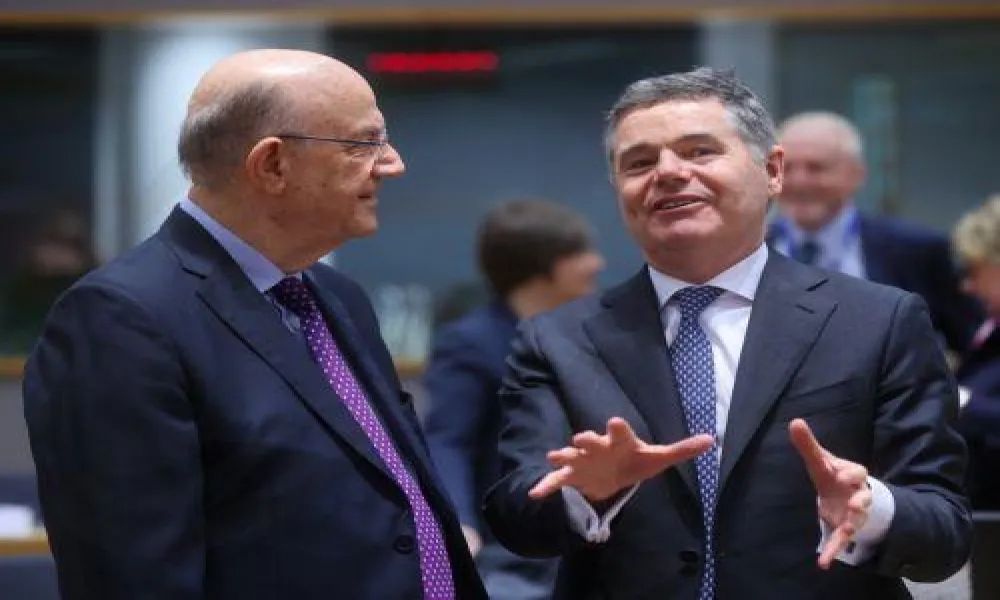

Strengthening the Union’s financial autonomy will take fast lane on the Cyprus Presidency ECOFIN leadership, as Nicosia heads out the Council striving towards a path of raising long term competitiveness and productivity, coupled with securing viable and inclusive development. As outlined by President Christodoulides in Lefkara last week, an ‘Autonomous Europe’ is the centre stage thematic of the country's Presidency.
Cyprus efforts will focus on close monitoring and coordination of national financial and fiscal policies, as well as a smooth exit from the age of the Recovery and Resilience Fund that has now come full circle.
The commitment over the next six months is towards supporting a comprehensive and effective implementation of the new financial governance framework, emphasising fiscal discipline but also the need to push for investment funding that’s connected to defence, green and digital transition. What’s of particular weight here is the request to activate national escape clauses on additional defence spending, with Nicosia called upon to operate as an ‘honest broker’ between countries with different, varying fiscal resilience.
A Savings and Investments Union
One of the most ambitious Cyprus Presidency ECOFIN priorities is to speed up the so-called Savings and Investment Union, ambitiously looking to pipeline European savings towards productive investments inside the Union. The Nicosia goal here is to push for measures raising capital market effectiveness, by simplifying the rules but also keeping the investors protection wall high and sturdy.
Yet another critical axis is strengthening competitiveness and unifying the European banking sector, by cutting down on fatty regulatory and administrative burdens, without undermining monetary stability.
There are packages to choose from at the table, such as the Retail Investment Strategy, FIDA-the data access-and promoting the Securitisation agreements, all ways of boosting funds for small and medium sized businesses as well as smaller economies.
Taxation
In the field of taxation policy, the Cyprus Presidency priority is the ‘simplifying and declogging’ of European taxation legislation, as the EU is seeking a balance between boosting business competitiveness and securing adequate public income. The work schedule refers to a new ‘omnibus’ package that will streamline direct taxation legislation, cutting down motivation for aggressive taxation planning both inside and beyond the EU.
When it comes to indirect taxation, Nicosia is taking the mantle of pushing forward negotiations on revising the VAT administrative cooperation directive, as well as changes in regulations on distance sales of imported goods, aimed at plugging holes which favour loss of income and unfair competition.
But the big test is managing the technical and political backlog around the Coal Border Adaptation Mechanism (CBAM), where balance is needed between ambitious climate protection goals and analogous consequences to the EU industrial base.
Nicosia is also committed towards combatting tax evasion and damaging taxation competition through frequent updates of the non cooperative jurisdictions ‘black list’.
Also on the same horizon, is the need to start work on revising the direct taxation administrative cooperation directive, aimed at more effective exchange of information and improved implementation.
Importantly, Cyprus will further seek a political deal on a new customs code and the establishment of a European Customs Authority, a response to rising geopolitical tensions, supply chain turbulence and single market protection purposes.
The European Budget
Negotiations on the long term 2028-2034 EU budget will be top of the pile. Even though main jurisdiction for the new Long Term Fiscal Framework lies with the General Affairs Council, the ECOFIN is called upon to fast track the more technical aspects. Nicosia wants to speed up the resources and performance framework reform as much as possible, so the EU can enjoy a stable, more autonomous taxation base that will be directed towards funding its priorities.
Ukraine financial support
At the ECOFIN table, the Cyprus Presidency is tasked to monitor the Ukraine loan implementation process as well as promoting new legislative proposals for the long-term funding of the war ravaged country’s reconstruction. This is a credibility test, both for European solidarity as well as the Union’s ability to use innovative funding tools without breaking down balances between member states.
Over the next six months, the ECOFIN will continue to evaluate the Ukraine war financial repercussions, look to escalate sanctions against Russia and Belarus, as well as examine second tier repercussions on the European energy, capital and trade markets.
Financial Security
This involves the discussion on the Financial Security Strategy. Nicosia must guide the on going debate on the need to protect the EU from supply chain bottlenecks, technology leaks and weaponised depencies, usig tools such as investment controls, through to targeted trade policy measures.