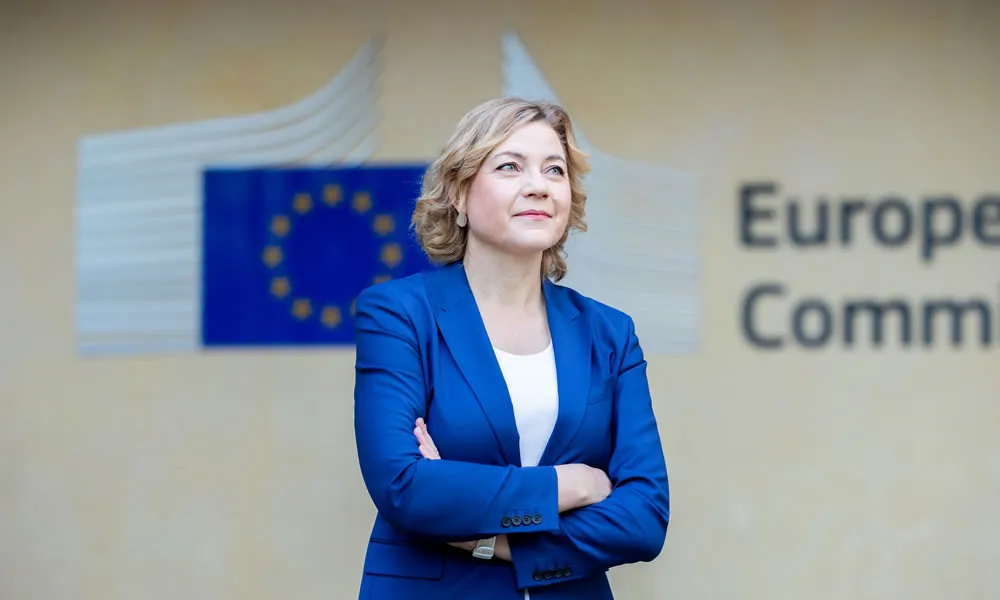

From cyberattacks on critical infrastructure and AI-driven disinformation to foreign interference in elections and growing pressure on independent media, the European Union is facing an increasingly complex digital threat landscape. In this interview with Politis to the point, European Commissioner for Tech Sovereignty, Security and Democracy Henna Virkkunen outlines how the Commission plans to respond, warning that cyber threats in one member state can quickly become a risk for the entire Union.
She details forthcoming measures to strengthen cybersecurity resilience, including a revised Cybersecurity Act and an expanded role for the EU’s cybersecurity agency, ENISA, while also addressing hybrid threats targeting democratic processes.
Virkkunen explains how new EU tools such as the Digital Services Act, the AI Act and the European Democracy Shield aim to protect elections, counter disinformation and support media freedom, as Europe seeks to defend its democratic systems while navigating rapid technological change.
On AI regulation and the pursuit of strategic autonomy, Virkkunen explains why “innovation-friendly” rules and investment – from AI factories to skills academies – are central to Europe’s push for competitiveness, and highlights Cyprus-specific initiatives such as Pharos-CY and the DiGiNN Digital Innovation Hub.
Interview with the European Commission’s Executive Vice-President for Tech Sovereignty, Security and Democracy Henna Virkkunen
Digital security and hybrid threats
Cyber threats are evolving rapidly, impacting everything from critical infrastructure to democratic processes. How is the Commission enhancing cybersecurity resilience across the EU, and what role can national authorities and private sector partners play in this strategy?
Indeed, as we look ahead in 2026, the rapidly evolving landscape of cybersecurity presents both anticipated and unforeseen challenges. In this complex environment, we are actively enhancing cybersecurity resilience across the EU by taking new actions and implementing our comprehensive framework. A cybersecurity threat in one Member State is a threat to all. That is why we collaborate with Member States, private sector partners, academia, and civil society.
To address anticipated threats, the Commission is focusing on scaling up existing cybersecurity measures and modernising current policies. We are embracing new technologies like AI for threat detection and response, securing supply chains, and safeguarding critical infrastructure. We also introduced a single-entry point where companies can meet all incident-reporting obligations in November 2025 and we will provide clearer and simplified guidelines to help companies comply with cybersecurity regulations and risk management standards.
The Commission also supports the Cyber Resilience Act, our plan to make sure all digital products are safe from cyber threats and the NIS2 directive, setting high, shared cybersecurity standards to protect our essential services. However, our cybersecurity resilience is not limited to anticipated threats alone.
We must also be prepared for unforeseen threats such as data integrity attacks against AI systems and convergence of cyber incidents with other crises like energy shortages.
To address these risks, we will be proposing a revised Cybersecurity Act on Tuesday (20 January 2026). The EU must take forceful action now to secure its supply chains, to give consumers confidence in the cybersecurity of the products and services in the EU, and to build up its societal and economic resilience.
ENISA, the EU Agency for Cybersecurity, will be reinforced and play a key role in supporting Member States and the EU in managing cybersecurity threats.
National authorities also play a crucial role in translating EU-wide initiatives into localised action. They are encouraged to implement EU guidelines and regulations, tailor them to regional contexts, and ensure their effective enforcement. National Cybersecurity Centres act as hubs for threat intelligence sharing and response coordination, aiding in the containment of incidents that transcend borders. In Cyprus, the Digital Security Authority fulfils this mission.
Private sector partners are indispensable in these efforts. They provide innovation, agility, and technological expertise essential for combatting rapidly changing threats. We encourage cooperation with industry leaders and startups alike to develop groundbreaking solutions, streamline security protocols, and integrate best practices across sectors.
The EU aims not only to anticipate and mitigate cybersecurity threats but also to strengthen its resilience against them.
With elections increasingly targeted by foreign interference, what concrete tools will the EU deploy to protect democratic processes, particularly in smaller and more vulnerable member states?
In Europe, we are facing a growing range of threats when it comes to elections, from foreign interference and coordinated disinformation campaigns central to hybrid warfare. These threats are evolving rapidly. And they can affect Member States big or small. Generative AI has transformed the landscape of influence, enabling hyper-realistic deepfakes and automated, personalised disinformation campaigns deployed at an unprecedented scale. These campaigns often intensify in the run-up to elections, posing a particular threat to our democracies.
We have built up strong enforcement tools to protect the information environment in the EU, with regulatory initiatives such as the Digital Services Act (DSA) – including its Code of Conduct on Disinformation – the AI Act, and the European Media Freedom Act. Large online platforms have a particular responsibility in the EU: when they present risks to public debate or elections, they must act and implement measures to reduce these risks.
Furthermore, recognising that protecting our democracies requires a whole-of-society effort, we also support those who strengthen the quality of information: journalists, researchers, fact-checkers, and media literacy actors. And above all, we want to strengthen the citizens themselves, developing their critical thinking and helping them learn how to verify information and take a step back from viral content.
This is our intention behind the European Democracy Shield presented in November 2025. The initiatives outlined under the Democracy Shield aim to help us better understand informational threats, protect elections and independent media, and strengthen media literacy for all audiences. Because manipulation can affect everyone. And because strong democracies rest on informed citizens.
The proposed European centre for Democratic Resilience, part of the Democracy Shield, will ensure that no Member State is left as a ‘weak link’. Working together will strengthen all of our democracies. In addition, the new European Network of Fact-Checkers project aims to ensure that high-quality fact-checking capacity is available in all EU languages and across all Member States, specifically targeting regions where coverage has been insufficient.
Finally, the Democracy Shield announced an update to the Election Toolkit under the DSA, which we will carry out together with the independent advisory group of Member States’ Digital Services Coordinators, which also includes Cyprus Radio Television Authority, bringing in relevant experience from recent elections.
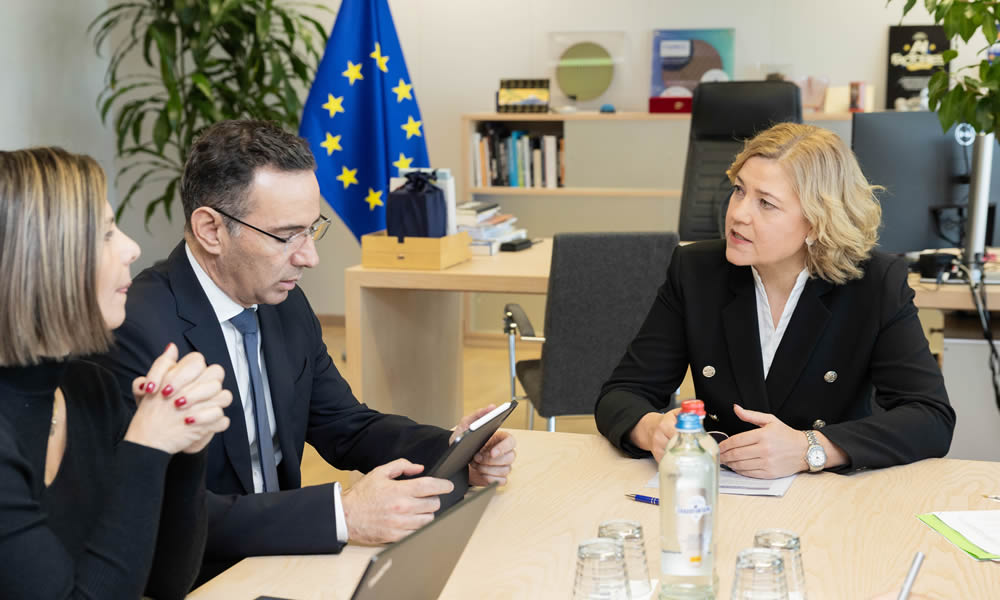
Commissioner Virkkunen met with Nicodemos Damianou, Cypriot Deputy Minister
for Research, Innovation and Digital Policy in Brussels last month
What is needed to protect and advance the role of independent media and journalistic integrity in safeguarding European democratic systems?
Strengthening the visibility of the EU media content and further supporting the economic viability of the media sector is one of the Commission’s priorities, as highlighted in the recent European Democracy Shield.
Last year marked a significant milestone as the European Media Freedom Act (EMFA) entered into application – the first-ever EU law to safeguard the independence of the media. The Commission has taken several steps to facilitate the implementation of EMFA, from close contact with Member States as they prepare to continued engagement to support effective implementation.
Moreover, this year Commission will evaluate and review the Audiovisual Media Services Directive (AVMSD). Among other things, this involves assessing ways to strengthen the prominence of media services of general interest and modernise advertising rules with a view to foster the sustainability of EU media.
In this context, and as underlined by the European Democracy Shield itself, we will maintain an active dialogue with relevant industry players and civil society organisations to ensure that the safeguards and mechanisms provided by our EU media laws, both under EMFA and AVMSD, are effectively applied across the EU.
AI regulation vs innovation
The EU has been at the forefront of shaping AI regulation, including the recent Artificial Intelligence Act. How do you balance the need to protect citizens and fundamental rights with the desire to foster innovation and competitiveness in the European tech sector?
The EU strives to balance the protection of citizens and fundamental rights with the need to foster innovation and competitiveness in strategic sectors. This is reflected in our approach to AI policy making, built on trustworthiness, competitiveness and sovereignty.
Adopting the AI Act was a major achievement for the EU, and marked a world first in outlining a comprehensive framework for a safe, trustworthy and innovation-friendly approach to this technology.
As you rightly mention, the AI Act is pivotal in ensuring that AI systems available on the European market are both safe and trustworthy. By imposing certain obligations depending on risk levels of AI systems to all providers in the EU, we are creating an ecosystem of trust, ensuring citizens are safe when interacting with AI technologies. At the same time, the AI Act is an innovation-friendly regulation that provides legal certainty for industrial actors in the EU, creating the right conditions for the development of a successful European AI ecosystem.
The effective implementation of the AI Act is now a top priority for me and the European Commission. That’s why, when we saw businesses facing additional implementation challenges, we proposed some simplification and timeline adaptations in the Digital Omnibus on AI. These will reduce costs and burdens on businesses, making implementation easier, without softening our safeguards.
Complementing the AI Act, the AI Continent Action Plan announced in April 2025 serves as our strategic roadmap to cultivate a thriving environment for AI innovation. It focuses on five critical dimensions for successful AI development and deployment: infrastructure, data, skills, regulatory facilitation and AI uptake.
The Action Plan is designed to encourage experimentation, foster collaboration, and allocate resources to European AI companies, aiming to leverage €200 billion to boost AI development in the EU.
One example of direct results of the Action Plan is the 19 AI Factories across Europe providing supercomputing infrastructure to train and deploy advanced European AI models.
These are complemented by AI Factory antennas, like Pharos-CY in Cyprus, which aims to accelerate the development and adoption of trustworthy, high-impact AI solutions in key sectors such as health, sustainability, as well as culture and language. It will be linked with the Pharos AI Factory in Greece including access to the Daedalus supercomputer.
And, AI Gigafactories will supercharge these sovereign computing capacities in the future.
The most recent piece of our AI puzzle is the Apply AI Strategy, announced in October, which presented our plan to bridge the offer of AI solutions with the needs of strategic sectors, such as healthcare, mobility, manufacturing, defence, and beyond, and therefore enhance both our competitiveness and sovereignty.
The strategy includes 70 targeted measures to accelerate AI adoption across 10 key industry sectors and the public sector. It encourages an ‘AI first policy’ where AI is considered as a potential solution whenever organisations make strategic or policy decisions, taking into careful consideration the benefits and the risks of the technology. It also promotes a ‘buy European’ approach, particularly for the public sector, with a focus on open-source AI solutions.
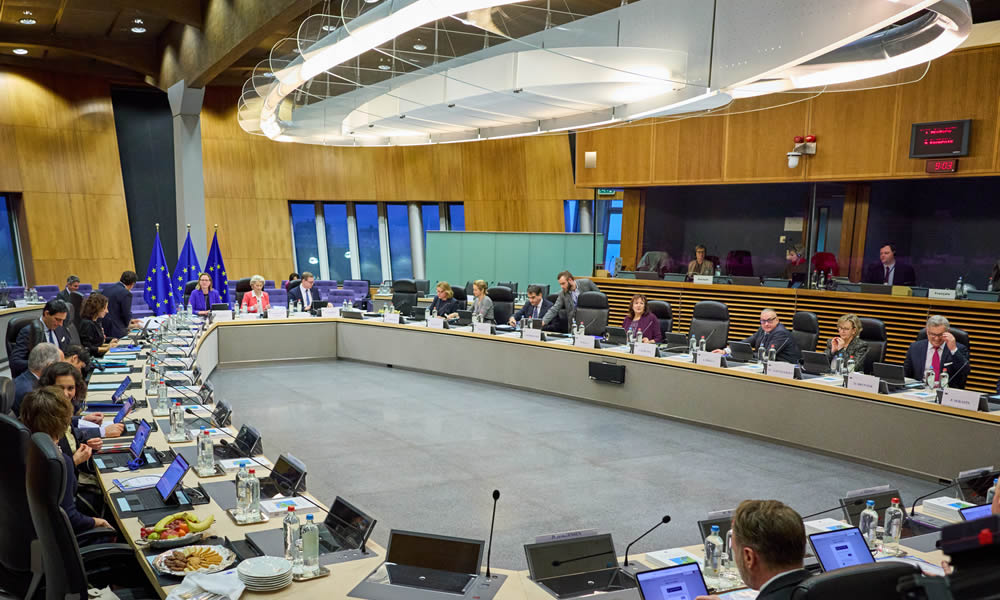
Meeting of the College of the European Commission in Brussels last week.
Strategic autonomy and global partnerships
What can Europe do to accelerate digital innovation and become competitive with the big US firms currently dominating the digital lives of EU citizens?
Europe has a strong innovation legacy. But right now, we are lagging behind which is why I have led new initiatives to unlock our potential and build our competitiveness on a global stage.
We cannot mention innovation and competitiveness without talking about AI. Here, we need to support all parts of the value chain, strengthening our research capacities, upgrading our computing infrastructure, helping small and medium-sized enterprises and startups as they scale and, above all, supporting companies as they adapt to AI technologies.
There is a huge competitiveness potential in the integration of AI in core business processes of strategic sectors, and this is in part what we are aiming to secure through the AI Continent Action Plan and the Apply AI strategy. Together, these guide our work and provide both the means and coordination needed for companies to benefit from the technologies we already have and for European AI startups to scale and become leaders in specific application domains.
Another important element of building our competitiveness is investing in our people. To maintain our world-class research and development and translate this to real world applications, we need to grow our digital skills talent pool. This is not just about training people, but about retaining the talent we have, and becoming a magnet for students, researchers and professionals skilled in the digital field.
The Commission has already launched several initiatives that put skills at the centre: the Union of Skills, the AI Continent Action Plan, the Quantum Strategy, the Apply AI Strategy.
Meanwhile, the Digital Europe Programme has enabled us to fund Skills Academies in AI, quantum, virtual worlds, semiconductors, and cybersecurity, all of which are pivotal to ensuring the best training offers and collaboration between academia and business to equip EU students, researchers and workers with the digital skills sets needed not just to keep pace with the digital transition, but to lead it.
Finally, the EU Startups and Scaleups Strategy highlights attracting and retaining the best talent, including digital talent, amongst its key actions to make the EU the best place in the world to launch and grow technology-driven innovative companies.
Digital transformation
Digitalisation can widen inequalities if skills and access are uneven. What strategies is the EU implementing to ensure that citizens and businesses– especially SMEs – across all member states, including Cyprus, can fully participate in and benefit from the digital transformation?
My vision for the digital transition is one that brings everyone along with it, no matter where they are in the EU, no matter if they are a big, established business or just getting started. This is a vision also reflected in our digital rights and principles, which stresses the EU’s commitment to a digital transformation that leaves nobody behind.
In the EU, we are taking action to ensure this becomes reality. For example, a prerequisite for a flourishing digital economy and society in the modern world is a cutting-edge digital infrastructure. This is why we will soon propose the Digital Networks Act, which will modernise the legal framework and boost innovation and investment in resilient and advanced fibre and 6G networks. And to ensure that consumers, citizens and businesses can fully benefit from this, we will propose measures to accelerate the transition to full fibre, in close cooperation with Member States.
We are also working to ensure everyone has the right digital skills to participate and benefit from digitalisation. The Digital Decade Policy Programme set ambitious targets for this – and we still have some way to go. To help us advance in this area, the Commission is investing in developing advanced digital skills in cutting-edge technologies to fill the EU digital skills gap and ensure business, especially SMEs, do not struggle anymore to recruit the digital talent they need.
Alongside this investment, the Commission will propose a 2030 roadmap on the future of digital education and skills, guiding our action as we build more inclusive, resilient and future-ready education systems.
Furthermore, we have over 250 European Digital Innovation Hubs like DiGiNN in Cyprus, funded by the Digital Europe Programme. These hubs support organisations to respond to digital challenges – in particular AI adoption – and to become more competitive throughout Europe. These hubs offer services in local languages, providing companies with technical and financial help as well as training.
In addition, the AI Skills Academy that I mentioned previously will be essential in reskilling and upskilling students, workers and the wider population as we adapt to new professional realities heralded by AI technologies. This Academy will be accessible via the Digital Skills and Jobs Platform, which already provides a wide range of high-quality information, resources and opportunities in the area of digital skills and jobs across all levels, from very basic to advanced.