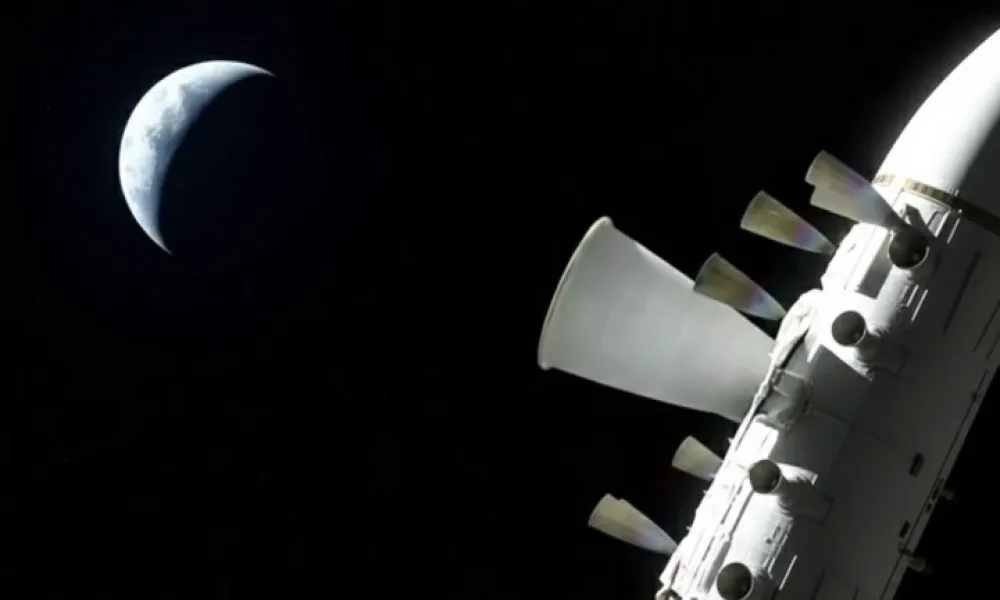

The Orion spacecraft carrying the four-member Artemis II crew is scheduled to splash down in the Pacific Ocean approximately 100 kilometres off the coast of San Diego at 3:07am Cyprus time on Saturday, completing what has been the farthest human journey from Earth in history.
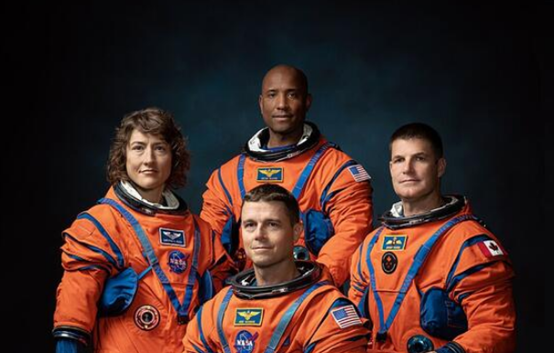
Commander Reid Wiseman, pilot Victor Glover, mission specialist Christina Koch, and Canadian Space Agency mission specialist Jeremy Hansen lifted off from Kennedy Space Center in Florida on 1 April and travelled farther from the planet than any human before them. Over ten days and 695,000 miles, the crew completed a lunar flyby that gave humanity its first close look at the Moon's far side in more than half a century.
The moment that counts
Before any of that can be celebrated, the crew must survive re-entry. As Orion blazes back into the atmosphere, the heat shield will be subjected to extreme temperatures caused by friction approximately 75 miles above Earth, with exterior temperatures soaring to around 3,000 degrees Fahrenheit (roughly 2,760 degrees Celsius). During that phase, communications with the crew will be temporarily lost as superheated plasma builds around the capsule. A series of parachute deployments will then slow the craft from around 300mph to 130mph and, finally, to 17mph for splashdown. The whole descent from atmospheric entry to ocean is expected to take approximately 14 minutes.
A heat shield never tested like this
The Avcoat heat shield protecting the crew, a composite of silica fibres set into an epoxy resin matrix across around 180 individual blocks, carries unresolved questions into this re-entry. During the uncrewed Artemis I mission in 2022, Orion's heat shield lost chunks of material, suffering far more damage than NASA's preflight models had predicted. Engineers determined that gases generated inside the Avcoat were unable to vent and dissipate as expected, causing pressure to build and charred material to break off in several locations.
Rather than replacing the heat shield for Artemis II, NASA modified the reentry trajectory by increasing the descent angle, reducing the time the spacecraft would spend in the thermal environment associated with the damage. The block design was also updated to allow gases to escape more readily. Even so, Orion programme manager Howard Hu acknowledged that some abnormal heat shield behaviour remained possible: "You will potentially see some char loss, so it's not zero."
Charles Camarda, a former astronaut and heat shield specialist who flew on the first mission after the Columbia disaster, has continued to object to flying the mission without a redesigned heat shield. Critics have drawn comparisons to the institutional complacency that preceded the Challenger and Columbia tragedies. NASA has pushed back firmly, with Administrator Jared Isaacman stating in January that the agency had applied rigorous analysis and testing at every step and was moving forward with confidence.
Crucially, Artemis I's heat shield did not fail: there was plenty of Avcoat remaining after splashdown, and data collected inside the capsule showed that internal temperatures stayed within normal limits throughout re-entry.
Once Orion reaches the water, recovery teams will retrieve the crew using helicopters and deliver them to the USS John P. Murtha, where the astronauts will undergo post-mission medical evaluations before travelling to NASA's Johnson Space Center in Houston. The USS John P. Murtha left its home port at Naval Base San Diego for the recovery site on 7 April.
Sources: NASA, National Geographic, NBC Los Angeles