
Why Fujairah matters
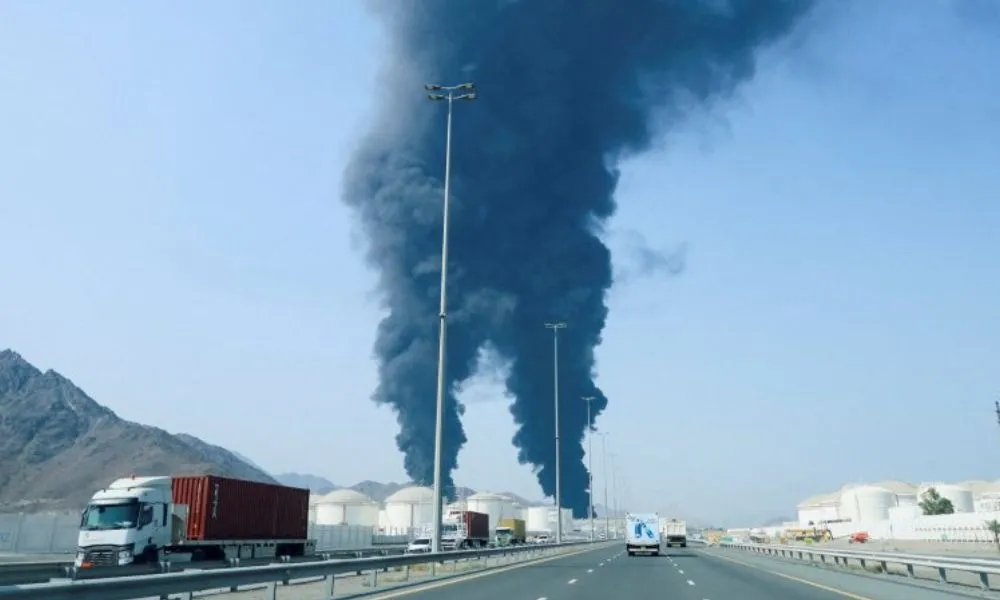
The oil facilities of Fujairah, located on the eastern coast of the UAE, are of critical importance to the global energy market. The port lies outside the Persian Gulf, on the Gulf of Oman, and serves as a major hub for oil storage, bunkering and exports.
Its strategic value lies in the fact that it is linked to Emirati pipelines that bypass the Strait of Hormuz, the region’s most vulnerable maritime chokepoint.
For this reason, any attack or fire near Fujairah immediately takes on international significance. It affects not only the UAE, but also maritime security, global oil prices and the ability of Gulf states to continue exports even in the event of a full‑scale crisis in the Strait of Hormuz.
Not only a message to Washington
Within hours of the Iranian strike, multiple sources reported heightened military mobilisation among Arab Gulf states against Iran. During the previous phase of the conflict, the United States had sought to reassure Saudi Arabia and its Gulf allies that the crisis would remain manageable, with Washington guaranteeing that Tehran would be defeated and made to pay a price.
This time, however, a new strategic actor appears to be emerging in the conflict. Gulf states possess advanced military capabilities and significant force projection, and their potential involvement would reshape the balance of any renewed confrontation.
Why Iran is choosing escalation
Since the United States imposed its own blockade alongside Iran’s closure of the Strait of Hormuz, Tehran has found itself at a critical crossroads. Iran’s inability to export its own oil and generate revenue has intensified economic pressure and deepened an internal crisis.
With negotiations stalled and Washington demanding that Iran’s nuclear programme be placed firmly on the table, Tehran appears increasingly inclined to export its crisis outward rather than absorb it domestically.
While US President Donald Trump has maintained a hard line and avoided issuing immediate deadlines, Washington can now argue that it is being drawn into a new confrontation not of its own choosing. The relative silence from the US should not be interpreted as indifference, as the alert has clearly been raised in Washington.
The limits of US options
The United States is not believed to have sought a renewed conflict at this stage, particularly amid reports in the American press of strained weapons stockpiles. A decisive victory over Iran would almost certainly require ground forces on Iranian territory, a scenario widely regarded as highly difficult.
Nevertheless, alternatives appear increasingly limited.
What comes next
The strategic landscape differs markedly from that of a month ago. If the conflict escalates, the number of active participants is likely to grow. Saudi Arabia and the UAE have signalled that they will no longer keep their air forces grounded and may choose direct action despite the risks involved.
Israel, meanwhile, appears intent on avoiding the spotlight. Prime Minister Benjamin Netanyahu is believed to prefer waiting for a signal from Washington, while prioritising the Hezbollah front and domestic political pressures, including elections due by October.
Although Israel retains the capability to strike Iran again, questions remain over its interceptor missile reserves, which rely heavily on US supply. Under these conditions, a limited US response rather than a sweeping operation appears more likely, though any such action would almost certainly be met by a broader Iranian retaliation.
Should Gulf states become directly involved, they would incur economic and military costs they avoided during the initial phase of the conflict, gambling that the final outcome, while costly, would also be decisive.
Source: protothema.gr