
France’s foreign ministry has stepped up its online presence to counter what it describes as a growing wave of disinformation originating from foreign actors, including accounts linked to Russia and the United States. A dedicated English-language account on X, operated by diplomats and fact checkers, has been used to respond directly to claims made by senior US officials, online users, and state-linked narratives.
A new digital response strategy
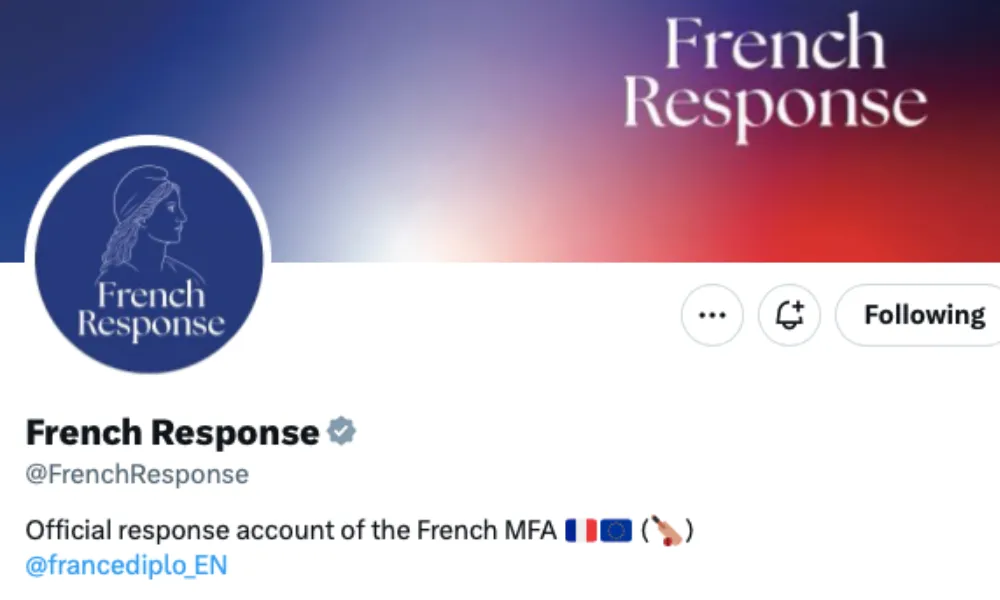
France’s foreign ministry has introduced a more assertive approach to countering online misinformation through its English-language X account, “French Response”. The account is designed to rebut what the ministry considers false or misleading claims about France and Europe circulating on social media.
French-German "tensions" https://t.co/FrbAG4My57 pic.twitter.com/8aVQv8JeMi
— French Response (@FrenchResponse) January 21, 2026
According to foreign ministry spokesman Pascal Confavreux, information has become “a new battleground”. He said the ministry had chosen to “occupy the space by turning up the volume and raising our voice”.
The account, which has been active since September, is run by a team including diplomats, former journalists and fact checkers. It has gained approximately 100,000 followers.
Reaction to comments by US officials
The account drew attention this week after responding to criticism of European culture posted on X by US Secretary of State Marco Rubio. In reply, the account published a comparison table of quality-of-life indicators, stating that the European Union outperformed the United States in areas such as life expectancy and levels of student debt.
The post framed the response as a defence of European living standards, using data rather than extended commentary.
Engagement during global political events
Activity on the account increased as world leaders gathered for the World Economic Forum in Davos. During this period, French President Emmanuel Macron attracted widespread attention after appearing in aviator sunglasses, which his office attributed to a burst blood vessel in his eye.
The president publicly stated that France did not like “bullies”. Media coverage subsequently featured images of Macron in sunglasses, with some commentators comparing his appearance to the fictional character Maverick from the film Top Gun. The “French Response” account referenced this coverage in its own posts.
Another impeccably planned French leave https://t.co/LjWXwN9TlP
— French Response (@FrenchResponse) January 22, 2026
Responses to Russian-linked claims
The account has also addressed claims attributed to Russian sources. In one instance, it responded to an assertion that President Macron had left Davos early to avoid an encounter with US President Donald Trump. French officials stated that Macron had never planned to attend Davos on the day in question.
Russia may be “compelled to use force” to expand its influence. Karaganov, 1992
— French Response (@FrenchResponse) January 27, 2026
“This war has already begun. Our real adversary is Europe.” Karaganov, 2025
When Russian doctrinaires speak Russian versus when they tweet for English-speaking audiences. https://t.co/cD4kSDlHn6
The account replied in English with the phrase “Another impeccably planned French leave”.
Concerns over official use of satire
Experts have cautioned against the use of humour and satire by official diplomatic channels. Ruslan Trad, an analyst at the Digital Forensic Research Lab, said there was a risk that adopting trolling tactics could blur distinctions between democratic institutions and disinformation actors.
He warned that matching the tone of adversarial accounts could lead audiences to perceive equivalence between state institutions and those spreading false information.
Earlier exchanges and symbolic references
Earlier in January, the account reacted to a post by a US user claiming that President Trump would easily take over France after the United States “conquered Greenland and Canada”. The French account responded with a reference to the Statue of Liberty, stating that it had been “spotted swimming back across the Atlantic” and preferred “the original terms and conditions”.
Ask Grok.
— French Response (@FrenchResponse) January 28, 2026
And just to help : Grok is embedded into X, so it falls under the DSA. As simple as that. https://t.co/aat3WP9QN7
The remark referenced the historical gift of the statue from France to the United States in the 19th century.
Source: AFP