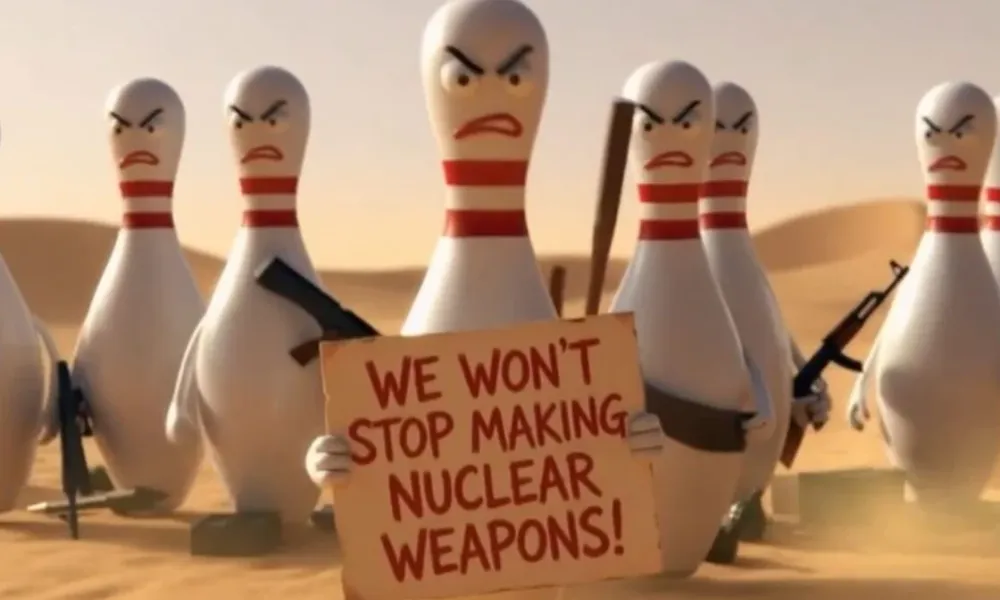

The White House has published a short video online portraying the war involving the United States, Israel and Iran through a striking visual metaphor.
The clip, shared with the caption “STRIKE”, depicts Iranian figures as bowling pins while the United States is represented as a bowling ball that knocks them down.
The imagery suggests that Iran continues to pursue nuclear weapons while the United States delivers decisive strikes against Iranian targets.
After the animated sequence, the video transitions to footage of US military operations showing airstrikes on Iranian sites.
The video ends with the words “The White House – President Donald Trump.”
The clip quickly circulated on social media, with many users describing it as overt wartime propaganda.
Social media campaign intensifies
The video is part of a broader wave of online content highlighting US military operations in the Middle East.
Several clips showing footage of American strikes on Iranian positions have appeared across social media platforms in recent days, presenting the campaign as a series of battlefield successes for the United States and Israel.
The online messaging effort appears aimed at shaping public perception of the conflict as the war enters its second week.
Trump says Iran ‘close to defeat’
Speaking on Wednesday, US President Donald Trump said Iran was “close to defeat” as the war entered its 13th day.
Trump warned that the United States had the ability to strike additional targets inside Iran if necessary.
“We could hit areas of Tehran and other locations,” he said while speaking to reporters after returning to Washington from a trip to Ohio and Kentucky.
“If we do that, it will be almost impossible for them to rebuild,” he added.
Trump said Iran was “close to defeat,” but suggested that military operations could continue until Tehran changes course.
Cost of the war rises
Meanwhile, Pentagon officials have told members of Congress that the cost of the military campaign against Iran exceeded $11.3 billion during the first six days of fighting.
The estimate was presented during a closed briefing on Capitol Hill earlier this week.
According to reporting by The New York Times, the figure does not include several major expenses associated with the buildup of forces and equipment before the first strikes.
Lawmakers therefore expect the total cost to rise significantly as further calculations are completed.
US defence officials previously told Congress that the military used $5.6 billion worth of munitions in the first two days of the war alone.
Earlier estimates from the Center for Strategic and International Studies suggested the first 100 hours of the operation cost roughly $3.7 billion, or nearly $900 million per day.
The growing financial cost has intensified questions in Washington about the long-term objectives, scale and duration of the war.
Sources: Reuters, BBC, PBS