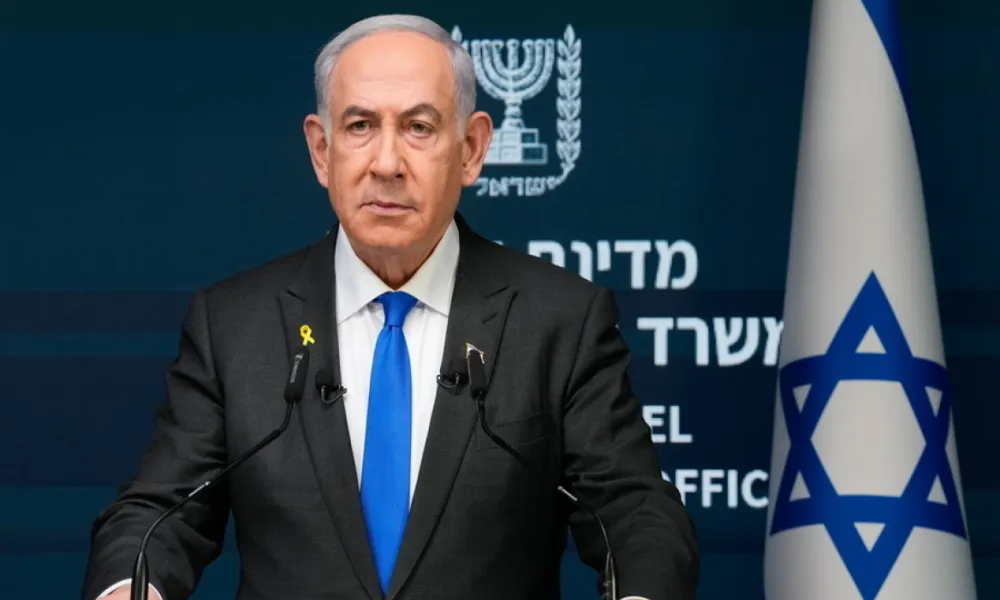
Israeli strikes on Iran have increasingly focused on the country’s internal security apparatus, as Prime Minister Benjamin Netanyahu seeks to weaken the regime’s grip and create conditions for a potential popular uprising.
According to reporting, Israeli operations have targeted command centres and infrastructure linked to forces responsible for suppressing domestic dissent, including units that have previously cracked down on anti-government protests.
Strategy aimed at internal destabilisation
Israel has framed its military campaign as delivering significant blows to Iran’s security system. Netanyahu has argued that weakening these structures could open a path for Iranians to challenge the ruling establishment.
“I’m telling the Iranian people… the moment you can come out for freedom is getting closer,” he said in a recent statement, adding that external support alone would not be enough without action from within.
The strategy reflects a broader objective that has been voiced at various stages of the conflict by both Israel and the United States: creating the conditions for political change inside Iran.
Targeting key figures and institutions
Israeli strikes have reportedly killed senior Iranian figures, including top security officials, while also hitting facilities linked to the Basij militia and the Ministry of Intelligence.
The Basij, a volunteer force affiliated with the Revolutionary Guards, has played a central role in suppressing protests over the years. Israeli officials believe that disrupting its command structure could reduce its operational effectiveness.
US strikes have also focused on the Islamic Revolutionary Guard Corps (IRGC), targeting command and intelligence facilities linked to the regime’s core security network.
Doubts over likelihood of uprising
Despite the strategic rationale, analysts remain divided over whether such a plan could lead to a meaningful internal revolt. Some former Israeli military officials argue that Iran’s internal security system remains too entrenched and resilient to collapse under external pressure alone.
Others suggest that even if the chain of command is disrupted, a popular uprising would still depend on broader social and political conditions inside the country.
“There’s enormous dissatisfaction with the regime,” one analyst noted, but warned that fear, repression and uncertainty about the future continue to limit the likelihood of mass mobilisation.
Fear and repression remain key barriers
Iranian authorities have issued warnings against any attempt to protest during the conflict, with officials threatening severe consequences for those seen as acting against the state. Recent demonstrations organised by the government, including large rallies in Tehran, have also highlighted that the regime retains a degree of support or control over segments of the population.
At the same time, past crackdowns, including those that resulted in thousands of deaths during protests in recent months, have reinforced a climate of fear. US President Donald Trump has also acknowledged the difficulty of triggering an uprising, noting that threats of violent repression make it harder for civilians to mobilise.
Strategic debate within Israel
Within Israeli security circles, there is ongoing debate about whether regime change is a realistic objective. Some analysts argue that weakening Iran’s internal security forces could accelerate existing fractures within the system. Others caution that expectations of collapse may be overly optimistic. Critics suggest that Israel should instead prioritise more tangible military objectives, such as limiting Iran’s missile capabilities, nuclear programme and regional influence.
Uncertain outcome
While Israeli strikes continue to target key elements of Iran’s security infrastructure, there is no clear indication that they will translate into internal political change. Many analysts believe the regime may emerge weakened but intact, highlighting the limits of external military pressure in reshaping deeply rooted political systems.
Source: The New York Times