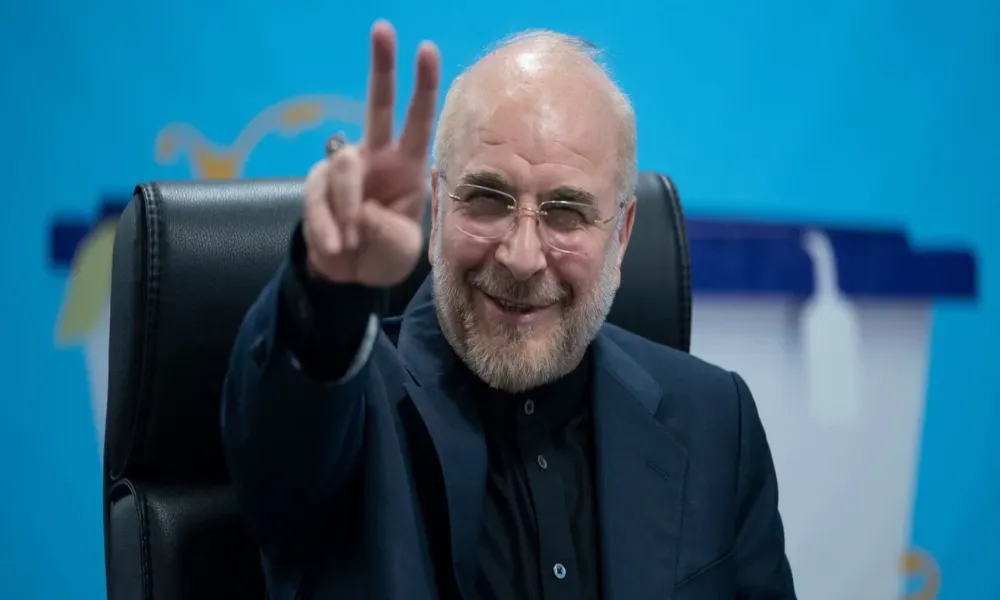
According to a report by Politico, the Trump administration is quietly assessing Iran’s parliament speaker, Mohammad Bagher Ghalibaf, as a potential negotiating partner and possible future leader, as Washington signals a shift from military escalation towards a diplomatic endgame.
Ghalibaf, 64, is viewed by some within the White House as a “workable partner” who could play a role in leading Iran and engaging in negotiations in the next phase of the war, according to two administration officials cited in the report. However, officials stressed that no final decisions have been made, with multiple candidates under consideration.
“He’s a hot option,” one official said. “He’s one of the highest… but we’ve got to test them, and we can’t rush into it.”
Search for an exit strategy
The internal discussions reflect a broader effort by the administration to identify a viable exit strategy from a conflict that has already unsettled global markets, driven up oil prices and reignited inflation concerns. White House press secretary Karoline Leavitt declined to comment on specific individuals, stating that “these are sensitive diplomatic discussions and the United States will not negotiate through the news media”. President Donald Trump has also hinted at outreach to what he described as “very solid” figures inside Iran, while announcing a five-day pause on planned strikes against Iranian energy infrastructure to allow space for diplomatic engagement.
Oil and strategic interests at the centre
Energy considerations appear central to the administration’s thinking. One official indicated that Trump is reluctant to target Kharg Island, Iran’s key oil hub, in the hope that a future leadership arrangement could secure favourable oil agreements.
“It’s about installing someone who will work with us and give us a good deal on oil,” the official said, drawing a comparison with Washington’s approach in Venezuela.
Doubts within and outside the administration
However, such thinking has drawn scepticism even among figures close to the administration.
“It seems like posturing,” said one individual with ties to Trump’s national security circle. “Iran has proven it can take a hit and still make things difficult. They’re not about to roll over and give up their oil.”
A Gulf-based official suggested that recent talk of negotiations may be partly aimed at buying time and stabilising markets, particularly after Trump had set and then stepped back from a deadline tied to reopening the Strait of Hormuz.
“He’s definitely buying time,” the official said. “What’s unclear is whether there is a real off-ramp or whether the demands are unrealistic.”
Analysts question feasibility
Analysts also question whether Ghalibaf himself would be willing or able to make meaningful concessions.
Ali Vaez of the International Crisis Group described him as “a quintessential insider… committed to the preservation of Iran’s Islamist order”, adding that even if he sought flexibility, Iran’s military and security establishment would likely constrain him.
“In the aftermath of U.S. and Israeli actions, the mood in Tehran is one of deep mistrust,” Vaez said.
Within the administration, exiled opposition figure Reza Pahlavi is reportedly not under consideration, with officials arguing he lacks domestic legitimacy inside Iran.
“Now do you put in Reza Pahlavi? God, no… that would mean chaos,” one official said, with another confirming he is “not on the table”.
Testing phase for potential leadership
Instead, the focus remains on figures already embedded within Iran’s political system. Ghalibaf has publicly denied any negotiations with the United States, though officials in Washington dismissed his remarks as internal positioning.
“We’re in the testing phase,” one official said. “We’re trying to figure out who can rise, who wants to rise. Then we test them.”
A senior White House official added that Trump is ultimately seeking “progress” on reopening the Strait of Hormuz and achieving a ceasefire, noting that “like anyone, he would rather have peace than war.”