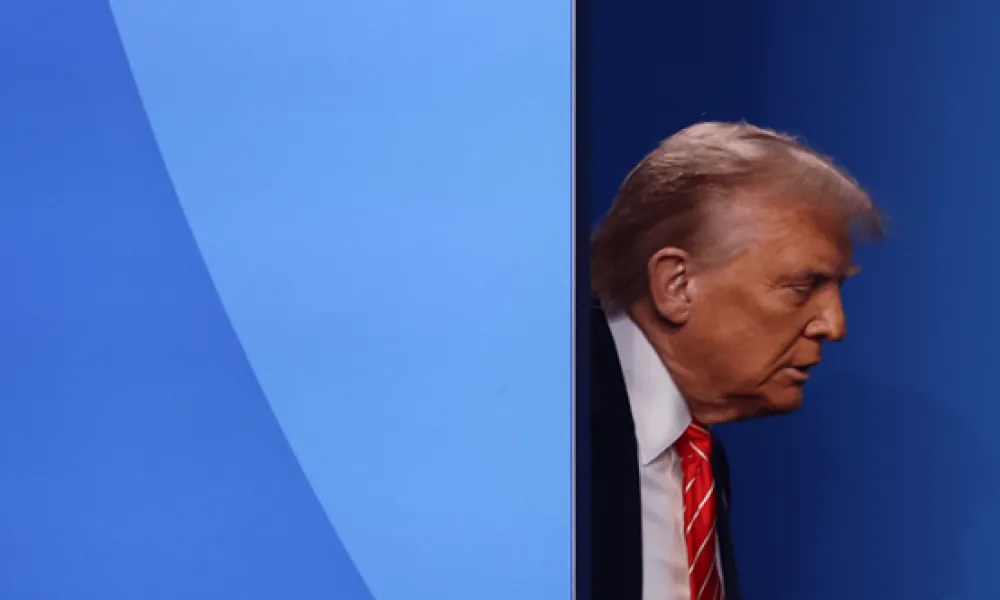



When Donald Trump launched his war on Iran on 28 February without consulting Congress, allies, or any international legal framework, he set in motion a chain of events that is now threatening the foundations of the Western security order. The crisis over NATO is not new, but it has reached a qualitatively different stage. What began as a transactional pressure campaign, pay more or else, has become something closer to a divorce proceeding, and the consequences extend well beyond the alliance itself.
A test
Trump has expressed anger that allies who were not consulted about the war, and who called it illegal, did not then rush to help the United States. The logic is worth pausing on: a war launched unilaterally, without prior coordination, became a "test" of allied loyalty the moment it ran into difficulty. For their part, allies have noted that Trump launched the war without their input or any international legal framework, and created the Hormuz crisis he is now demanding they resolve.
Several European governments drew clear lines. Spain refused to permit American military aircraft to use its airspace for operations against Iran. Senior German officials publicly described the war as "not ours." Despite Trump's pressure, NATO allies declined to contribute military forces to the war, outside of defensive manoeuvres. The White House response was to frame this restraint as betrayal. Press secretary Karoline Leavitt said NATO had "turned their backs on the American people" and that the alliance had been "tested, and failed."
Trump's reaction after his meeting with NATO Secretary-General Mark Rutte was to post on Truth Social in capitals: "NATO WASN'T THERE WHEN WE NEEDED THEM, AND THEY WON'T BE THERE IF WE NEED THEM AGAIN. REMEMBER GREENLAND, THAT BIG, POORLY RUN, PIECE OF ICE!!!" Rutte described their discussions as "very frank" and "very open," acknowledged Trump's frustration, but pushed back against the broader indictment, noting that the large majority of European nations, including France, had done what they committed to do, providing basing, logistics and overflight access.
Punishment and withdrawal
The consequences being discussed in Washington are concrete. The Wall Street Journal reported that Trump was considering withdrawing US troops from some NATO countries, with Spain and Germany identified as targets for potential base closures, while Poland, Romania, Lithuania and Greece, countries that declared readiness to participate in Hormuz surveillance operations and maintain high defence spending, are said to be in line for enhanced American presence.
Beyond troop movements, the more alarming prospect is full withdrawal. Secretary of State Marco Rubio said in a Fox News interview that the US may need to "re-examine" whether NATO still serves American purposes, or whether it has become "a one-way street." Trump himself said he was "absolutely" considering leaving, calling the alliance a "paper tiger." Formal withdrawal would require congressional approval, but analysts warn that Trump's rhetoric alone is badly weakening NATO regardless of whether he follows through. As former US ambassador to NATO Ivo Daalder put it, "military alliances are at their core based on trust: the confidence that if I am attacked, you will come help defend." That trust, he said, is now very hard to see intact.
Senator Thom Tillis warned that Trump's contemplation of a NATO withdrawal was fulfilling the "greatest dreams" of Vladimir Putin and Xi Jinping, while undermining America's own national security. The point is not lost on Moscow. Russian officials and state media are openly revelling in Trump's attacks on the alliance, casting them as validation of Europe's weakness. Surging oil prices caused by the Hormuz closure are simultaneously filling Russia's war chest.
A rift with deep roots
This is not a crisis that appeared in February. Taken together, Greenland and now Iran have forced European leaders to confront the need for a security architecture that could stand without the American pillar. Trump's threats to seize Greenland from NATO ally Denmark had already raised the once-unthinkable prospect that one member of the alliance might threaten another. His tariff campaigns against European economies, his tilt toward Putin on Ukraine, and his contempt for multilateral frameworks had all prepared the ground. The Iran war simply collapsed whatever remained of the pretence that the relationship was fundamentally stable.
Even as Trump has voiced unhappiness with European support, he is still relying on the continent's airspace and bases to fight the war. The contradiction is telling: an alliance Trump calls a "paper tiger" is also the logistical backbone of his military campaign. That dependence may be the only structural brake on how far he actually pulls back.
Where diplomacy is moving
While the Western alliance strains, a different kind of diplomatic architecture is quietly taking shape elsewhere. The ceasefire that pulled the United States and Iran back from the brink on 7 April was not brokered by any NATO member, the EU, or the UN. It was brokered by Pakistan.
More than two weeks of intense, largely unseen diplomacy preceded the announcement, with Pakistani officials activating channels across multiple capitals while publicly maintaining neutrality, positioning Islamabad as a bridge between Washington and Tehran, two adversaries with no direct diplomatic relations. Pakistan's army chief Asim Munir spoke directly to Trump as early as 22-23 March, as the US president had already signalled openness to a diplomatic exit by pausing strikes on Iranian energy infrastructure. In the final hours before Trump's deadline, Munir had direct calls with both US and Iranian interlocutors and steered the final understanding, with Trump and Vice President Vance also speaking directly with him at critical junctures.
Pakistan's leverage derived from a rare combination: close relations with the United States, a shared border with Iran, institutional representation of Iranian interests in Washington, and a Chinese partnership that gave Islamabad credibility in Tehran. Washington-based scholar Michael Kugelman described it as "one of Pakistan's biggest diplomatic wins in years," adding that it defied sceptics who doubted Islamabad had the capacity for such a complex, high-stakes effort.
The ceasefire is fragile. Less than 24 hours into the truce, Iran's parliamentary speaker said Washington had violated its terms, and Israeli strikes on Lebanon killed hundreds, with Iran warning it would be "unreasonable" to proceed with peace talks. The Strait of Hormuz has not fully reopened. Fundamental differences between Washington and Tehran remain unresolved. But the episode reveals something significant about the shape of global diplomacy in the Trump era: when the traditional Western-led multilateral framework seizes up, smaller and more agile actors with cross-cutting relationships can move into the vacuum.
The world order that NATO was built to sustain, one in which American power underwrote a rules-based system to the benefit of its allies, is under stress from the very country that created it.
Sources: Al Jazeera, Axios, The Hill, CNN, France 24