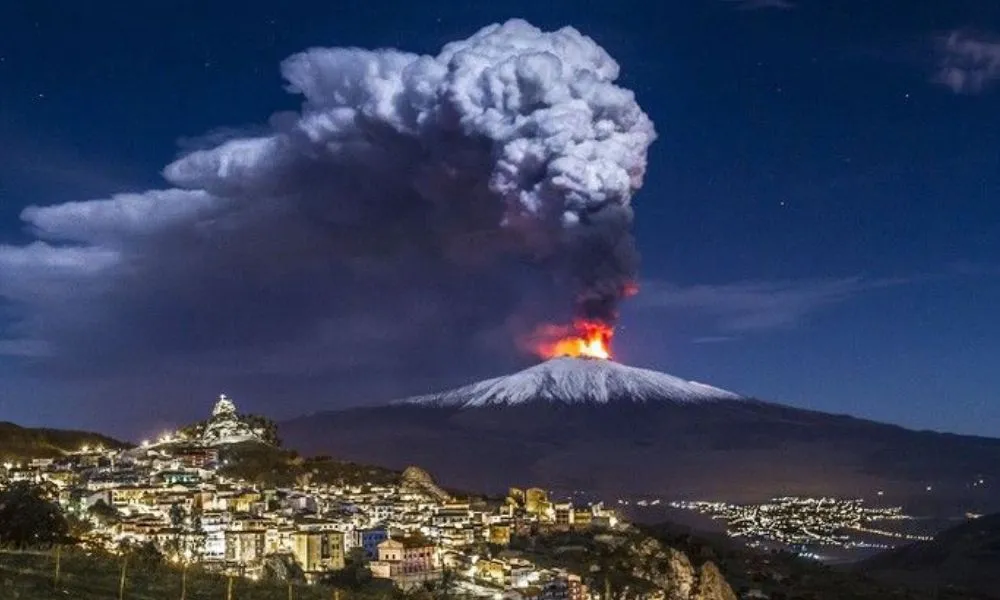

Italy’s most active volcano, Mount Etna, erupted again on Saturday, dramatically piercing its snow-covered slopes with towering plumes of ash and smoke. The eruption prompted scientists to raise aviation warnings to the highest level, amid concerns that volcanic ash could disrupt flights over the region.
On 27 December, dense clouds of ash were seen rising above the volcano in eastern Sicily, creating a striking contrast against the winter landscape. At the same time, skiers were reported to be on the mountain’s slopes, highlighting the surreal coexistence of leisure and geological force.
According to the Italian National Institute of Geophysics and Volcanology, Etna’s activity has intensified in recent hours, with several craters emitting ash almost continuously. Monitoring teams continue to track the situation closely as the eruption evolves.
Flights under watch, airport still open
Despite the escalation of the aviation alert to “red”, local authorities said that the nearby airport is continuing to operate normally. They stressed that restrictions will only be introduced if ashfall increases significantly in surrounding areas.
Etna is known for its frequent eruptions and is among the most closely monitored volcanoes in the world. While such activity is rarely unexpected, the combination of winter snowfall and renewed explosive behaviour has once again drawn attention to the volcano’s power — and its ability to disrupt both daily life and air travel at short notice.