
Cyprus has promised to bring a “different mindset” to the European Union as it assumes the rotating presidency of the Council of the EU, with defence, migration and the war in Ukraine set to dominate the bloc’s agenda amid heightened geopolitical uncertainty.
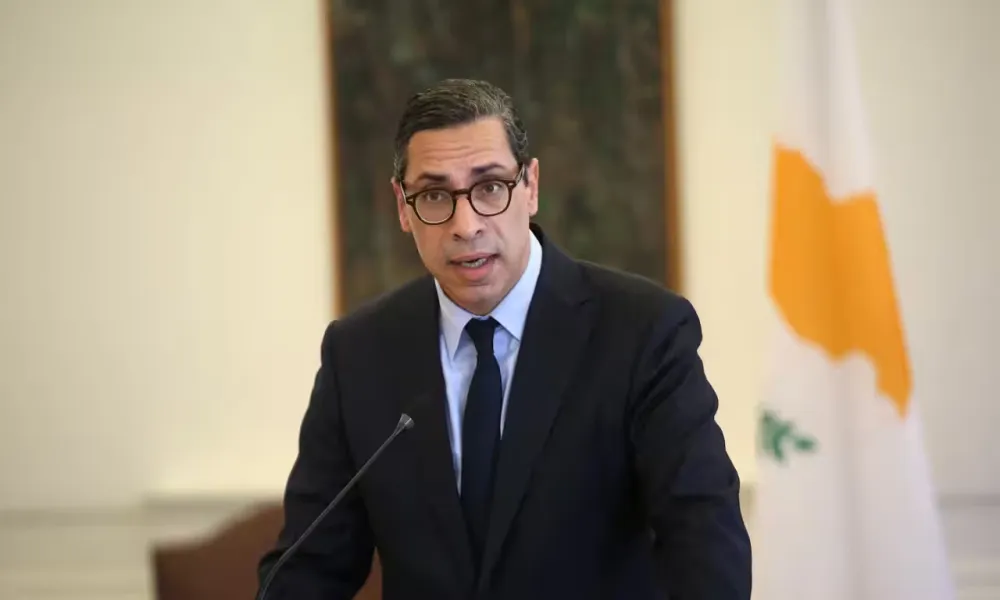
Speaking to The Guardian, Cyprus’ foreign minister Constantinos Kombos said the country would approach its six-month term with discipline, dedication and a perspective shaped by its status as one of the EU’s smaller member states.
“We believe that small states have a lot to offer in these kinds of situations,” Kombos said, arguing that Cyprus can contribute a distinct approach rather than simply administering the presidency as a procedural obligation.
Ukraine and security remain central
As the war in Ukraine enters its fourth year, Kombos stressed that EU focus on Kyiv and Russia’s invasion would remain unwavering. Drawing on Cyprus’ own history, more than five decades after Turkey’s 1974 invasion and the island’s subsequent division, he said Cypriots understood deeply the realities of military conflict and occupation.
Despite Cyprus’ past ties with Moscow, including the presence of wealthy Russian nationals on the island, Kombos said the government was particularly sensitive to the plight of Ukrainians. “The agenda is rightly about Ukraine and it will remain so,” he said.
Looking beyond Europe’s immediate neighbourhood
Alongside Ukraine, Cyprus intends to place greater emphasis on the wider Middle East, positioning itself as a bridge between regions often viewed separately in Brussels.
“We see Cyprus as being part of that region as well,” Kombos said, arguing that EU engagement should not be limited to crisis management in places such as Syria, Gaza, Lebanon or the Red Sea, but should also recognise longer-term opportunities.
Preparations for the presidency, Cyprus’ second after its first term in 2012, have been underway for more than two years. In Nicosia, the divided capital, infrastructure upgrades and EU presidency branding now signal the start of the term, which officials describe as ambitious in scope.
Turkey, defence cooperation and unresolved tensions
Cyprus’ unresolved division and strained relations with Turkey continue to cast a shadow over its EU role. Concerns have been raised in Brussels that tensions with Ankara could complicate defence cooperation at a time when closer alignment is seen as vital for regional stability.
Nicosia, along with Athens, has blocked Turkey’s participation in the EU-funded defence procurement programme SAFE. President Nikos Christodoulides has ruled out Ankara’s involvement, citing the continued presence of Turkish troops in the north of the island, which Cyprus considers occupied EU territory.
Despite this, Kombos insisted that Cyprus would not use the presidency to advance national disputes. He said Christodoulides had publicly expressed a wish for Turkish President Recep Tayyip Erdoğan to attend an informal EU council meeting in April, underlining that Nicosia did not intend to obstruct EU-Turkey relations.
Autonomy, trade and global outreach
As president of the Council, Cyprus will oversee the EU’s legislative agenda and steer diplomatic negotiations. Christodoulides has pledged to prioritise security and defence readiness as part of a broader push to strengthen the EU’s strategic autonomy.
The presidency’s motto, “an autonomous union, open to the world”, reflects this dual ambition. Cypriot officials say it signals a determination to reinforce the EU’s independence while expanding its global engagement.
With global trade disrupted by renewed US tariffs under President Donald Trump, Cyprus argues that the moment is ripe for the EU to diversify its economic partnerships. Kombos said Nicosia would seek to advance discussions on a potential EU–India free trade zone, while also deepening ties with the Middle East.
“The EU is a success precisely because it has managed to navigate repeated crises,” Kombos said, acknowledging criticism of the bloc while insisting that it continues to adapt and move forward.
Source: The Guardian