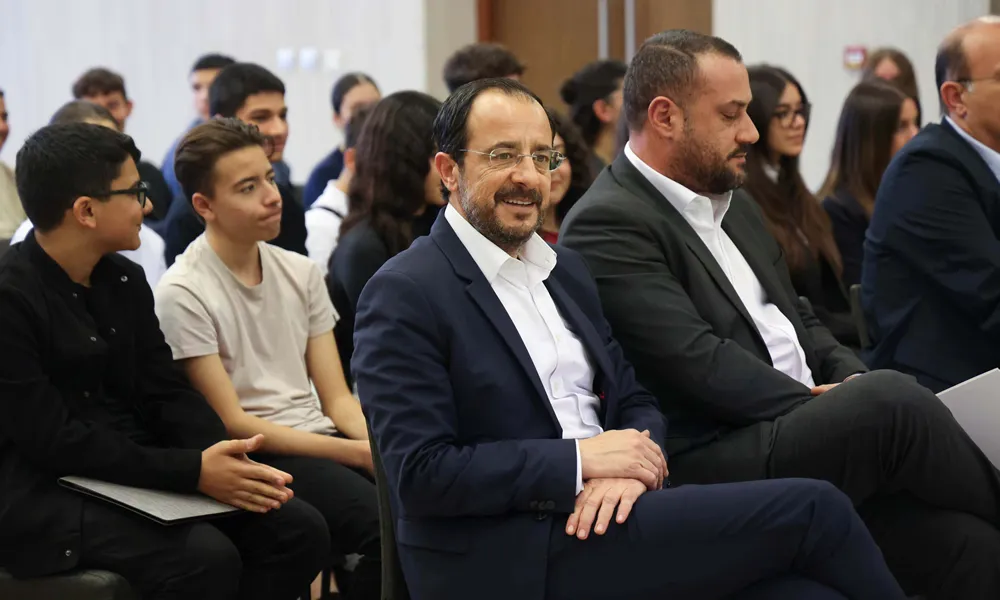

In response to criticism of the recent maritime agreement signed with Lebanon, President Nikos Christodoulides invited the Turkish government to sit down and agree on their respective Exclusive Economic Zones (EEZ).
Turkish Cypriot leader Tufan Erhürman and Turkey criticised the EEZ delimitation agreement signed with Lebanon on Wednesday, noting that it ignored the Turkish Cypriots who were “equal partners on the island and possess equal sovereign rights”.
Asked to comment on Thursday, Christodoulides reminded that the Republic of Cyprus is a member of the UN and EU and, based on international law and good neighbourly relations, as well as the 1982 UN Convention on the Law of the Sea (UNCLOS), proceeds with agreements with neighbouring states.
He stated the readiness of the Cyprus Republic to sit down at the same table with Turkey to agree on maritime borders, on the basis of UNCLOS.
Christodoulides argued that if the Turkish side is so certain and confident about its positions, it could just sit down with the Republic of Cyprus to discuss and determine maritime borders, "as we did with neighbouring states and as we will continue to do".
Conflicting claims
Cyprus’ position, as reflected in its maritime agreements with Egypt, Lebanon and Israel, gives full effect to its maritime rights, adopting the middle line between its coastline and that of the opposing coastline to determine the boundary between the two countries’ economic waters.
Turkey, on the other hand, facing the Eastern Mediterranean and Aegean, argues that islands do not have full maritime rights as coastal states do. As the state with the longest coastline, Turkey further argues that its continental shelf cannot meet Cyprus halfway, but must be greater, eating considerably into Cyprus’ claims.
While Turkey consistently highlights the equal rights of Turkish Cypriots over all of Cyprus’ economic waters, and the resources contained within, at the same time, it does not recognise the full rights of an island to an EEZ. In other words, the hydrocarbons found in the southern tip of Cyprus’ EEZ, such as the Aphrodite gas field in Block 12, as Ankara’s argument goes, should fall within Egypt’s continental shelf.
UNCLOS
The UN Convention, signed by 170 states plus the European Union, determines the rights and obligations of countries at sea, setting a clear legal framework for determining economic waters, and resolving maritime disputes. The main methodology under UNCLOS for determining maritime boundaries is to draw a median line between opposing or adjacent coastlines, and where relevant, consider special or other circumstances that might influence the final drawing of the line. The treaty is complemented by a considerable amount of international case law on maritime delimitation.
A handful of states have not signed or ratified the treaty, mainly for political reasons, including the US, Turkey and Israel, though given its widespread adoption, many of the treaty's provisions are now considered part of customary international law. That is, they apply whether one has ratified the treaty or not.
Turkish Cypriots will not hide from world
Regarding Erhürman’s message that Turkish Cypriots will not hide from the world, waiting for negotiations to end, while the Greek Cypriot leadership takes decisions for the whole island, Christodoulides said Erhürman’s stance will not determine the Republic’s planning.
He repeated that he is ready "even tomorrow to resume talks from where they left off in Crans-Montana,” and to continue even during Cyprus’ EU Presidency.
His message to Turkey and Erhürman was: if there is political will, which he has, then “we are fully prepared, yes, we can in a short time get to a solution of the Cyprus problem on the basis of the agreed framework”.