
By Constandinos Tsindas, guest analyst
In early December, the Byron storm affected the Eastern Mediterranean and the wider Middle East. Around the island we fumbled and grumbled, as we do, about the cold, flooding and how authorities needed to take more action in terms of prevention and infrastructure.
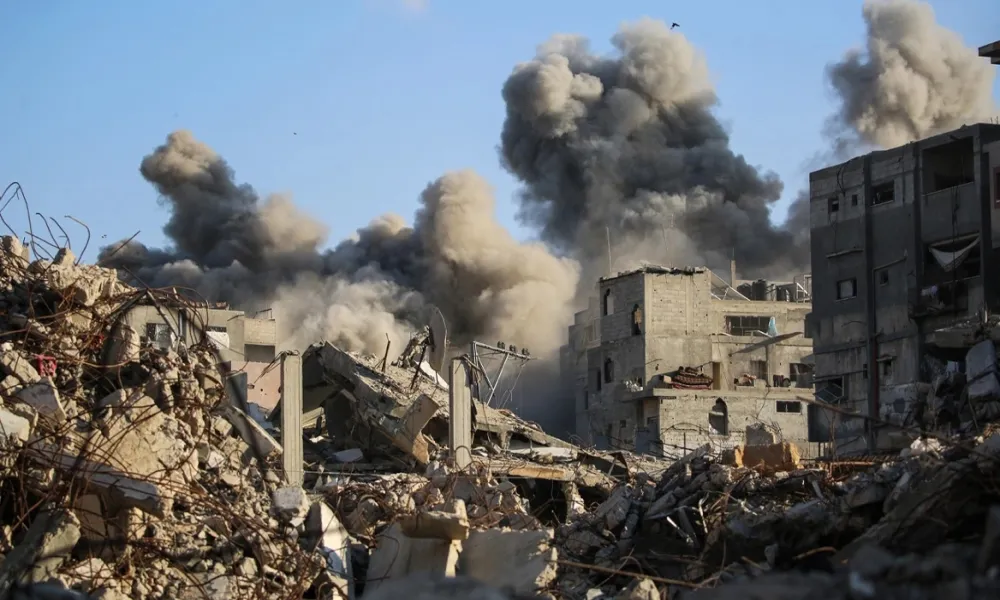
The storm came and went. And so did we, surging ahead with our early Christmas preparations. But as most tragically saw in the main news, the storm also hit Gaza. A post-ceasefire wasteland of debris, hunger of dystopian proportions with hundreds dead and broken communities. A horizon of tents, housing more than a million people, as humanitarians and NGOs struggled, exhausted by massive needs.
And this reality is not made less or hardly minimized by the fact that Israeli jets are-for now-not flying frequent daily sorties over destroyed cities. That, at least, was taken care of, in October, when a hesitant conditional deal came through, allowing people to return. To what you might ask? Nothing. And even the ceasefire remains a volatile affair to a starving population, still unbelieving that they might have a chance at rising from the pit. The present is staring Palestinians in the eye and the future is hazy.
Tens of thousands ended up knee-deep in mud or worse during storm Byron in ravaged Gaza, as there was no other refuge. The hastily put together tent cities offering no protection really from the onset of a harsh winter for a region largely affected by the worsening climate crisis. It was even more desperate for the displaced who sought refuge in the ruins of their homes following their return, as flooding took away the ramshackle subsistence of the ceasefire reality, which many celebrated about. Not there.
‘The humanitarian crisis in Gaza has unfolded with devastating speed and scale, leaving millions in urgent need of aid’, said the British Red Cross, in its own timeline of 2025 Gaza events, more of an appeal for urgently needed assistance, as deliveries remain grossly inadequate, continuing to trickle in through closely watched Israeli lines.
Conditions remain far from settled and Tel Aviv keeps arguing that Hamas is still stealing away critical food supplies and reselling them to a population that has no options but to succumb to all the hardships thrown at them, whatever the direction and hope that the fragile conditions will soon turn into a path. Long road.
The timeline of 2025? Simply put, hot and cold, a series of frequent escalations, coupled by weak hope, starting with a ceasefire in January, that at least provided Gazans a brief respite from suffering. Thousands of internally displaced people, who moved around every single day, air raids not allowing them to stay in one place for more than a single night, were emotionally reunited with loved ones and able to bury civilian victims of the conflict, running in its second year.
Many of Hamas’s Israeli hostages were released, the Red Cross facilitating the transfers, as it navigated through the war zone, while hundreds of Palestinian detainees were freed from Israeli detention centres to Gaza and the West Bank.
The volume of aid crossing the border rose significantly during the first two months of the year, with more than 200 trucks-still grossly inadequate, going through Rafah and Kerem Shalom.
This was predictably short lived. Relief soon gave way to a rising tide of shattering hostilities as the conflict entered a new phase. Aid was suspended in March and the population was subjected to unrelenting bombing campaigns, as Israel argued Hamas was regrouping, attacking in many areas and organising in the protected backdrop of civilian infrastructure, such as mosques and schools, whatever was left in any case.
The shattered health care system had long not been able to carry the burden of casualties, with only a handful of hospitals still partly operational, in difficult conditions, missing the basics of care, as children bore the brunt of the suffering. Thousands were malnourished and the break in aid - no baby formulas, no milk, no basics for child growth - meant unimaginable hardship.
In the midst of many casualties against humanitarian workers, late May saw the replacement of the UN with an Israeli American foundation as the main distributor of aid across the war-ravaged enclave. Beyond the debate about other considerations that formulated this new arrangement - rejected by Israel - the summer saw hundreds of civilians killed as they attempted to approach this new foundation’s aid distribution centres. Palestinian civilians said they had to cover distances for a few bags of flour, as the centres were located far from where they were most needed. Tel Aviv argued that Hamas was killing them and blaming the Israeli army, who said they had been fired upon on many occasions.
In July, the Red Cross referred to ‘malnutrition of catastrophic proportions’ for the civilian population. The UN soon followed, declaring famine conditions on August 22 in the Gaza Governorate region, an area including Gaza City, the largest urban centre.
A largely symbolic effort by thousands of activists to break the naval blockade of Gaza in early autumn, spearheaded international pressure to break the cycle of violence, as the famine set in.
The US President got involved, taking the lead in efforts, as Arab countries once again scrambled to respond to another’s initiative, rather than be at the forefront, with the diplomatic rush intensifying across the board.
Even so, and despite arguments that this was really an American driven peace coordinated with Israel, a ceasefire was declared on October 10th 2025, three days after the 2nd anniversary of the Hamas attacks.
Putting aside the romp and pomp of the Sharm El Sheikh affair, which saw the officialising of the agreement on the first phase of a long-term solution - including the ceasefire and the exchange of Israeli hostages with Palestinian prisoners, it was a welcome relief for the Palestinian population.
But there is no quick solution here. Reconstruction will take dozens of years and billions in funds. Most significantly, the thorniest of issues here is what will happen to Hamas, where will Israel be and what kind of guarantees will stand the test of time. Time that the region doesn’t have, as millions are still living in squalid conditions.
As 2026 dawns, civilians remain unbelieving that this will last. Notwithstanding the jaw dropping Trump Riviera promises, survival is what’s at stake here. And we’re still at a point where there is no mechanism in place about what exactly will happen next in terms of infrastructure building, reconstruction and most crucially for the future - who will be running this. Trump said international monitoring will be in place through guarantees, Fatah might take over at some point, if it can (Abbas is 90, who will the successor be and what power will they have). Many know how this ended up on other occasions. It’s hazy, to say the least, as the enclave moves forward in tatters, with little aid, a tent life and debris ridden. Eighty thousand killed, many more injured, children orphaned, homes destroyed.
The question here rides into an uncertain horizon, as there are currently no multilateral negotiations on the next phase, but Trump and Netanuahu discussing the issue yesterday during their Florida talks.
In addition, the recent Israeli recognition of Somaliland has given impetus to theories that Israel will ‘encourage’ Palestinians to move there, implementing a policy of forced population transfer, a violation of international law. Will the border demarcation lines, as set up in the Trump plan, actually survive? No easy questions, no easy answers. It pretty much looks like it always has in the Middle East. Hit and miss and hope for the best. But this time, any miss will be costly.