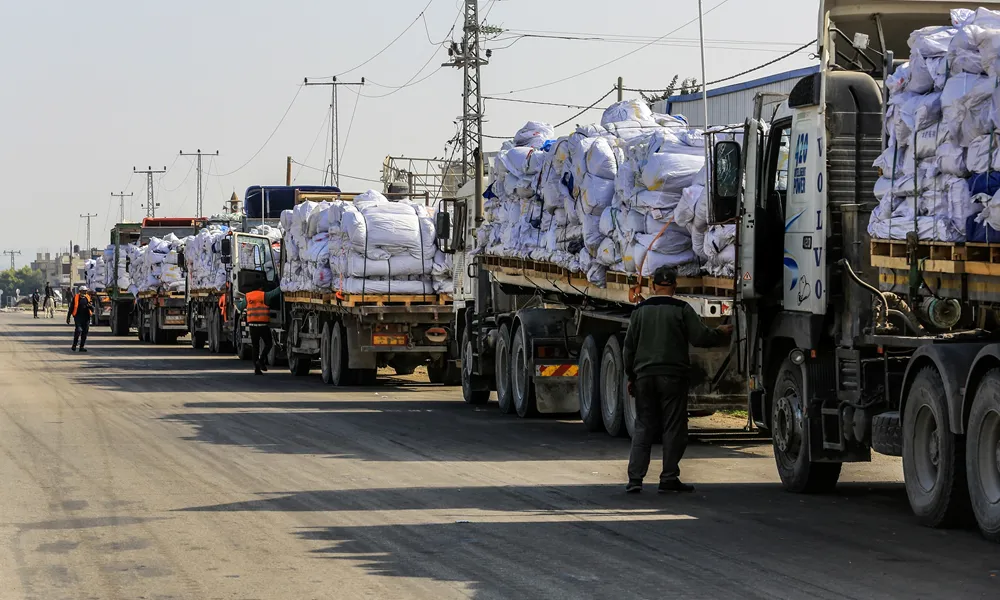
The Israel government confirmed on Thursday that it has barred 37 major international humanitarian organisations from accessing the Gaza Strip, accusing them of failing to submit staff lists now formally required for “security” reasons.
The move has sparked serious concern over further delays to humanitarian assistance in Gaza, which has suffered vast destruction after two years of war. Most of the territory’s population urgently needs shelter, medical care and food. The measure has also raised fears among NGOs that Palestinian staff could be subjected to surveillance by Israeli authorities, a practice some organisations consider unlawful.
“The organisations’ permits have expired and they are prohibited from providing aid. They have two months to withdraw their teams,” a spokesperson for the Ministry of Diaspora Affairs and Combating Antisemitism told Agence France-Presse.
By 1 March, “if they choose to submit the documents they refused to provide over the past ten months, we will examine their requests,” added Gilad Tzvik.
In a statement, the ministry said the requirement is intended to prevent the “infiltration of terrorists into foreign humanitarian structures.”
“Humanitarian aid is welcome. The exploitation of humanitarian frameworks for terrorist purposes is not,” the minister, Amichai Chikli, insisted.
Israel has faced mounting international criticism as the deadline it set for NGOs to comply with the new obligations expired late Wednesday. Among the organisations affected are Médecins Sans Frontières, the Norwegian Refugee Council, CARE, World Vision and Oxfam.
Humanitarian actors under pressure
MSF said earlier this week that it had received neither “guarantees” nor “clarifications” from Israel regarding what it described as a “deeply concerning” demand.
Shayna Lowe, spokesperson for the Norwegian Refugee Council, told AFP that actions have been underway “for two years now to obstruct and marginalise humanitarian actors.”
In Gaza, she said, local staff are “exhausted,” while international colleagues “provide an additional layer of assistance and safety. Their presence is a form of protection.”
She confirmed the NRC’s refusal to hand over staff identities and personal data to Israeli authorities. “We proposed alternatives. They refused,” she added.
On Wednesday, the European Union called for the lifting of “obstacles” to humanitarian aid.
The Office of the United Nations High Commissioner for Human Rights chief, Volker Türk, warned that “such arbitrary expulsions worsen an already unbearable situation for the population of Gaza,” where a fragile ceasefire has been in place since 10 October between Israel’s military and Hamas.
Disputes over humanitarian assistance have repeatedly flared since the war began, triggered by Hamas’ attack on southern Israel on 7 October 2023. In 2024, Israel barred the UNRWA from operating on its territory, after accusing around a dozen of its staff of involvement in the 7 October assault.
“A dangerous precedent”
UNRWA Commissioner-General Philippe Lazzarini described the new Israeli restrictions as a “dangerous precedent,” accusing Israel of showing “contempt for international humanitarian law” and of multiplying obstacles to aid delivery.
On Thursday, 17 Israeli left-leaning organisations said the ban on NGOs “undermines humanitarian action,” puts “staff and communities” at risk and weakens the effectiveness of aid distribution.
“Subjecting aid to political considerations and demanding the disclosure of sensitive personal data violate the duty of protection and expose workers to surveillance and attacks,” the groups said in a joint statement.
According to COGAT, an average of 4,200 trucks enter Gaza each week, roughly 600 per day, in line with the ceasefire agreement. However, NGOs and the UN say only between 100 and 300 of these vehicles actually carry humanitarian aid.
Source: AMNA