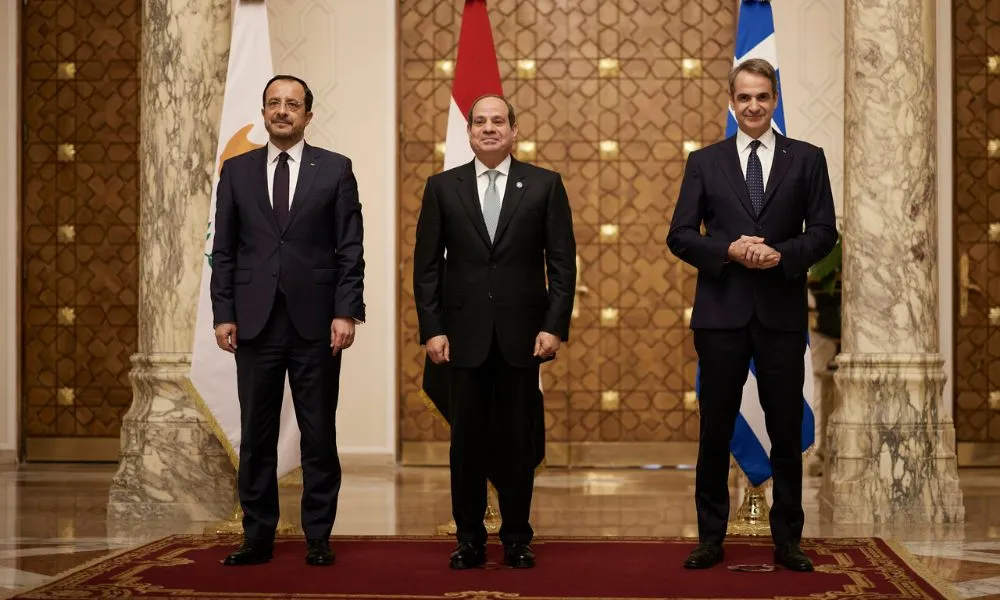

The trilateral cooperation between Greece, Cyprus and Egypt has demonstrated its strength and durability since its inaugural summit in Cairo in 2014, Greece’s Foreign Minister Giorgos Gerapetritis said on Monday, describing it as a model for similar initiatives across the region.
A cooperation rooted in shared vision
Speaking after the trilateral meeting of foreign ministers of Greece, Cyprus and Egypt in Cairo, Giorgos Gerapetritis stressed that the partnership is deeply rooted in the history of the three neighbouring countries, actively shapes the present and offers strong prospects for the future.
He underlined that a key factor behind the success of the trilateral format is the shared understanding of regional and international relations among the three countries.
Commitment to international law and diplomacy
Gerapetritis reaffirmed the partners’ commitment to international law, including the United Nations Convention on the Law of the Sea, the principles enshrined in the UN Charter and the resolutions of the United Nations Security Council.
“We prioritise diplomacy over war and promote stability over chaos,” he said. “We believe in cooperation and understanding, rejecting hatred and division. We envision the Mediterranean not as a region condemned to conflict, but as a space of peaceful coexistence for all its peoples and future generations.”
Focus on Middle East and regional crises
Discussions during the meeting focused on developments in the Middle East, with particular emphasis on Gaza and the West Bank, as well as Syria, Yemen, Sudan, the Horn of Africa, Iran and Libya.
Trump invitation to Greece for Peace Council
Gerapetritis also revealed that Greece has received an invitation from US President Donald Trump to become a founding member of a proposed Peace Council, noting that Athens is carefully reviewing all relevant documents.
He said the initiative aligns with UN Security Council Resolution 2803, which Greece supported as an elected member. Greece, he added, consistently backs initiatives that promote peace, security and stability and will coordinate closely with its European partners and key regional allies, including Egypt.
Gaza, Palestinian issue and two-state solution
On the Palestinian issue, the Greek foreign minister said the three countries welcome the launch of the second phase of the US 20-point plan aimed at ending the conflict in Gaza, approved under UN Security Council Resolution 2803.
He praised Egypt’s efforts towards peace in the Middle East and stressed that Palestinian sovereignty is critical for the post-conflict future of Gaza. A reformed and strengthened Palestinian Authority, he said, could serve as a credible partner for peace.
“Greece remains firmly committed to the resumption of the political process, with the goal of achieving a two-state solution based on UN resolutions, as the only answer to the long-standing Palestinian demand for an independent state,” he said.
Syria, Iran and human rights
Referring to Syria, Gerapetritis said the country is pivotal to stability in the Eastern Mediterranean and the Arab world, and its reintegration into the region should be supported. He called for an inclusive political transition ensuring representation for all ethnic and religious communities.
On Iran, he reiterated Greece’s position in favour of de-escalation, dialogue and a peaceful resolution of the current crisis, while stressing that fundamental human rights must be fully respected and that no penalties should be imposed on those demonstrating for freedom.
Maritime security and cooperation expansion
Maritime security and irregular migration were also high on the agenda, with discussions covering developments in Africa, including Libya, Somalia and Sudan. Gerapetritis highlighted the importance of safeguarding freedom of navigation, particularly in the Red Sea, a key artery of global trade.
He also expressed deep concern over the humanitarian crisis in Sudan and parts of sub-Saharan Africa, noting that international intervention on the ground remains insufficient.
The meeting concluded with agreement on significant scope to strengthen and expand cooperation in areas such as the economy, trade, tourism, energy, innovation and new technologies, culture and education.
“Greece, Egypt and Cyprus are more determined than ever to build on their shared history and common values, offering a clear example of what reliable communication and cooperation can achieve in an unstable international environment,” Gerapetritis concluded.