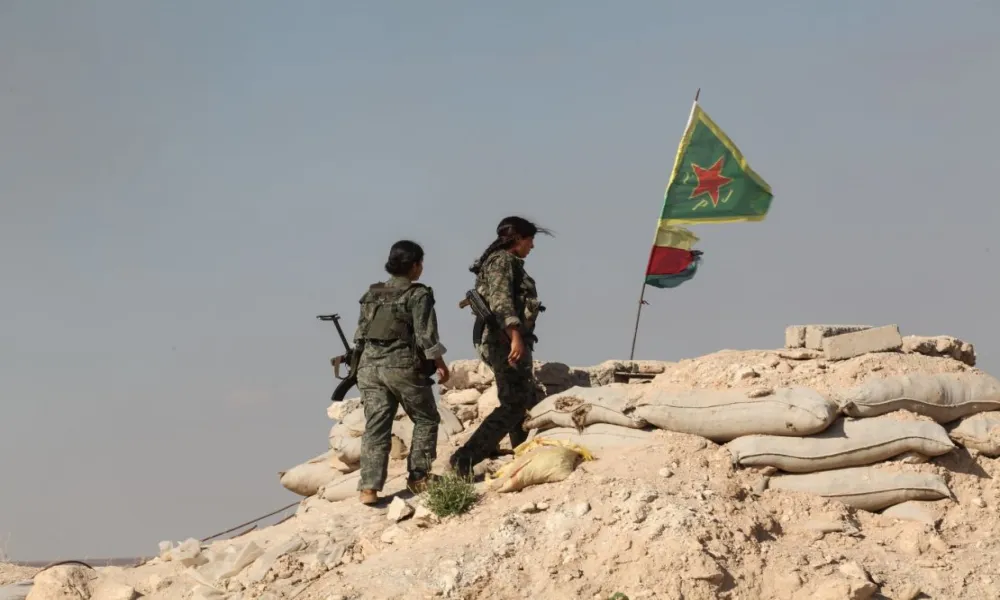

The rapid recapture by the Syrian government of territories long controlled by the Kurdish-led Syrian Democratic Forces (SDF) was shaped by a series of high-level meetings in Damascus, Paris and Iraq earlier this month, according to nine sources familiar with behind-the-scenes deliberations who spoke to Reuters.
The previously undisclosed accounts, provided on condition of anonymity, indicate that the United States did not stand in the way of an operation that fundamentally altered the balance of power in Syria, to the detriment of a former ally.
The meetings paved the way for Syrian President Ahmed al-Sharaa to secure two major gains: advancing his pledge to reunify all Syrian territory under a single leadership, and emerging as the preferred interlocutor of the US administration under Donald Trump, the sources said.
The offensive effectively dismantled the autonomous zone Kurdish authorities had hoped to preserve in northeastern Syria, testing the limits of US backing for al-Sharaa, who previously led the local affiliate of al-Qaeda.
Despite this, al-Sharaa emerged strengthened. US envoy Tom Barrack said Washington could now work with the Syrian state and had no interest in maintaining a separate role for the SDF.
Syria had been proposing an operation for weeks
The United States began supporting the Syrian Democratic Forces in 2015, when the group was formed to drive Islamic State militants from northeastern Syria.
The SDF subsequently used the area to establish a de facto autonomous enclave with its own political and military institutions.
In late 2024, however, al-Sharaa’s forces overthrew longtime ruler Bashar al-Assad and pledged to bring all Syrian territory back under the control of the new government, including areas held by the SDF.
After months of talks in 2025, a deadline for integrating the SDF into Damascus expired at the end of the year without progress, setting the stage for military action.
On 4 January, a meeting in Damascus between Syrian officials and the SDF on integration collapsed abruptly after being cut short by a Syrian minister, according to three Kurdish officials.
The following day, a Syrian delegation travelled to Paris for US-brokered talks with Israel on a security arrangement. Syrian officials accused Israel of backing the SDF and urged Israeli counterparts to stop encouraging Kurdish delays in integration, according to two Syrian sources.
At those talks, Syrian officials proposed a limited operation to retake some SDF-held areas and encountered no objections, another Syrian source said.
Syria’s ministries of information and foreign affairs did not immediately respond to Reuters queries. The US State Department referred to Barrack’s statement urging the SDF to integrate and stressing that Washington has no interest in a long-term military presence in Syria.
Israel’s ambassador to the US, Yechiel Leiter, denied approving any Syrian military action against the Kurds.
Syria also received a separate message from Turkey that Washington would approve an operation against the SDF provided Kurdish civilians were protected, according to a Syrian official.
Turkey has repeatedly intervened against the SDF, accusing them of links to the outlawed Kurdistan Workers’ Party (PKK).
“The Paris agreement gave the green light for this war,” said Kurdish official Hadiya Yousef.
Kurds accuse the US of betrayal
Two weeks later, the offensive began. Washington started signalling to the SDF that it was withdrawing its long-standing support, according to a US diplomat, a Syrian source and another person familiar with the matter.
On 17 January, Barrack met SDF commander Mazloum Abdi in Iraq’s Kurdistan region and told him that US interests now lay with al-Sharaa rather than the SDF, according to three sources. An SDF official denied this account.
A US military official and two Kurdish officials said the US had assured the SDF it would intervene if al-Sharaa’s advance endangered Kurdish civilians or destabilised detention centres holding Islamic State fighters.
As Syrian forces pushed beyond the initially proposed zone, the US military urged them to halt, while coalition aircraft dropped warning flares over some flashpoints. Kurdish officials said this fell far short of their expectations.
“What coalition forces and American officials are doing is unacceptable,” Yousef said. “Do you have no principles? Are you so ready to betray your allies?”
Asked about US assurances, the State Department again referred to Barrack’s comments on integration.
Al-Sharaa nearly overstepped
According to three US sources, al-Sharaa came close to going too far in the final phase of the offensive.
His forces swiftly retook Arab-majority provinces from the SDF and continued advancing. By 19 January, they were encircling the last Kurdish towns in northeastern Syria, despite a ceasefire announced the previous day.
US officials were angered by what they saw as Syrian disregard for the truce and feared mass violence against Kurdish civilians. Two sources said US lawmakers were considering the reimposition of sanctions if fighting continued.
A White House official told Reuters the US was monitoring events “with serious concern” and urged all parties to prioritise the protection of civilians from all minority groups.
As Syrian forces approached the final Kurdish strongholds, al-Sharaa abruptly announced a new ceasefire on Tuesday, saying his troops would not advance if the SDF submitted an integration plan by the end of the week.
US sources said the move satisfied Washington and placed al-Sharaa “out of danger”.
Minutes later, Barrack issued a statement saying the SDF’s original role in fighting Islamic State had “largely concluded” and that the Kurds’ best opportunity now lay under al-Sharaa’s new government.
Source: Reuters