
Voice Across
February 6 is no longer merely a date in Türkiye’s recent history. It is a permanent fracture in the national conscience. Three years ago, before dawn, the ground beneath Kahramanmaraş, Hatay, Adıyaman and Malatya tore itself open and exposed far more than a geological fault. It exposed the accumulated failures of a state, a system, and a long-cultivated habit of denial.
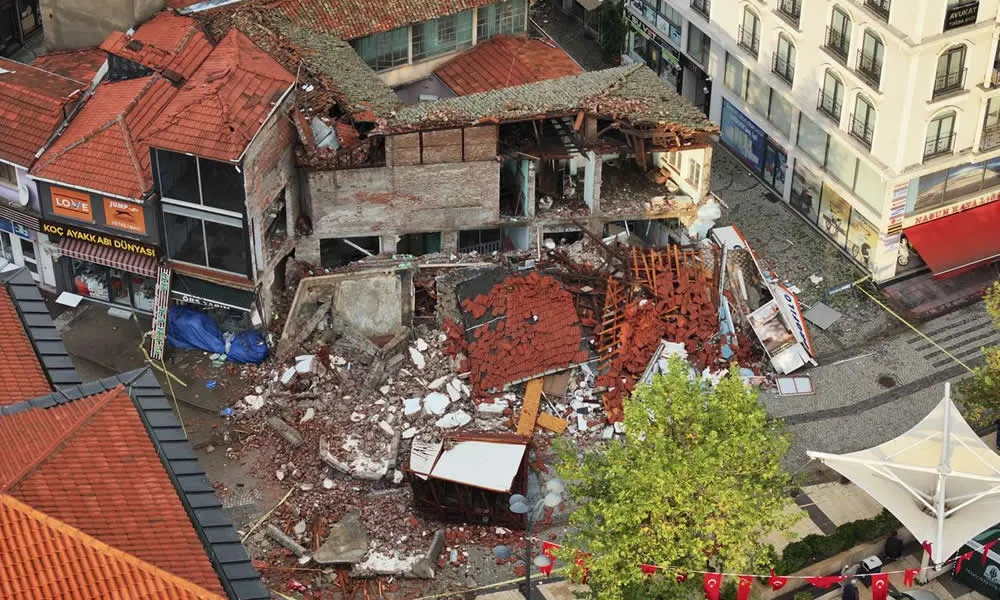
More than 53,000 people lost their lives, according to official figures. Entire neighborhoods collapsed within seconds. Families were erased beneath concrete poured cheaply, inspected perfunctorily, and approved with indifference. Survivors roamed the frozen streets, calling out names that would never be answered.
This was not merely an earthquake. It was a reckoning long postponed. On this third anniversary, remembrance is unavoidable. But remembrance without responsibility is betrayal. The dead do not need our tears. They demand our honesty.
Disguised as fate
Türkiye is not surprised by earthquakes. It is betrayed by them. The February 6 earthquakes struck exactly where experts had long warned they would. The science was unambiguous. The maps were public. The risk was fully known. What failed was not knowledge, but will, eroded over time by administrative fatigue, political complacency, and a chronic refusal to act before catastrophe.
Yet, once again, the oldest refuge was invoked: fate. Destiny. God’s will. Fatalism may explain fear, but it cannot excuse negligence. Fate did not legalize unsafe buildings through repeated construction amnesties. Fate did not silence engineers who raised alarms. Fate did not turn inspection into a box-ticking exercise or allow political loyalty to trump professional integrity. Earthquakes are natural phenomena. Mass death is a man-made outcome. What collapsed that night was not only reinforced concrete, but the illusion that shortcuts could forever defy physics.
From mourning to forgetting
In the days following the disaster, Türkiye appeared to awaken. Anger mixed with grief. The public demanded answers. Officials promised accountability. Courts opened files. Cameras rolled. “Never again” became the refrain.
Then came normalisation, forgetfulness and quiet retreat. Three years later, the uncomfortable questions remain largely unanswered. How many decision-makers paid a political price. How many contractors faced sentences proportionate to the crimes. How many unsafe buildings were actually removed from the housing stock rather than reclassified on paper.
Türkiye mobilizes heroically after disaster. But prevention requires something far more threatening to entrenched interests: consistency, enforcement, and courage. Rescue is dramatic. Prevention is politically costly.
Isias Hotel and the Champion Angels
Among the countless tragedies of February 6, one case emerged with a clarity that stripped away every alibi. The collapse of the İsias Hotel did not merely kill. It exposed.
Buried beneath its rubble were children who had not chosen to live in a risky neighborhood, nor to inhabit a structurally dubious building. They had arrived briefly, officially, and lawfully. They were there to compete in a school volleyball tournament, carrying sports bags, team jerseys, and the quiet excitement of youth. They trusted the most basic promise of modern life: that a licensed hotel would not become a grave.
The young athletes who would later be known as the Şampiyon Melekler, the Champion Angels, died alongside their teachers, coaches, and parents. Their deaths carried a devastating symbolic weight. These were not anonymous residents of informal housing or victims of unavoidable exposure. They were guests. Children. Students. They represented the clearest possible test of whether the system worked at all.
It did not. And because it did not, ambiguity collapsed with the building. No one could credibly invoke fate. No one could hide behind personal choice or unavoidable risk. This was a structure that stood only because rules were bent, warnings ignored, and responsibilities diluted.
What followed was extraordinary not because of rhetoric, but because of resolve.
Turkish Cypriots did not relegate this loss to condolence messages or annual remembrance ceremonies. They transformed it into a sustained, collective moral demand. Across Northern Cyprus, political divisions fell silent. Party lines blurred. Institutional rivalries paused. Civil society organizations, bar associations, trade unions, educators, students, and families moved in unison.
This unity was not emotional. It was principled.
The İsias case became more than a legal process. It became a line that could not be crossed quietly. A declaration that some losses are too clear, too young, and too preventable to be absorbed into the routine machinery of forgetting.
The families of the Şampiyon Melekler embodied this stance with quiet determination. They did not shout. They did not sensationalize their grief. They traveled relentlessly, attended hearings meticulously, and spoke with discipline and restraint. In courtrooms long accustomed to technical evasions and procedural fatigue, they insisted on one unyielding truth: these children did not die because the earth moved, but because the system did not.
Their dignity unsettled a culture accustomed to resignation. Their persistence illuminated how rare sustained civic pressure has become in the pursuit of accountability.
Verdicts but not justice
And then came the verdicts. For the families, and for Turkish Cypriots across the spectrum, from the president to ordinary citizens who had invested not only hope but profound moral expectation in the judicial process, the outcome felt painfully familiar. Sentences appeared restrained rather than resolute. Responsibility was defined narrowly, as if the collapse of a building could be reduced to a series of isolated errors. Chains of accountability were cut precisely at the point where responsibility would have become uncomfortable.
Those who authorized, ignored, or normalized risk remained largely untouched. The logic of fragmentation prevailed: technical staff scrutinized, contractors partially sanctioned, systemic responsibility dispersed until it effectively disappeared.
What should have been a landmark ruling became another confirmation of a long-standing pattern. Justice calibrated not to the scale of harm, but to the limits of institutional tolerance.
This was not simply a legal failure. It was a moral fracture.
Because when court decisions fail to reflect the magnitude of loss, they do more than disappoint victims. They establish precedent. They signal that mass death caused by negligence can be administratively absorbed. That accountability has a ceiling. That some lives, even children’s lives, do not carry enough institutional weight to trigger full responsibility.
The reaction to the İsias verdicts revealed something crucial. Society is ahead of its institutions. Families are prepared for long, exhausting struggles. Citizens are ready to confront uncomfortable truths about governance, construction, and enforcement.
It is the system that hesitates. And in the context of preventable mass death, hesitation is no longer neutrality. It is complicity by delay.
The İsias case will endure not only as a tragedy, but as a measure. A measure of whether this country is willing to treat negligence that kills children as a grave crime, or merely as a regrettable inconvenience.
Istanbul: The waiting catastrophe
If February 6 was a tragedy, Istanbul is a warning siren that never stops.
A megacity of more than 16 million people. The country’s economic heart, financial bloodstream, cultural core. A city sitting not metaphorically, but physically, on one of the most dangerous fault systems in the eastern Mediterranean: the Main Marmara Fault, running silently beneath the Sea of Marmara.
A major Istanbul earthquake is not a possibility. It is an inevitability.
What has changed in recent years is not the risk, but the clarity of the warning. Seismological evidence now shows that earthquake ruptures along the Main Marmara Fault are progressing eastward, toward the locked segment directly beneath Istanbul. The magnitude 6.2 earthquake in April 2025, the strongest on this fault line in more than six decades, was not reassuring. It was alarming. It confirmed that accumulated stress is being released step by step, migrating toward the city like a slow-burning fuse.
This is how large earthquakes prepare themselves.
Over the past 15 years, seismic patterns show a disturbing trend: moderate earthquakes above magnitude 5 are inching closer to the Princes’ Islands segment, long identified as one of the most dangerous and tightly locked sections of the fault. When that segment ruptures, experts warn, it could generate a magnitude 7 or higher earthquake, releasing enormous energy directly beneath a densely populated urban basin.
The numbers alone should shatter complacency. Scientific estimates place the 30-year probability of a magnitude 7.3 or greater earthquake near Istanbul between 35 and 47 percent, factoring in stress accumulation since the 1999 İzmit earthquake. This is not abstract modeling. It is a rolling countdown.
Worse still, rupture direction matters. If a major break propagates eastward toward Istanbul, ground shaking could intensify due to directivity effects, amplifying destruction precisely where population density, aging building stock, and weak soils converge.
Yet three years after February 6, Istanbul remains frighteningly exposed.
Risky buildings are identified but still inhabited. Tens of thousands of structures known to be unsafe remain standing, not because the danger is disputed, but because evacuation is politically inconvenient and economically costly. Urban transformation projects advance at a pace that mocks urgency, slowed by bureaucracy, legal disputes, financing gaps, and the quiet fear of social backlash.
Emergency assembly areas, once designated as lifelines, have quietly vanished into zoning revisions, shopping centers, luxury residences, and speculative real estate ventures. What should be public safety infrastructure has been absorbed by the logic of rent and return.
Meanwhile, responsibility fractures along political lines. Central and local authorities argue jurisdiction, funding, and authority. Municipalities point to ministries. Ministries point to municipalities. The fault line, indifferent to elections and mandates, remains unmoved by these disputes.
This is not ignorance. It is deliberate delay. Delay until the ballots are counted; until the coffers are refilled; until accountability can be passed on to someone else.
Scientists from leading institutions, including European research centers, warn that the Main Marmara Fault is now “critically loaded.” Continuous real-time monitoring shows that stress levels are dangerously high. At the same time, Istanbul’s vulnerability is compounded by unstable soils in large districts, unregulated or poorly regulated construction, and a building stock that mirrors, in disturbing ways, the weaknesses exposed so brutally on February 6.
Public awareness is not the problem. Surveys show that more than 85 percent of Istanbul residents fear a destructive earthquake in the near future. They know. They worry. But fear does not retrofit buildings. Anxiety does not relocate families. And individual awareness cannot compensate for collective inaction.
The most dangerous illusion is the belief that time equals safety. In reality, time is neutral. What matters is what is done with it. And so far, time has been largely wasted.
When the Istanbul earthquake comes, it will not only test engineering standards. It will test governance. It will test whether lessons written in mass graves were taken seriously or quietly filed away. It will test whether February 6 marked a turning point or merely another chapter in a cycle of disaster, mourning, and forgetting.
The ground beneath Istanbul is already speaking.
The question is whether anyone in power is truly listening.
Beyond fate
Yes, fatalism exists in this society. But fatalism did not choose substandard concrete. Fatalism did not ignore inspection reports. Fatalism did not transform public safety into a political inconvenience.
Those were choices. And they are still being made.
Every unsafe building left standing is a decision. Every delayed retrofit is a gamble. Every diluted court verdict is an invitation to repeat disaster.
On this third anniversary, the most meaningful tribute to the dead is not ritual mourning, but sustained refusal. Refusal to forget. Refusal to normalize. Refusal to accept that the next mass grave is inevitable.
The February 6 earthquakes shattered cities.
The Champion Angels shattered indifference.
If the next catastrophe finds us still talking and still not acting, history will not call it fate. It will call it repetition. And repetition, after warning, is not tragedy. It is responsibility denied.