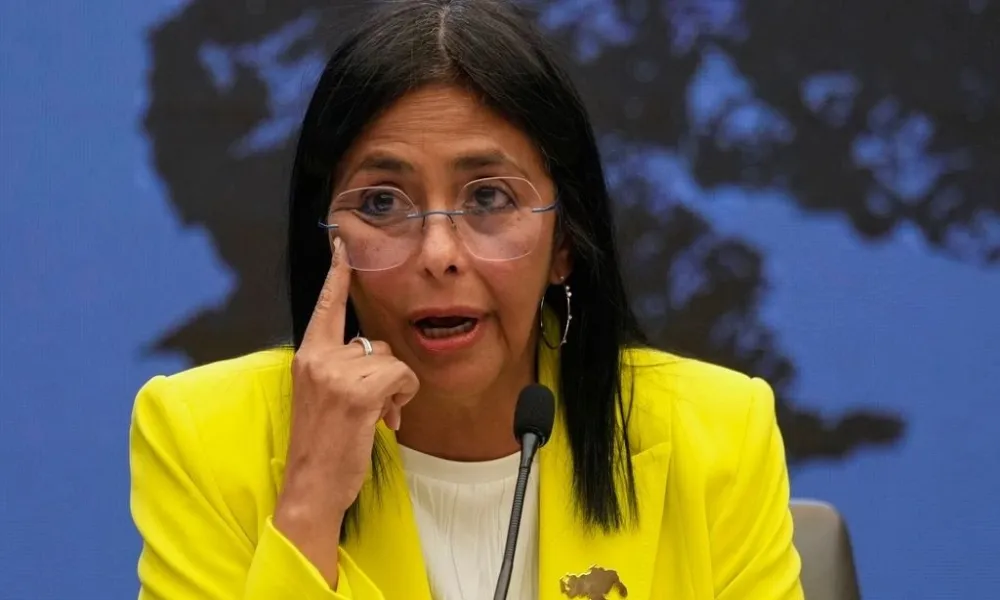

Venezuela has entered a new and highly volatile political phase after its Supreme Court ordered Vice-President Delcy Rodríguez to assume the powers and duties of the presidency. The decision follows the removal of President Nicolás Maduro by the United States, a move that has already triggered global reactions and deepened uncertainty over the country’s immediate future.
Supreme Court decision
Venezuela’s Supreme Court ruled late on Saturday night, local time, that Vice-President Delcy Rodríguez should assume presidential powers after concluding that Nicolás Maduro is in a “substantial and temporary inability” to carry out his duties.
The ruling stated that Rodríguez will “assume and exercise, as acting president, all powers, duties and responsibilities arising from the office of president of the Bolivarian Republic of Venezuela, in order to ensure administrative continuity and the comprehensive defence of the country”
The decision was read out by Supreme Court judge Tania D’Amelio during a session broadcast on state television VTV. Under Venezuela’s constitution, the vice-president must replace the president in cases of temporary or permanent absence.
Who is Delcy Rodríguez
Rodríguez, 56, was born on 18 May 1969 in Caracas. She is a lawyer and the daughter of a left-wing guerrilla fighter. She works closely with her brother, Jorge Rodríguez, who heads the legislative branch of the National Assembly.
Alongside her role as vice-president, Rodríguez has served as minister of economy and oil, making her a central figure in Venezuela’s economic management and its relationship with the private sector.
She became vice-president in 2018, having previously held several senior government posts, including minister of communication and information, foreign minister, and head of a pro-government constituent assembly that expanded Maduro’s powers in 2017. During her tenure, she implemented orthodox economic measures aimed at curbing Venezuela’s hyperinflation.
Maduro had famously described her as a “tiger” for her staunch defence of his socialist government, praising her as “a young woman, brave, experienced, the daughter of a martyr, a revolutionary, and tested in a thousand battles”.
Signals from Washington
US President Donald Trump said Rodríguez told US Secretary of State Marco Rubio that she was “willing to do what we consider necessary to make Venezuela great again”. Trump added that the United States would govern the country during the transition.
Rodríguez, however, demanded that the US government provide proof that Maduro and his wife are alive.
“Venezuela will never be a colony”
In a televised address broadcast by state television, Rodríguez said Venezuela “will never become a colony” of any country.
She stressed that Venezuela is open to a relationship of mutual respect with the Trump administration, but only within the framework of international law and Venezuelan law.
At the same time, she called for the release of Maduro and his wife, insisting that the detained leader remains the country’s “sole” legitimate president.