
Pharmacies are not commercial shops, nor simply businesses. They do not merely sell sunscreen, cosmetics and vitamins, nor do they merely fill prescriptions. Pharmacies constitute a primary healthcare structure. As such, we ought to ask ourselves whether we have placed their mode of operation, and by extension their opening hours, on the right footing. Pharmacies are the first line of prevention: the pharmacist is the one who takes our blood pressure, checks our sugar levels. Theirs is a structure of immediate, accessible care. In Cyprus, as Ploutarchos Georgiadis, President of the Pancyprian Pharmaceutical Association (PPA), told us, one pharmacy serves on average around 800 people, compared with the European average of roughly 3,000 people per pharmacy. It is therefore safe to conclude that almost every neighbourhood has a pharmacy that could, beyond its commercial activity, meet the public's primary care needs. But how can it do so under the current opening hours?
Rota and Night-Duty Pharmacies
For emergencies, there is the system of rota pharmacies. The Decree itself defines a rota pharmacy as one that "remains open after the end of pharmacies' daily working hours and/or during the midday rest period and/or on public holidays." Rota duty runs until 23:00. After that, the pharmacist in charge must remain reachable by telephone for emergencies until 8:00 the following morning, an obligation the Decree spells out explicitly, requiring the pharmacist, before closing, to display the number at which they can be reached "in a prominent position, in an illuminated case."
Pharmacy opening hours are set by Ministerial Decree, meaning it is the Minister of Health, not the Minister of Commerce, who determines the hours during which pharmacies, as primary care structures, serve the public. Successive Ministers have chosen, unfortunately, to align pharmacy hours with those of commercial shops or, where possible, of the civil service: fixed, static and outdated. Pharmacies open in the morning, close for a midday break, then reopen until early evening, though this schedule does not apply on Wednesdays or at weekends. A separate decree sets out the rota pharmacies, those operating beyond the standard hours. Specifically, it requires every pharmacist on rota duty to keep their pharmacy open "from 1.30pm to 4.00pm and from 7.30pm to 11.00pm," and on Wednesdays and Saturdays "from 1.30pm to 11.00pm" without a break. Those on rota duty on Sundays, or on the public holidays of 1 May, 1 June and 15 August, must remain open "from 8.00am until 11.00pm." According to Mr Georgiadis, rota pharmacies are chosen geographically, to serve residents across different areas, with numbers increased whenever a spike in certain illnesses is observed. He added that both the geographical spread and citizens' waiting times are satisfactory, backed by supporting data. But is that really the case?
How well do pharmacy hours actually serve the public?
Pharmacies are now part of GESY, meaning medicines once dispensed by hospitals are now distributed through pharmacies, which, of course, keep set hours. As a result, a patient discharged from hospital at midday may find no pharmacy open to fill their prescription.
Miltos Miltiadous, President of the Cyprus Federation of Patients' Associations (OSAK), told us that patients' longstanding demands are:
- extending pharmacy hours through the midday period, so patients discharged at that time can be served;
- increasing the number of rota or night-duty pharmacies; and
- extending night-duty hours further.
The options that were rejected
On the question of extending pharmacy hours, Mr Georgiadis told us that, almost a year ago, at the pharmacists' General Assembly, 98% voted down a proposal to change the opening hours. In a letter, the then Minister of Health, Michalis Damianos, had put forward the following six scenarios to pharmacists:
- The first scenario proposed keeping the existing hours: in summer, pharmacies would open Monday, Tuesday, Thursday and Friday from 8:00 to 13:30 and 16:00 to 19:30, and Wednesday and Saturday from 8:00 to 13:30. In winter, they would close at 18:30 on Monday, Tuesday, Thursday and Friday.
- The second scenario proposed Monday, Tuesday, Thursday and Friday from 8:00 to 18:30, and Wednesday and Saturday from 8:00 to 13:30, as summer hours (from early May to the end of October); in winter, Wednesday and Saturday hours would stay the same, while the 18:30 closing on other days would move to 17:30.
- The third scenario proposed Monday to Saturday from 8:00 to 20:00 in summer and 8:00 to 19:00 in winter.
- The fourth scenario was similar to the third, except that pharmacies, regardless of season, would open from 8:00 to 19:00 Monday, Tuesday, Thursday and Friday, and from 8:00 to 13:30 on Wednesday and Saturday.
- The fifth scenario proposed letting each district's local Association set its own pharmacy hours.
- The sixth scenario proposed entirely free scheduling, with each pharmacy deciding its own daily hours and days of operation.
Under every scenario except the last two, pharmacies would remain closed on Sundays and public holidays, while rota duty would continue to apply in all cases.
Case study: a night on duty
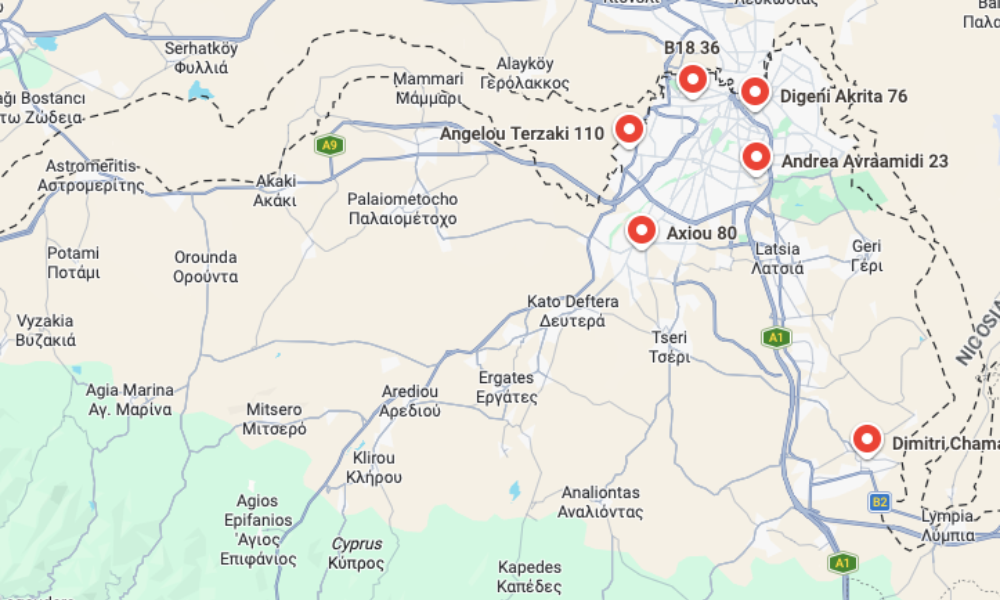
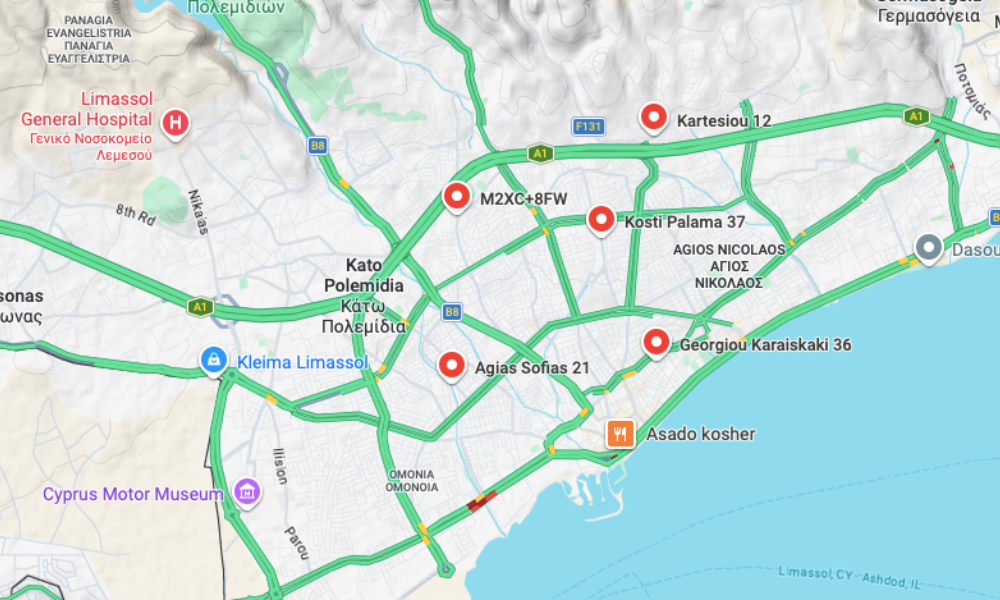
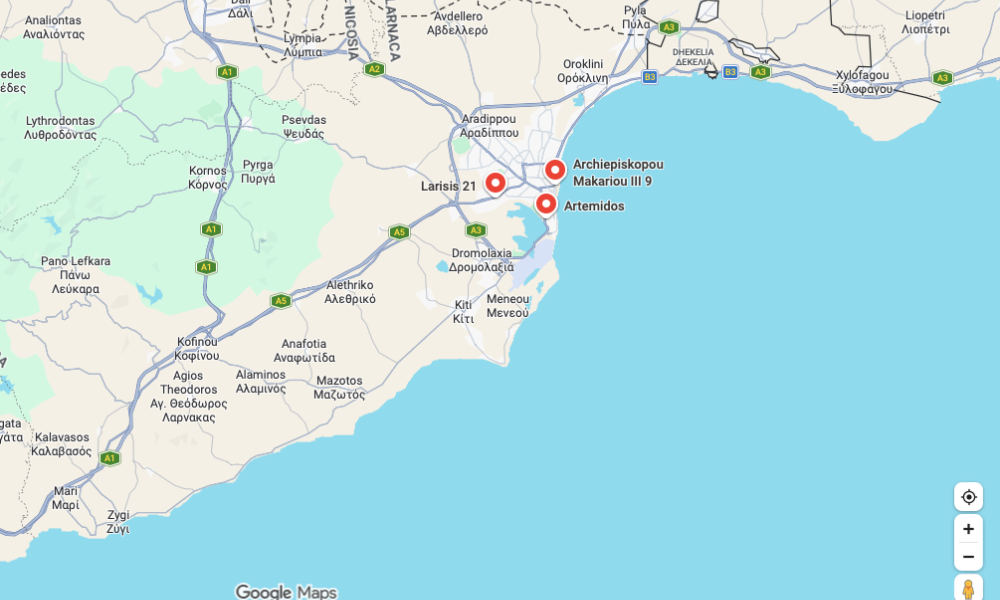
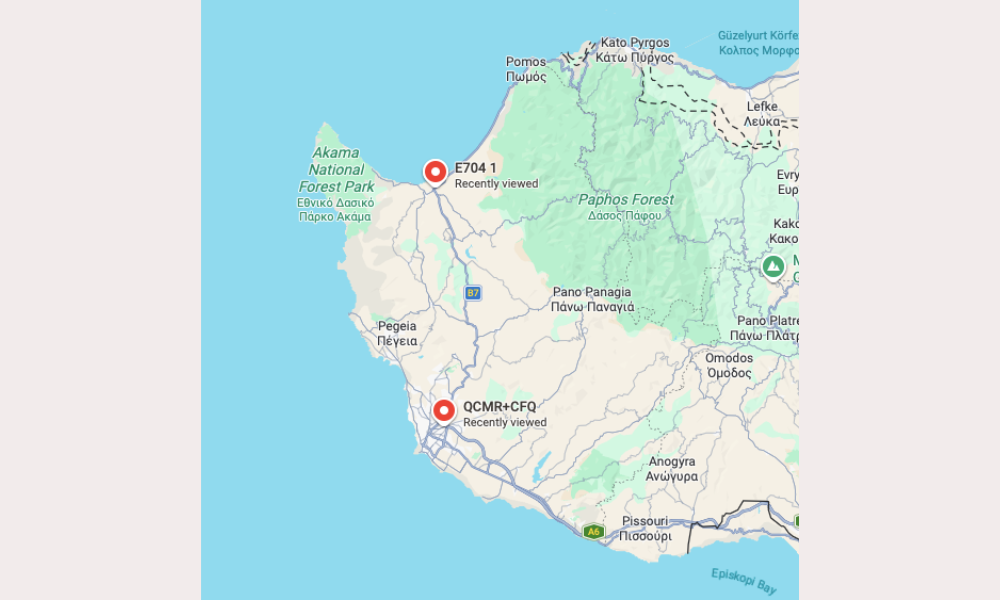
Cyprus's towns have grown outward rather than upward, unlike many European cities, where limited space forced vertical development. As a result, distances here are disproportionately long given our population and size. To see whether the selection of rota pharmacies genuinely meets the needs of the areas it covers, we picked a random date from the list already published on the Pharmaceutical Services website and mapped the areas involved. On Tuesday 8 September 2026, the rota pharmacies numbered 6 in Nicosia, 5 in Limassol, 3 in Larnaca, 2 in Paphos and 2 in the free area of Famagusta:
Nicosia
- Konstantinos Yiangkou, Grigori Afxentiou 36, Agios Dometios
- Evdokia Malea, Angelou Terzaki 110, Engomi
- Anastasia Tatti, Axiou 80, Lakatamia
- Avgi Stavrou, Digeni Akrita Avenue 76, Nicosia
- Anna Mourouzi Polykarpou, Andrea Avraamidi 23A, Strovolos
- Dimitris Petrikkos, Dimitri Hamatsou 51B, Dali
Limassol
- Andreas Georgoudis, Agias Sofias 21
- Haroula Agamemnonos, Vasileos Konstantinou 131
- Grigoris Grigoriou, Kosti Palama 37B, Mesa Geitonia
- Anna Syngelidou, Karaiskaki 36Z
- Anagnostis Ketsimpasis, Renatou Kartesiou 12, Agios Athanasios
Larnaca
- Andreas Christoforou, Larissis 21
- Andreas Sergiou, Archbishop Makarios 9
- Despina Andreou, Artemidos Avenue 30
Paphos
- Lenia Tselepou, Eleftheriou Venizelou 91, Paphos
- Panayiotis Gavriil, Vasileos Stasioikou 1, Polis Chrysochous
Free Famagusta
- Stelios Stylianou, Sotiras 7A, Paralimni
- Antonia Leontiou, Eleftherias 71, Deryneia
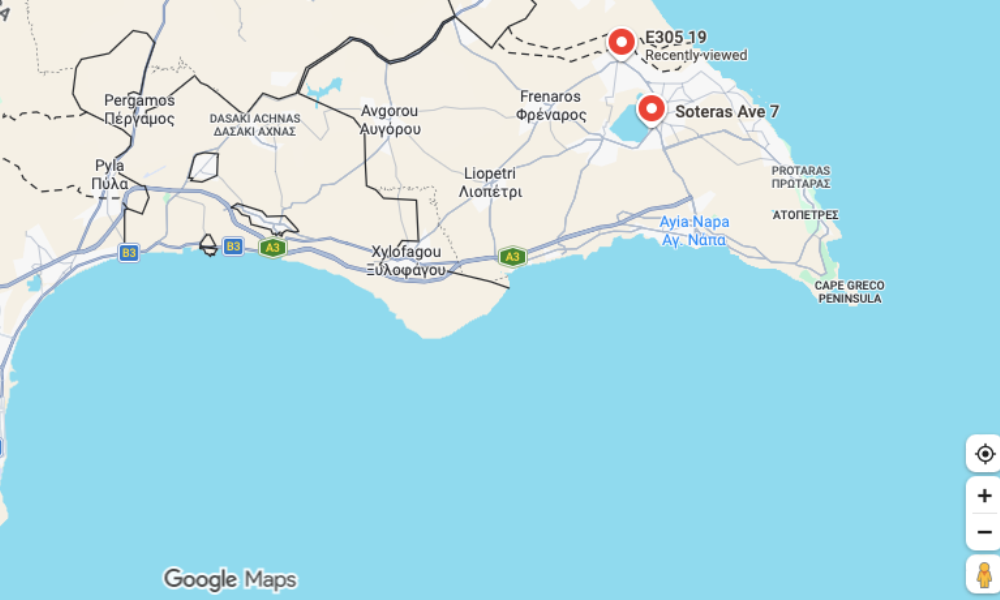
The map of coverage provided by each rota pharmacy is only indicative, and there are many areas left uncovered or without a nearby option. Beyond the distance one must travel to reach an open pharmacy, there is the further difficulty of reaching the pharmacist once there and asking to be served, only to find, at times, that the medicine needed simply isn't stocked at that rota pharmacy. Marios Koulloumas, honorary president of OSAK, told us that one of the Federation's demands has been to increase the number of night-duty pharmacies in every municipality, not just the larger urban ones. But what, in truth, happens with pharmacies in rural or mountainous areas?
What's happening in Kato Pyrgos Tyllirias?
The case of Kato Pyrgos Tyllirias is telling. As Politis had already reported back in 2019, the community "does not even have a private pharmacy," and the situation remains unchanged today: no pharmacy appears in the area under the current 2026 Register of Private Pharmacies. The nearest pharmacy is in Polis Chrysochous, roughly a fifty-minute drive along a mountain road. And it was precisely there, in Polis Chrysochous, that one of only two rota pharmacies covered the entire Paphos district on Tuesday 8 September 2026, the other being in Paphos town itself. For residents of Kato Pyrgos, then, even emergency access to a pharmacy on a rota day means an equally long journey.
Service outside the towns
In rural and mountainous areas, pharmacies, owing to their small number, are permitted to set their own hours in order to serve local residents. Familiarity between neighbours makes reaching the pharmacy owner directly a simple matter. But what happens when a visitor or tourist needs a pharmacy? Where would they find out, how would they be served, and how, in practice, does the pharmacy deliver the primary care that's required?
An app to the rescue
Mr Koulloumas told us there is a proposal to develop an application that would show which pharmacies are open, on rota, or on night duty, not just in the major urban centres but also in tourist zones, the countryside and mountainous areas, while also flagging medicines currently in short supply. The proposal is before the Pharmaceutical Council, and in 2026, building such a tool, in both Greek and English, is if not essential then certainly of vital importance, given that the health of citizens in areas we want to revitalise must be taken seriously.
Walled Nicosia
It has long been a grievance among residents, shopkeepers and workers in walled Nicosia that there is no pharmacy within its boundaries. Elderly residents, young families who moved in through European housing schemes, local businesses and tourists alike lack access to this basic form of care. The current Register of Private Pharmacies shows no pharmacy registered with an address inside the walls. Exactly when the last one closed is not clearly documented in the public record. What is known, however, is the story of the Hadjipavlou family pharmacy, opposite the Church of Panagia Faneromeni, which operated from 1909 to 1949 before being converted into an optician's shop, a use it retained until 2020, shortly before the building took on its current new purpose. The issue, like the demand itself, remains unresolved.
Seasonal pharmacies
The Pharmaceutical Council issues separate extended-hours licences to pharmacies within tourist zones, distinct from rota pharmacies, to meet the needs of areas where the population more than doubles during the tourist season.