
Cyprus entered 2026 with momentum from a record tourism year, but the Middle East crisis disrupted bookings and air travel during the spring. At the Cyprus Hotel Association’s 90th annual general meeting, the government focused on extending the season, while hoteliers called for a permanent framework to protect the industry from future shocks.
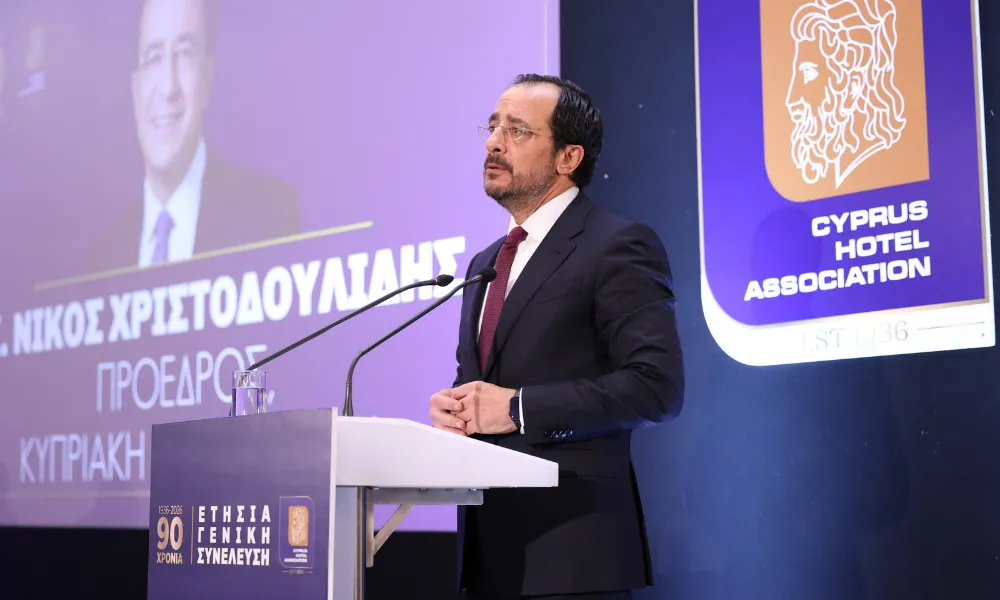
President of the Republic Nikos Christodoulides said the losses recorded so far in airline capacity and organised holiday packages remained manageable under the circumstances.
Government targets longer tourism season
Christodoulides said the government had acted from the beginning of the crisis to preserve the country’s air connectivity, maintain tourism programmes and reinforce Cyprus’s image as a safe and reliable destination.
He urged hotel businesses to make use of the support measures introduced for the sector, noting that the number of applications submitted so far remained limited.
The government’s main objective, he said, was to extend tourism activity until at least the end of November, helping the industry offset losses recorded in March and April.
“The aim must be to extend the year,” Christodoulides said. “We can reach at least the end of November, and that will help us address any losses caused by the crisis.”
He pointed to the performance of 2025 as evidence that Cyprus could move closer to becoming a year-round destination.
Tourism’s contribution to the Cypriot economy increased from 12.8% in 2023 to 14% in 2025, according to the President. Last year, Cyprus recorded more than 4.5 million arrivals and €3.7 billion in tourism revenue.
Christodoulides also referred to efforts to improve air connectivity, including plans for a direct connection with India and the launch of direct flights from Kazakhstan.
The recently approved National Tourism Strategy 2035 will guide the sector’s development over the next decade, focusing on a longer operating season, alternative forms of tourism and a wider distribution of tourism revenue across the country.
Bookings and cancellations affected
Outgoing Cyprus Hotel Association President Thanos Michaelides said the sector was at a critical point, moving from the record results of 2025 to managing the impact of regional instability.
The United Kingdom remained Cyprus’s largest tourism market last year, while arrivals from Israel, Poland, Germany and Romania recorded significant increases.
Annual hotel occupancy rose to 55.5%, with overnight stays exceeding 19 million.
However, research conducted by the association in cooperation with the Greek Institute of Tourism Research and Forecasting found that bookings declined and cancellations rose by approximately 30% during March and April.
The negative trend continued in May and June, although the situation showed some improvement.
Michaelides welcomed the government’s approval of the Special Employment Support Scheme for the hotel industry, saying the protection of jobs remained a central priority.
He warned that the way the current disruption was handled would have a significant effect on tourism performance in 2027.
Hoteliers seek permanent crisis mechanism
Michaelides called for stronger international promotion campaigns and greater penetration into markets including Germany, Switzerland and countries in Central and Northern Europe.
He also proposed the creation of a permanent crisis management team, bringing together representatives of hotels, tour operators, airports and the Deputy Ministry of Tourism.
A formal tourism advisory body should also be established, he said, to improve coordination between the public and private sectors.
The association also announced the creation of Xenios Analytics, a digital platform that will collect and analyse information on hotel performance, operating costs and wider market trends.
The platform is intended to provide more reliable data for decision-making and the development of tourism policy.
Competitiveness and licensing
Michaelides said Cyprus needed to improve its competitiveness through investment in quality, innovation and staff training, while gradually reducing its dependence on a limited number of source markets.
Better air connectivity would also be essential to broadening the country’s tourism base.
He renewed the association’s proposal for a single licensing authority, or one-stop shop, for hotel businesses. Hotels currently have to deal with approximately 12 different government services to obtain the necessary permits, increasing administrative costs and delays.
Cyprus Hotel Association Director General Christos Angelides said the organisation’s 90th anniversary marked both an opportunity to review its contribution and to prepare the industry for its next phase.
Church highlights tourism investment
Archbishop of Cyprus Georgios said the Church had consistently supported initiatives contributing to tourism and economic development, including through investments in the hotel sector.
He said quality, innovation, sustainability and high standards of service were essential for Cyprus to maintain its position in an increasingly competitive international market.
The Archbishop also referred to the impact of the 1974 Turkish invasion, during which hotel properties belonging to the Church and private owners in the occupied areas were seized, destroyed or looted.
The meeting concluded with honours presented to Archbishop Georgios for the Church’s contribution to tourism and to 15 families recognised for their role in the development of Cyprus’s hotel industry.
Source: CNA