
Restrictions on nuclear generation, Europe’s gradual move away from Russian energy, and the emergence of the Eastern Mediterranean as an alternative source of natural gas and green electricity are adding a new dimension to the debate over the Cyprus-Greece-Israel electricity interconnection.
The Great Sea Interconnector (GSI) is unlikely to become Europe’s “saviour” on its own. Under certain conditions, however, it could form part of a new energy corridor from the Eastern Mediterranean to the European market.
Until recently, the debate over the Great Sea Interconnector in Cyprus was conducted mainly in terms of cost: How much will the Cypriot consumer have to pay? Is the project economically viable? And does the small Cypriot market need a €2 billion electricity interconnection?
The energy reality around Cyprus, however, is changing so rapidly that the equation can no longer be limited exclusively to the domestic market.
Within just a few years, Europe has found itself facing two different but interconnected risks: the geopolitical insecurity of fuel supplies and the climate insecurity of electricity generation itself.
Nuclear power
The summer of 2026 perhaps offered the clearest picture yet of the second risk.
In France, extreme heat and high river temperatures forced EDF to reduce or temporarily halt the operation of nuclear units. By mid-August, it was estimated that around 15% of France’s nuclear capacity would be affected by the heatwave, while units such as Bugey and Golfech were temporarily taken offline in order to comply with environmental limits on the temperature of water used for cooling.
The situation on the Danube was even more dramatic. At the end of July, Romania was forced to shut down both reactors at Cernavoda because of historically low river levels. The two units, with a combined capacity of around 1,400 MW, account for approximately 20% of the country’s electricity generation.
Hungary and Bulgaria faced similar problems, with Paks drastically reducing its output and Kozloduy reducing its power for the first time because of low water levels in the Danube.
This does not mean that nuclear power is ceasing to be a key pillar of Europe’s energy system. It does, however, mean that climate change is introducing a new source of instability even into forms of generation that were traditionally regarded as reliable.
Heatwaves simultaneously increase demand for electricity for air conditioning and, in certain circumstances, restrict the ability to generate electricity. The result is precisely what the European market recorded this year, with summer electricity prices at certain times approaching levels that until recently were associated mainly with winter.
The second uncertainty is geopolitical
At the same time, Europe is gradually — and now institutionally — disengaging from Russian energy.
The dependence has not fallen to zero: in 2025, Russia still accounted for approximately 13% of EU natural-gas imports, down from 19% in 2024. However, in January 2026, member states approved the gradual banning of Russian gas imports, with LNG to be fully phased out from the beginning of 2027 and pipeline gas from the autumn of the same year.
Europe is not in the state of panic seen in 2022. It has built new LNG facilities, diversified its suppliers, and the European Commission estimates that there is no immediate risk to supplies for the winter of 2026–27.
The fundamental issue, therefore, is not that Europe is about to “run out” of energy. It is that it is seeking more sources, more routes and greater capacity to move electricity from one region to another when shortages or major price differences arise.
This is where the Eastern Mediterranean becomes more interesting.
From energy island to potential exporter
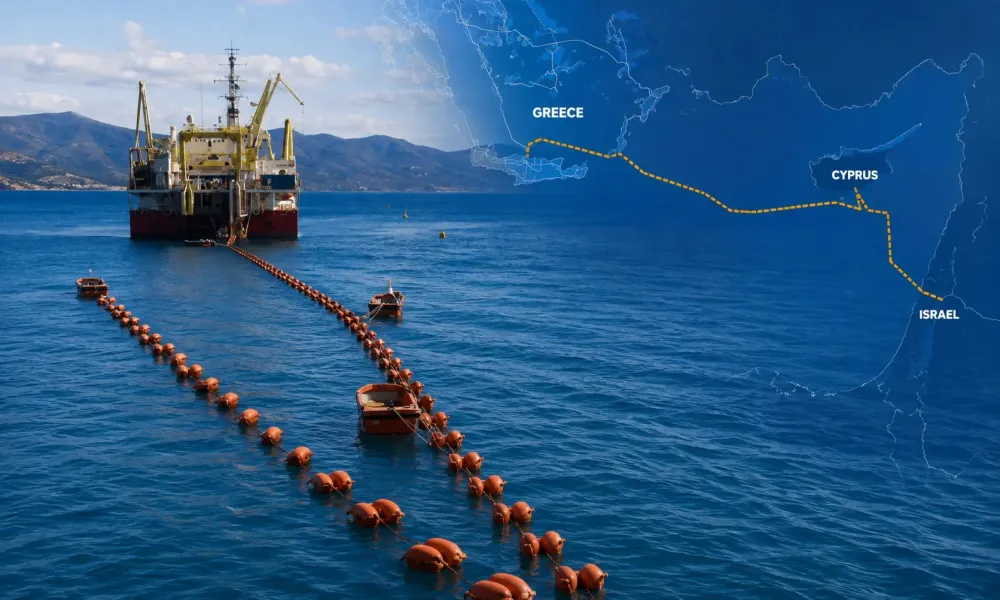
Cyprus is currently the last EU member state without an electricity connection to the European system. The GSI is specifically designed to end this isolation.
The Crete-Cyprus section is approximately 898 kilometres long, while the planned Cyprus-Israel extension would add a further 324 kilometres or so. The nominal transmission capacity is 1,000 MW, with electricity able to flow in both directions.
That capacity is impressive when compared with the size of the Cypriot system.
On 23 July 2026, Cyprus recorded a historic peak in electricity demand of 1,372 MW. A 1,000 MW cable is therefore not a supplementary detail for Cyprus. It is infrastructure capable of radically changing the way the electricity market operates, allowing both large-scale imports during periods of shortage and exports when there is surplus generation.
And this may be the strongest argument in favour of the interconnection.
Cyprus has far more sunshine than its isolated electricity system can currently make use of. Curtailments of photovoltaic generation have increased dramatically.
According to an analysis of official data from the Cyprus Transmission System Operator, approximately 230 GWh of photovoltaic energy was curtailed between January and July 2026, compared with around 178 GWh that was fed into the grid.
The System Operator now publishes daily reports on renewable-energy curtailments.
Without storage and interconnections, more photovoltaics do not automatically mean more usable energy. With an interconnection, however, surplus generation can acquire a buyer instead of being curtailed.
Gas as a “bridge”
The natural-gas fields of the Eastern Mediterranean must also be considered as part of this picture.
The European Commission already regards Israel, Egypt and Cyprus as strategic partners in efforts to diversify European energy supplies.
Cyprus is even moving from theory to production. TotalEnergies and Eni took a final investment decision in July on the Kronos field, with production expected to begin in 2028 and a target of approximately 2.8 million tonnes of LNG per year.
The gas will be transported via an undersea pipeline to Egypt, liquefied at Damietta and from there supplied, among other destinations, to the European market.
This demonstrates the new value of Cyprus’ geographical position, but also the limits of the argument.
Natural gas will not be transported through the GSI. It could, however, in the longer term also be used for electricity generation in the region, with the electricity produced then transmitted through interconnections.
For Egypt, the picture is more complex.
The country has enormous LNG infrastructure, but is currently experiencing a decline in domestic production and has been forced to import large quantities of natural gas.
Egypt’s real potential as an electricity exporter to Europe is more closely linked to its enormous potential for solar and wind power and the planned GREGY cable to Greece, with capacity of up to 3,000 MW.
The GSI’s real challenge
The GSI should therefore not be presented as a cable that will meet Europe’s energy needs.
A capacity of 1,000 MW is enormous for Cyprus but small in relation to the European electricity system. Its strategic importance lies elsewhere.
If the GSI, GREGY, the Greek interconnections with Bulgaria, Italy and the Balkans, the major expansion of solar and wind power in the Eastern Mediterranean, and available natural-gas generation are combined, a new southern energy corridor to Europe could gradually emerge.
During periods of low generation in northern or central Europe, electricity could flow northwards. During periods of cheaper European generation, the same cable could supply Cyprus and later Israel, and potentially even Lebanon, Syria and Turkey.
Turkey is a huge market and could become one of the pillars of the system, provided it overcomes its problems with Israel and Cyprus.
This is the major advantage of interconnections. Not that they always guarantee cheap energy, but that they increase the available options.
And precisely because the era of energy certainty is coming to an end, whether because of wars or because of droughts, heatwaves and extreme weather events, the ability to choose is acquiring greater economic and geopolitical value.
In this sense, climate change and geopolitical upheaval do not automatically prove that the GSI is economically viable. They do, however, change the parameters against which its viability must be assessed.
The question is no longer simply how much a cable to Greece will cost Cyprus. It is also how much it is worth for Cyprus to find itself, for the first time, on an energy corridor that could, over the coming decades, connect the sun and gas fields of the Eastern Mediterranean with the markets of Europe, the Near East and the Middle East.
A Cyprus settlement is key
With a settlement of the Cyprus problem and a substantial normalisation of Turkey-Israel relations, the energy map of the Eastern Mediterranean could change fundamentally.
Turkey, with an electricity market several times larger than those of Cyprus and Israel, and with existing electricity connections to Greece and Bulgaria, could simultaneously function as a major buyer and as a second gateway from the region to the European market.
A future Cyprus-Turkey electricity interconnection would not necessarily have to compete with the GSI. On the contrary, it could complement it, creating a network of interconnections linking Israel, Cyprus, Greece and Turkey.
At the same time, a settlement of the Cyprus problem would remove one of the major political obstacles that for years stood in the way of the idea of transporting Israeli natural gas to Turkey.
In such a scenario, Cyprus would no longer be the isolated end of the European energy system, but the hub where the European, Turkish and Eastern Mediterranean energy markets meet.
This, of course, requires vision from the political leaderships of Cyprus, Israel and Turkey — something that, unfortunately, is not exactly abundant.
What the region does have in abundance, however, is a foolish nationalism that obstructs any serious planning for economic development for the benefit of our peoples.