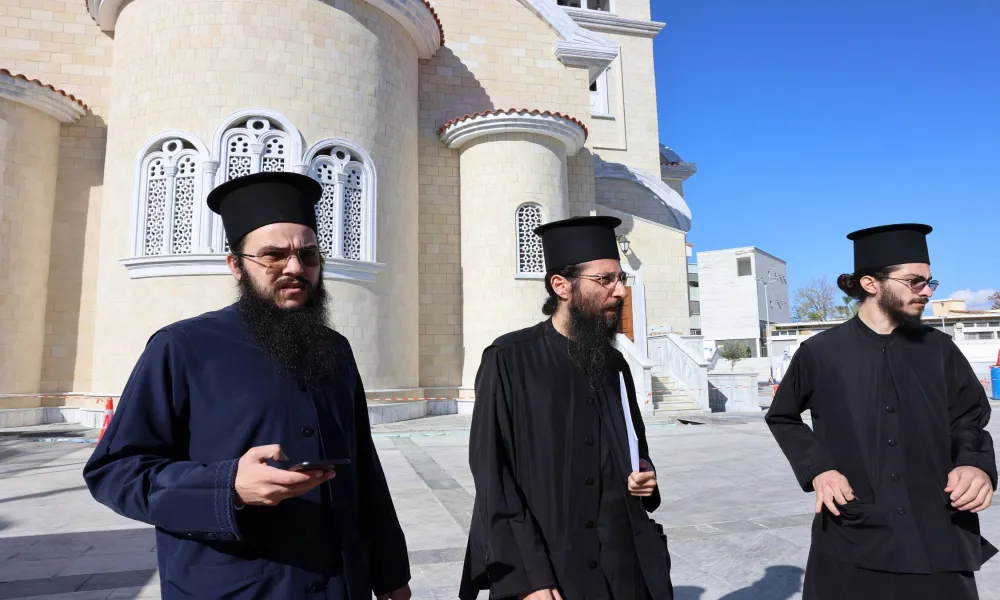



Financial allegations against monks at the Holy Monastery of Saint Avvakoum, the circumstances in which they allegedly admitted wrongdoing, and the handling of money and items transferred to Tamasos Metropolis were among the main issues raised during cross-examination at Nicosia Criminal Court.
Defence lawyer Costis Efstathiou, representing the first defendant, monk Nektarios, questioned prosecution witness Father Dionysios Koptidis during the latest hearing.
The proceedings covered the €790,000 reportedly associated with the monastery's safes, the timing of the collection of financial evidence, a Metropolis announcement inviting members of the public to submit complaints, and the circumstances surrounding a signed declaration by hieromonk Avvakoum.
The cross-examination also addressed allegations of a sexual nature, items transferred from the monastery to Tamasos Metropolis, and questions of ecclesiastical and canon law concerning the relationship between monasteries and their local metropolitan.
Defence questions financial allegations against Nektarios
Efstathiou pressed the witness on whether the specific financial offences allegedly attributed to Nektarios had been clearly identified.
Referring to Father Dionysios's written testimony, the lawyer read out a passage stating that Nektarios had been presented with what were described as “incontrovertible evidence” from audiovisual recordings concerning ecclesiastical offences, breaches of Church rules and financial misconduct.
Efstathiou asked which financial offences had specifically been put to the monk and whether the alleged acts had been explained to him.
Father Dionysios said the meeting at Tamasos Metropolis had not been limited to financial matters. He added that details concerning the financial issues emerged later, following appearances at the Metropolis and the launch of investigations after the case became public.
Asked when information about the specific financial matters had come to light, the witness referred to the start of the financial investigation and the publication of an announcement inviting members of the public to report any problems or complaints involving the monastery.
€790,000 and the monastery safes
The examination turned to the monastery's safes and the €790,000 they were reportedly said to contain.
Efstathiou asked whether the alleged financial misconduct related to the existence of money that had not been declared to the Metropolis.
Father Dionysios said the sum should have been declared to the Metropolis, clarifying, however, that no financial investigation had been conducted at the time and that the money was declared subsequently.
The lawyer questioned whether Nektarios could be said to have admitted financial misconduct without the specific acts attributed to him having been identified.
The hearing also examined the circumstances in which a safe was opened and its contents counted. Referring to the witness's written testimony, Efstathiou said Nektarios had requested to be present during the counting because he knew the safe's combination.
The lawyer asked who had opened the safe and whether the abbot had attended the process.
Father Dionysios said he had been present during the counting for a few minutes before leaving.
Dispute over allegations of a sexual nature
Efstathiou referred to a section in the written testimony stating that monks Nektarios and Avvakoum had allegedly admitted guilt while seeking a compromise.
Asked what he meant by saying the monks had no other option, Father Dionysios replied that the matter did not concern financial issues alone, but also matters of a sexual nature.
The defence lawyer noted that these references did not appear in the witness's written testimony and asked whether Nektarios had been questioned specifically about such matters.
Father Dionysios said the monk had been examined over alleged financial misconduct, adding that the other issues arose from audiovisual material.
Efstathiou put it to the witness that his references to moral or sexual offences were not supported by his testimony and accused him of lying on the matter.
Father Dionysios rejected the accusation, insisting that he was not lying.
Questions over Avvakoum's signed declaration
The cross-examination then turned to hieromonk Avvakoum and a declaration he had reportedly signed.
Efstathiou asked what specific accusation had been made against Avvakoum and whether it had been put to him verbally.
Father Dionysios said there had been a specific allegation, which he explained concerned the placing of myrrh on a cross.
Asked who had prepared the declaration, the witness said he had drafted it himself.
The lawyer sought further clarification about the circumstances in which the document had been signed and whether it appeared in the audiovisual material presented to the court.
Father Dionysios referred to the existence of video footage and maintained that Avvakoum himself had admitted to the matters set out in the declaration.
Efstathiou disputed that account, arguing that the hieromonk had never accepted its contents.
Questions were also raised about Father Dionysios's role in the process, including whether he had recorded statements dictated by the metropolitan or other individuals.
Metropolis announcement and public complaints
The defence also examined a written announcement prepared at the direction of the Bishop of Tamasos. It invited anyone with a problem or complaint concerning the Monastery of Saint Avvakoum or its members to contact the bishopric.
Efstathiou asked whether the metropolitan had requested the announcement and explained why it was being issued.
Father Dionysios confirmed that the announcement had been requested by the metropolitan but said no reason had been given to him.
The lawyer linked the announcement to the case becoming public and to the first telephone calls reportedly received by the Metropolis.
He also asked how many people had responded to the invitation and what action had followed, including whether complaints had been made to the police.
The witness said he could not remember the number of complaints but confirmed that they had been submitted to the police.
Items transferred from the monastery
Efstathiou questioned the witness about items collected from the monastery by 16 authorised individuals and transferred to Tamasos Bishopric.
Asked what the items were and where they had been placed, Father Dionysios said he could not remember where they were kept on the night they were transferred.
He added that he saw them again some time later in the basement of the Metropolis.
Dispute over monasteries' relationship
Part of the cross-examination focused on ecclesiastical and canon law, with the defence and the witness disagreeing over the autonomy of monasteries and the extent of the authority exercised by the local metropolitan.
Efstathiou argued that monasteries within a diocese were fully subject to the relevant metropolitan, citing provisions of the Church's Charter and ecclesiastical canons.
Father Dionysios maintained that the rule read to him concerned the monastic habit and tonsure, including the examination of a candidate before becoming a monk.
The discussion also addressed the legal status of monasteries. Both sides agreed that monasteries were legal entities but disagreed over whether this meant they were independent of the metropolitan or whether their legal personality coexisted with ecclesiastical dependence.
A further disagreement arose over an analogy used by the witness, who compared the relationship between a bishopric and its monasteries to that between a parent company and its subsidiaries.
Efstathiou described the comparison as offensive to religion and monasteries. Father Dionysios replied that it was intended to illustrate a monastery's dependent relationship with its local metropolitan see.
The lawyer also cited the Council of Chalcedon, arguing that the metropolitan's consent in relation to a monastery concerned its construction and foundation.
Defence plans to question 16 individuals
The cross-examination also examined events at Tamasos bishopric and the involvement of 16 individuals who, according to the testimony, had been authorised by Bishop Isaias of Tamasos to visit the Monastery of Saint Avvakoum.
At Nicosia Criminal Court, the witness was asked whether he knew the individuals concerned and what role some of them had played in the subsequent events.
The defence said it intended to call the 16 individuals for cross-examination and also expressed its intention to call Metropolitan Isaias to give evidence.
The proceedings form part of the ongoing criminal case relating to the Monastery of Saint Avvakoum. The allegations and disputed accounts raised during the hearing remain subject to the court process.