My phone rang the other day. It wasn't an ordinary call, and on the other end wasn't a friend, a colleague or a relative. It was a man I didn't know, who, in all likelihood, will never learn anything more about me beyond the voice he heard for a few minutes through his phone.
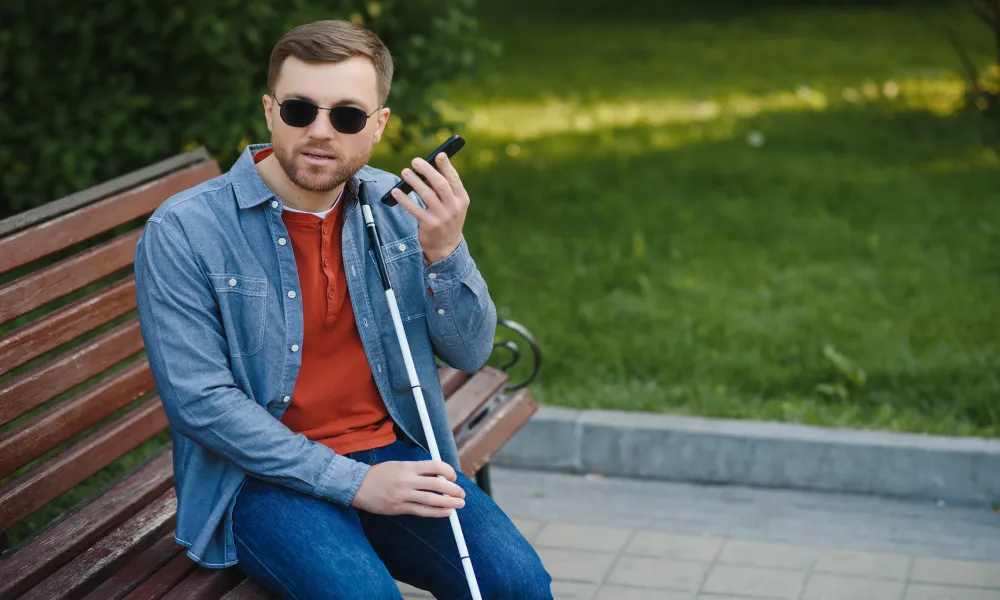
The man wanted to print something from his computer and needed help finding the right options on the screen. Through his phone's camera, I could see what was in front of him and guide him, ask him to move the phone slightly, show me the screen more clearly, explain where the option he was looking for was located. It wasn't anything difficult. For a sighted person, clicking the right icon and sending a document to the printer is an almost automatic action, one of those things we do without ever pausing to consider how much information our eyes take in within a few seconds. For someone who is blind or has seriously impaired vision, though, that small step can become a real obstacle.
Be My Eyes
The call had come through Be My Eyes, an app I had only recently installed as a volunteer. Until that moment, I knew the theory: that someone with a vision impairment can ask for help, the app alerts available volunteers, and whoever answers first is connected to them by video call. But there's a real difference between reading how an app works and suddenly seeing the world on your own screen through the camera of someone who needs your… eyes.
The experience lasted only a few minutes, but that was enough to grasp just how simple, and at the same time how powerful, the idea behind Be My Eyes really is. It doesn't ask the volunteer for money, specialised knowledge, or any long-term commitment. It asks for something far more basic: to lend, just for a moment, something they use every day without a second thought, their eyesight.
How the idea was born
Behind Be My Eyes is Hans Jorgen Wiberg, a Dane who himself has impaired vision, and who knew firsthand the difficulties that can turn an otherwise simple everyday task into a real problem. The idea began to take shape in 2012, while Wiberg was working with people who had vision problems. He had noticed that many blind people were already making use of video calling, phoning relatives or friends whenever they needed someone to describe something in front of them, a label, a food item, a letter, a display on a household appliance, or something showing on a computer screen. The problem wasn't always a big one. But that, in a way, is precisely the point. For many of these needs, no specialised care is required. All that's needed is a pair of eyes, for a few minutes.
To be able, when you're struggling, to ask for help and know that someone will answer. The other day, that someone happened to be in Cyprus. A stranger wanted to print something from his computer and, for a few minutes, needed to see through someone else's eyes. I lent him mine.
Wiberg realised that technology could dramatically widen the circle of people someone could turn to for this kind of help. Instead of the user having to call a family member or friend every time, there could be an entire international network of volunteers, available through the phone. The idea was presented at a startup event in Aarhus, Denmark, and gradually began to take technological shape. On 15 January 2015, Be My Eyes launched for the first time on iPhone, and the response exceeded initial expectations. Within the first 24 hours, more than 10,000 volunteers had already signed up. Two years later, an Android version followed, and the community began growing on a global scale.
10 million volunteers
Today, Be My Eyes counts more than one million blind and visually impaired users, while registered volunteers now exceed 10 million worldwide. The huge gap between these two numbers is, in fact, part of what makes the app work. For the model to function, not every volunteer needs to take calls every day. What's needed is enough people spread across different countries and time zones so that, whenever a user asks for help, someone is there to answer.
How it works
The app takes into account volunteers' language and availability. Once a request is submitted, the notification reaches available people, and whoever responds first is connected with the user. No details are exchanged beforehand, no appointment is arranged, and, typically, the two people speaking know nothing about one another. The volunteer sees through the rear camera of the user's phone, and the two can talk normally. From there, everything depends on the need of the moment.
A woman might want to know which of two similar-looking boxes contains the medication she's looking for. Someone might need to read the expiry date on a food item, tell apart the colour of a piece of clothing, or find an object that's fallen on the floor. Another might be standing in front of a washing machine and need to know which position a dial is set to. And a man, like the one who called the other day, might simply want to print something from his computer. Precisely because many of these needs seem small, Be My Eyes reveals a side of disability that often goes unnoticed by those who don't experience it. A person's independence isn't limited only by major obstacles. It's also limited by dozens of small pieces of information that the world around us still assumes are simply picked up by sight.
The role of AI
More than 11 years after it first launched, Be My Eyes is no longer just an app for video calls with volunteers, since the development of artificial intelligence (AI) has created new possibilities, and the platform has incorporated them through Be My AI. With this feature, a person with a vision impairment can photograph something in front of them and ask the system to describe it. They can then ask follow-up questions, requesting more information about specific elements of the image.
This capability significantly changes how the app is used day to day. A large share of simple queries can now be answered without needing to call a human volunteer at all. The AI can describe a photo, identify objects, or read information that appears within an image.
One might assume this development would gradually make Be My Eyes's original model obsolete. But that hasn't happened. People remain part of the service, because there are moments when a description simply isn't enough. What's needed is dialogue, guidance, real-time adjustment to what the user is doing and, at times, the simple reassurance that a real person is on the other end who understands what's being asked of them. This coexistence may well be one of the most interesting features of Be My Eyes today.
At a time when the conversation around artificial intelligence often revolves around whether machines will replace people, here technology is being used differently. Sometimes it replaces the need for help, and sometimes it finds the right person to provide it.
The platform has also created options for direct communication with companies and services, allowing a visually impaired user to receive specialised support for specific products. In this way, an idea that began as a volunteer network has gradually grown into a broader infrastructure for digital accessibility.
Trust
Growth, of course, brings questions of privacy along with it. The person answering a call may find themselves, for a few minutes, inside the personal space of a complete stranger. The camera might show their home, a personal document, a letter, or a screen containing information not meant for anyone else. This is why trust is an essential ingredient of the app. The volunteer isn't there to become an observer of someone else's life, but to see only as much as is needed to solve the specific problem at hand. Helping requires discretion and respect, perhaps all the more so precisely because the person asking for help is forced, for a few minutes, to trust the eyes of a complete stranger.
The satisfaction
That was the feeling my first Be My Eyes call left me with. When the connection ended, the man went back to what he was doing, and I went back to my own day. I never learned who he was, where he was, or exactly what he wanted to print. Nor was there any reason to. But something from those few minutes stayed with me. The sense that, behind all the talk about technology, artificial intelligence, and apps that promise to transform our daily lives, some of the most meaningful innovations still rest on an extremely old human need. To be able, when you're struggling, to ask for help and know that someone will answer. The other day, that someone happened to be in Cyprus. A stranger wanted to print something from his computer and, for a few minutes, needed to see through someone else's eyes. I lent him mine.