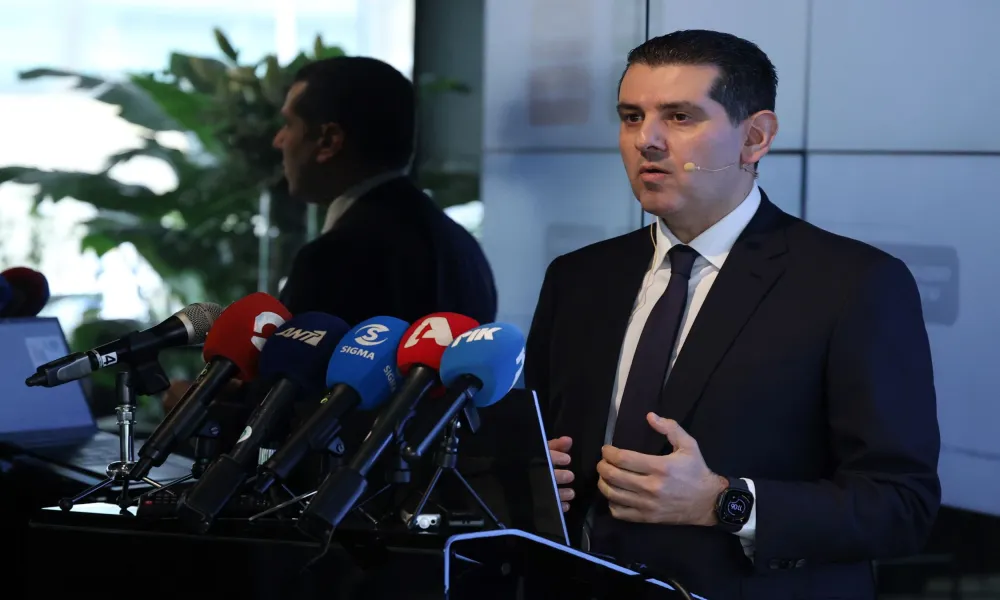

President Nikos Christodoulides will travel to Antalya next month for COP31, the UN climate conference that Turkey is hosting from 9 to 20 November. The decision follows weeks of diplomatic friction. Ankara reportedly tried to leave the Republic of Cyprus out of the leaders’ gathering, and EU institutions and member states insisted that all 27 be treated equally. If the visit goes ahead, it will be the first by a Cypriot president to Turkey in a decade.
The invitation dispute
The dispute came into the open on Sunday 11 October. The Turkish President Recep Tayyip Erdoğan had sent personal letters to the heads of government of 26 EU member states, inviting them to the conference’s leaders’ meeting on 11 and 12 November.
On the same day, a government source told CNA that Cyprus had received an invitation letter for COP31 in Antalya. The source credited what it called “systematic and coordinated” Cypriot diplomatic efforts, together with the mobilisation of European institutions and EU member states.
According to the same source, EU pressure, described as clear and coordinated, had played a substantive role. EU member states’ position, the source added, is that the full and equal participation of a member state in international processes cannot be questioned or subjected to unilateral restrictions.
Months of friction before Antalya
Earlier this year, Cyprus was reportedly left out of a COP31 briefing at UN headquarters in New York. Turkish media reported that officials in Ankara rejected the criticism and said Turkey had no obligation to invite a state it does not recognise. Turkish diplomatic sources drew a line between UN-coordinated COP31 events, to which they said Cypriot delegations had been invited, and the New York briefing, which they said Turkey had organised outside the UN process.
In June, Cyprus raised concerns that Ankara planned to invite only 26 of the EU’s 27 member states. EU Climate Commissioner Wopke Hoekstra said that excluding Cyprus would be unacceptable and that all member states must be treated equally.
At the EU Environment Council in Luxembourg on 25 June, Greek Environment and Energy Minister Stavros Papastavrou backed the Commissioner’s position. “The participation of all 27 member states is both self-evident and non-negotiable. Either all 27 or none,” he said.
The EU’s written position
The EU then put its position in writing. In conclusions approved on 12 October to prepare for COP31, the Council of the EU “underlines the importance of the participation of all EU Member States at COP31 in Antalya, Türkiye”. It also reaffirmed “the principle of solidarity among EU Member States in this regard”.
At the European Council summit later that week, EU leaders went further. At Cyprus’s initiative, their conclusions include an explicit reference to COP31. The European Council “underlines the importance of the equal participation and treatment of all EU member states” at the conference in Antalya.
“Of course I will attend”
President Christodoulides confirmed his attendance on Tuesday 13 October. “Of course I will attend. The Republic of Cyprus always attends these summits,” he said.
He credited “our partners” and diplomatic work carried out without publicity for the outcome. He said the development also carried messages about the Cyprus problem. According to reports, he added that preparations covered every eventuality, that unwelcome developments could not be ruled out, and that Cyprus would respond to any such developments as a member of the 27-strong EU.
Erhürman also invited
On 14 October, Turkish Cypriot leader Tufan Erhürman confirmed that he too will be in Antalya during the summit. He said in a social media post that Erdoğan had invited him on 14 July.
“As we always say, diplomacy and dialogue are always a good thing,” Erhürman said.
A rare presidential visit
Only three Cypriot presidents have set foot in Turkey since independence. Each visit was tied to a particular moment in relations between the two countries.
The first was Archbishop Makarios III, the Republic’s first President, who made an official visit to Turkey in 1962, two years after independence. It is still the only official bilateral visit by a Cypriot head of state.
In November 1999, President Glafcos Clerides travelled to Constantinople for the summit of the Organisation for Security and Co-operation in Europe (OSCE). He attended as Cyprus’s head of state at a multilateral gathering, not as Turkey’s guest. The summit came only months before the island’s EU accession process gathered pace.
The most recent visit was by President Nicos Anastasiades, who attended the UN World Humanitarian Summit in Constantinople on 23 and 24 May 2016. It also came at a significant time, as UN-backed reunification talks were under way. Those talks later collapsed at Crans-Montana in July 2017.
If Christodoulides travels to Antalya in November, he will be the fourth Cypriot president to visit Turkey, more than ten years after Anastasiades’ trip. Like the visits of Clerides and Anastasiades, it would be for a multilateral summit, not a bilateral visit.
One summit, two presidencies
Antalya will also host a conference with an unusual structure. For the first time, the COP presidency and leadership of the negotiations will be split between two countries. This is set out in a special COP31 publication by Turkish news agency ANKA.
Turkey and Australia both bid to host COP31. The host has to be agreed by consensus within the Western European and Others Group, and neither side was willing to step aside. The deadlock was resolved at COP30 in Belém. Turkey would host the conference and hold the COP presidency, while Australia would take charge of the formal negotiations.
Turkey’s Environment, Urbanisation and Climate Change Minister Murat Kurum, as COP31 President, will oversee the host presidency, the World Leaders’ Summit and the Action Agenda. Australia’s Climate Change and Energy Minister Chris Bowen, as President of Negotiations, will have “exclusive authority” over the negotiating process. That includes selecting facilitators and preparing draft texts and the cover decision. Final decisions remain with the parties and require consensus.
Asked by international journalists in September, Kurum stressed that Turkey and Australia are not co-presidents. “The final decision lies with the presidency of COP31,” he said.
The Action Agenda covers ten themes, from clean energy and electrification to food security, oceans, health, zero waste and green industrialisation. The leaders’ climate action summit, which Christodoulides is due to attend, takes place on the third and fourth days of the conference.
The host’s climate record under scrutiny
The ANKA publication also examines Turkey’s own record as host. It notes that Turkey became Europe’s largest coal-fired electricity generator in 2024.
Turkey has set a net-zero target for 2053. Its long-term strategy allows emissions to keep rising until they peak by 2038 at the latest. In its 2035 Nationally Determined Contribution, submitted in November 2025, Turkey pledged to cut emissions by 466 million tonnes from a projected 1,109 million tonnes, bringing them to 643 million tonnes of CO2 equivalent. That target is set against projected future emissions, not as an absolute cut from current levels. Climate Action Tracker estimates that, excluding forests and land use, Turkey could still emit 694 million tonnes in 2035, which is 31% more than in 2018.
According to Turkey’s latest national inventory:
- Total emissions reached 584.5 million tonnes of CO2 equivalent in 2024
- That is 155.3% higher than the 228.9 million tonnes recorded in 1990
- After slight falls in 2022 and 2023, emissions rose again by 5.3% in 2024
Turkey has expanded renewables quickly. Wind and solar supplied a record 22% of its electricity in 2025. But coal still generated 34%, or 121 TWh, which is close to its record high. Turkey aims for 120 GW of wind and solar by 2035, nearly triple current levels. Energy think tank Ember calculates that reaching this would require around 8 GW a year, while the planned annual YEKA auctions would provide only 2 GW.
Turkey has not set a coal phase-out date. Ember also points to an $8.7 billion purchase guarantee for domestic coal plants announced in 2025. The OECD has said current policies are not sufficient to reach net zero by 2053.
The venue
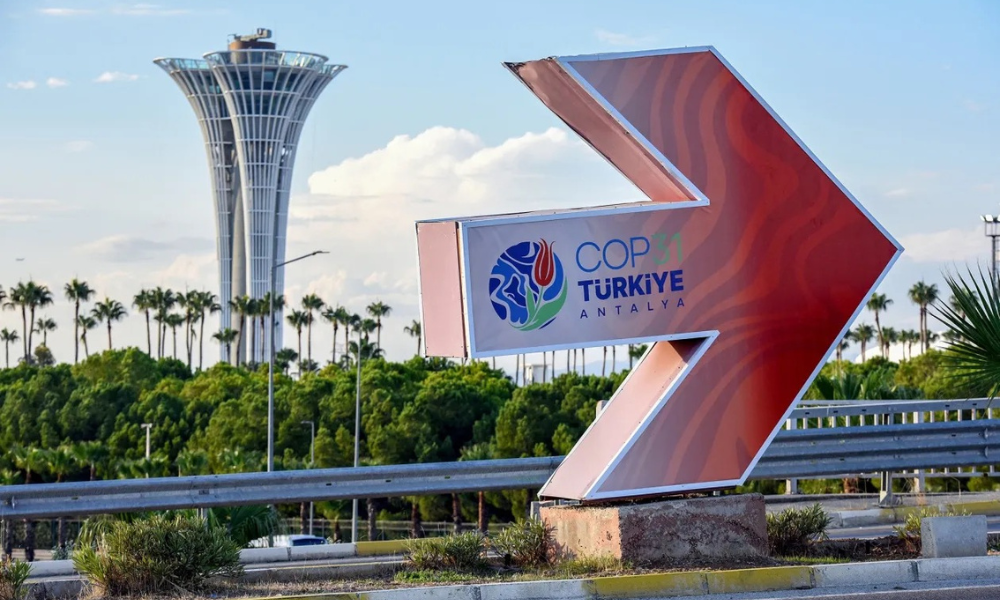
The conference will take place at the former EXPO 2016 Antalya grounds, beneath the 101-metre EXPO Tower. The site will be divided into two areas:
- the Blue Zone, managed by the UNFCCC, where national delegations negotiate and entry requires accreditation
- the Green Zone, open to businesses, researchers, NGOs, civil society and visitors
The ancient city of Perge, once the capital of Pamphylia, lies just a few kilometres from the conference grounds.
With information from ANKA