
Former judge Andreas Paschalides is approaching the end of his extended deadline to identify the person or persons who commissioned and financed Israeli intelligence firm Black Cube's operation in Cyprus, which led to the release of the controversial eight-minute 'Videogate' video.
Appointed as an independent criminal investigator by Attorney General George Savvides, Mr Paschalides has been tasked with identifying those behind the operation, which brought allegations of corruption involving the Presidential Palace into the public spotlight.
According to information, the investigator has yet to reach firm conclusions about the identity of those who commissioned the operation. He is also understood not to have accepted as established the motive publicly attributed to the operation by Black Cube itself.
In a statement to Politis, the Israeli firm said its objective had been to expose alleged corruption involving Cyfield. Mr Paschalides, meanwhile, had previously left open the possibility of foreign state involvement, pointing towards Russia.
A third scenario has also returned to the spotlight in recent days, linking the operation to Israeli businessman Simon Aykut. However, no publicly available evidence has so far established any involvement on his part in organising or financing the operation.
The Aykut scenario
The scenario centres on Israeli businessman Simon Aykut, who was sentenced to five years in prison by the Nicosia Criminal Court in October 2025 for usurping Greek Cypriot properties in the occupied areas.
The theory has gained renewed attention partly because of a series of apparent coincidences in the timing of events and the public dispute between the Aykut family and President Nikos Christodoulides.
A few days after Black Cube handed the video to the Law Office of the Republic, Mr Aykut, who had been held at the Central Prisons in Cyprus, was transferred to Israel to serve the remainder of his sentence.
Approximately one month before the deadline for the Videogate investigation, he was released from an Israeli prison without having served even half of his sentence. His release was reportedly justified on the grounds that his health had become critically serious.
The sequence of events, combined with the family's public confrontation with the Cypriot government, has brought Mr Aykut's name back into discussions about the possible individuals behind the operation.
However, no evidence has so far been made public to substantiate claims linking him to its organisation or financing.
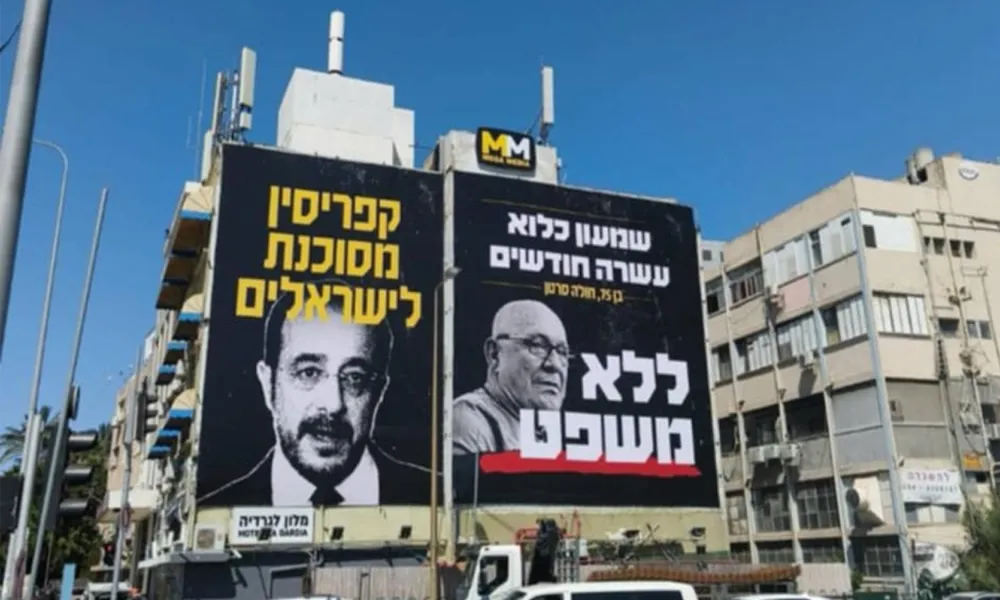
The Aykut family had publicly turned against President Christodoulides as early as April 2026. During the President's visit to Tel Aviv, family members placed advertisements on billboards in the Israeli capital bearing the message 'Cyprus is dangerous for Israelis', accompanied by a photograph of the President.
In addition, Mr Aykut's son sent letters to Jewish organisations in the United States, urging them to boycott Mr Christodoulides' visit and refrain from holding meetings with him.
The eight-minute video
On 8 January 2026, an eight-minute video was posted on social media platform X by an account operating under the name Emily Thompson.
The footage featured conversations concerning the financing of President Christodoulides' 2023 presidential election campaign, as well as alleged arrangements for individuals posing as prospective investors to gain access to the Presidential Palace.
Among those featured were former Energy Minister George Lakkotrypis, who had dealings with the supposed investors; Presidential Office Director Charalambos Charalambous, who appeared willing to facilitate the proposed investment; and Cyfield Group chief executive George Chrysochos.
The proposed investment, reportedly worth €150 million, was allegedly intended for a company belonging to the Cyfield Group, specifically its power station at Vasilikos.
The video's release triggered strong political reactions and led to resignations.
Mr Charalambous, who is also related to the President by marriage, resigned as Director of the Presidential Office. First Lady Philippa Karsera also stepped down as president of the Social Support Agency.
The video included references to the alleged use of the agency by the presidential couple for electoral purposes.
The Presidential Palace dismissed the footage as a 'product of fabrication, distortions and hybrid interference', firmly rejecting its contents and describing it as a targeted attempt to destabilise the country.
Those featured in the video also argued that the material had been manipulated through selective editing and the partial presentation of conversations, distorting their actual meaning and creating misleading impressions.
Black Cube's involvement
In its 10 April 2026 edition, Politis revealed that Israeli firm Black Cube was behind the controversial video.
Founded in 2011 by what it describes as 'veterans of elite Israeli intelligence units', the company is internationally known for its intelligence-gathering operations and has been dubbed a 'private Mossad'.
Following the Politis report, Black Cube issued a statement confirming its involvement in the case.
The company said it was 'proud' of its role in exposing alleged corruption involving Cyfield in Cyprus. It also said it had co-operated with the Cypriot authorities and expressed confidence that the investigation would establish the truth and bring those responsible to justice.
The firm's public confirmation added further political and institutional significance to an already controversial case.
Producing the eight-minute video reportedly required a substantial operation. A total of 26 hours of audiovisual material was recorded, with the associated costs estimated to have reached several million euros.
The supposed investors, who were allegedly agents working for Black Cube, reportedly used state-of-the-art equipment.
Their meetings with Mr Lakkotrypis took place over several months at luxury hotels and restaurants in Amsterdam and London, with all expenses covered. Mr Lakkotrypis also reportedly received a monthly payment of €5,000 in his capacity as a consultant.
The criminal investigation
On 13 January 2026, Attorney General George Savvides appointed former judge Andreas Paschalides as an independent criminal investigator.
His mandate was to assist the police in carrying out their investigative duties in relation to all matters connected with the video.
Mr Paschalides was initially given three months to complete the investigation.
The first official update on its progress came on 6 April 2026, when the investigator announced two significant developments.
First, the Attorney General had approved a request to extend the investigation by a further three months.
Second, during the initial three-month period, investigators had managed to secure the entire original audiovisual material, amounting to 26 hours of footage, from which the eight-minute video posted on X had been produced.
It subsequently emerged that the complete original footage had been handed over to the Cypriot authorities by Black Cube's lawyer in Cyprus, prominent criminal defence lawyer Antonis Demetriou.
The independent investigator submitted his findings to the Attorney General on 17 July 2026, with the main findings made public on 20 July.
However, the submission of the report did not bring the investigation to a complete close. One of its most important aspects remained unresolved: identifying those who had commissioned and financed the operation.
Mr Paschalides was therefore granted a further six-month extension, with the deadline for completing this part of the investigation set for the end of 2026.
Two individuals under scrutiny over possible corruption
Two individuals featured in the 26-hour audiovisual material are being examined by the Law Office of the Republic to determine whether there is sufficient evidence of possible corruption offences under Cyprus' ratifying law implementing the Council of Europe's Criminal Law Convention on Corruption.
The assessment focuses on their actions, representations, promises, statements and overall conduct, as documented in the independent investigator's findings.
The convention covers offences including bribery in both the public and private sectors, trading in influence and money laundering.
Two aspects of Mr Paschalides' announcement are particularly significant, as they leave open the possibility of further investigation into potential corruption offences by the Law Office.
The first concerns confidentiality and service agreements signed between three Cypriot individuals featured in the footage and the supposed investors. Under these agreements, two of the individuals reportedly received financial benefits.
The second relates to the legal assessment of their conduct.
Although the investigator said the evidence gathered at that stage did not indicate that any of the Cypriot individuals featured in the video had violated the Criminal Code, he clarified that both he and the police investigation team had also examined the possibility of offences under the Council of Europe's Criminal Law Convention on Corruption (Ratifying) Law of 2000.
This assessment covered the individuals' actions, representations, promises, statements and overall behaviour.
However, Mr Paschalides stressed that both he and the police team had reservations about whether such offences could ultimately be established.
It is also worth noting that the original 26-hour footage reportedly features other prominent figures from Cyprus' political and business circles, both current and former, who did not appear in the eight-minute video released publicly.