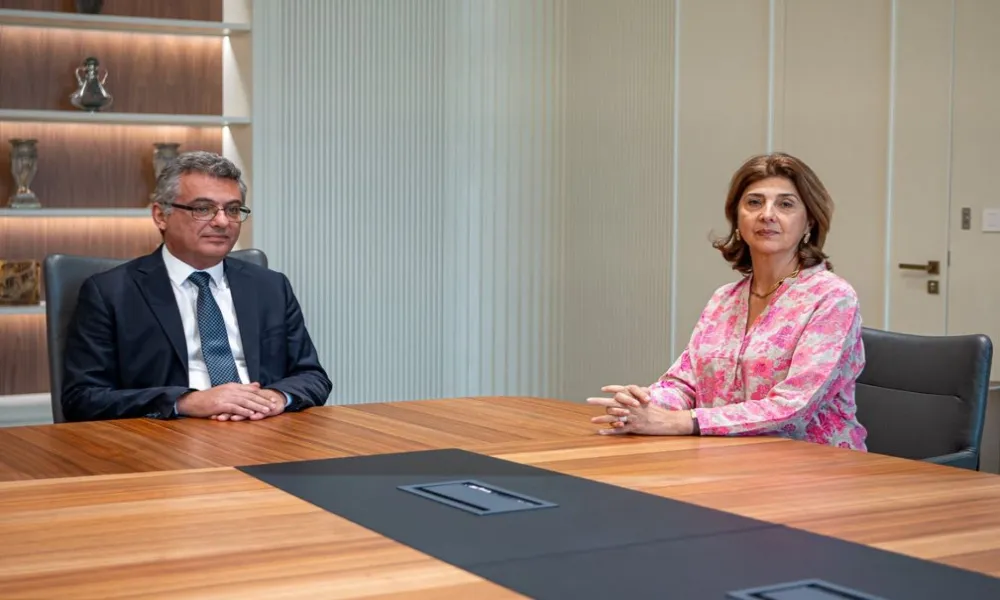
Despite a shared acknowledgment that there is a certain momentum in the Cyprus issue with the presence of María Ángela Holguín in Nicosia, the statements by the two leaders in Cyprus are positive in tone but differ in their assessments of the prospects of the effort.
In his initial evaluation of his own meeting with the UN Secretary-General’s envoy on Monday, Turkish Cypriot leader Tufan Erhürman appeared cautiously positive yesterday about convening a 5+1 informal meeting on Cyprus. He insisted that such a meeting must be “properly prepared so that it leads to a meaningful outcome.” He believes that if preparatory work is completed by the end of June or mid-July, the meeting could take place then; otherwise, it could be postponed to September if preparations are not ready by August.
No symbolism
A central element of Erhürman’s stance is that a new 5+1 meeting should not be held merely for symbolic reasons or to sustain momentum around the Cyprus issue. Instead, he argues that intensive preparation is required, along with prior agreement on the content, objectives and expected outcomes of the meeting.
This approach reflects the Turkish Cypriot side’s intent to avoid a repeat of previous processes that failed to produce substantive progress. Erhürman insists that both the content and the goals, as well as the expected outcomes of the meeting, must be clearly defined in advance.
While he described his meeting with María Ángela Holguín as sincere, useful and productive, he sent the message that it is still too early to draw conclusions, without prejudging either the success or failure of the new effort. He nevertheless maintained that agreement on specific confidence-building measures (CBMs) could form the first stage of the process, followed by agreement on the methodology for the start of negotiations.
The dominant condition
Based on Erhürman’s statements, it is clear that his side cannot proceed with the process unless it includes the four key demands he set from the outset:
- Political equality must be guaranteed and not subject to negotiation.
- A timetable must be set with clear start and end dates for the negotiations.
- Already achieved convergences must be maintained and reaffirmed.
The central element of these conditions is the position that there should be no return to the status quo in the event of withdrawal by the Greek Cypriot side – in other words, that the current situation should not be restored if negotiations fail due to Greek Cypriot responsibility.
Tough decisions ahead
According to information obtained by Politis, there is a growing perception within the Turkish Cypriot side that the discussion around the process is closely linked to, and partly shifting towards, the core principles set out by Erhürman.
It is also considered certain that if the process fails, the fourth condition regarding non-return to the status quo will be reactivated.
The emphasis on preparation indicates that the Turkish Cypriot leadership is seeking a more predictable and clearly defined framework for talks. Based on broader information, parallel contacts and discussions currently under way are creating the conditions for all sides to take bold decisions at the forthcoming expanded meeting.