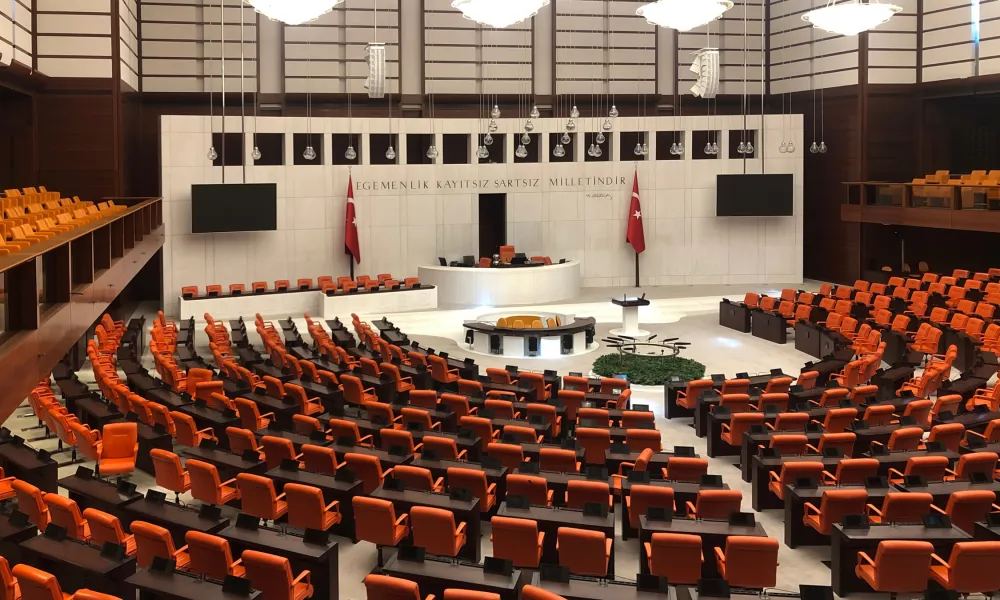

The Cyprus problem was at the centre of debate in the Turkish Grand National Assembly on Thursday, prompted by a motion from the Yeni Yol (New Path) party calling for discussion of the international non-recognition, isolation and embargoes facing the north.
The debate developed into a wide-ranging clash between government and opposition over Ankara's Cyprus policy, relations with the European Union, the "Blue Homeland" doctrine, and Turkey's international standing.
Istanbul MP Mustafa Kaya of Yeni Yol proposed renaming the north from the "Turkish Republic of Northern Cyprus" to the "Cypriot Turkish Republic." Kaya argued that since, in his view, Turkish Cypriots hold rights across the whole of Cyprus and to the Eastern Mediterranean's hydrocarbon reserves, there should no longer be talk of a "north" and "south" of the island. He accused the government of failing to prevent the north's international isolation following the 2004 referendum on the Annan Plan.
Kaya said promises to lift restrictions and establish direct international flights to the illegal airport in occupied Tymbou had not been fulfilled, and also criticised the Republic of Cyprus's accession to the European Union.
Turhan Çömez, deputy leader of the İYİ Parti (Good Party) parliamentary group, said Turkey "is losing significant ground" on the Cyprus problem, arguing that defending Turkish positions cannot rely solely on infrastructure projects and government buildings in the north, but requires a stronger diplomatic presence. He criticised the Turkish government over the fact that some Turkic states have opened embassies in the Republic of Cyprus, and referred to developments in the Eastern Mediterranean, arguing that the Greek Cypriot side is acting in areas Turkey considers part of its "Blue Homeland" doctrine.
Orhan Erdem, an MP for the governing AKP, responded that the north's security matters more than its international recognition, arguing that Turkey's presence as a guarantor power makes the north "one of the safest places in the world." He also defended Ankara's investment in the north, asking rhetorically whether state institutions should instead be housed "in old British buildings or tobacco factories."
The CHP argued that, despite the outcome of the 2004 referendum, Recep Tayyip Erdoğan's government had failed to prevent the continuation of international restrictions on the north, apportioning blame to both the European Union and the Turkish government. The pro-Kurdish DEM party said any solution should be based on the will of Cyprus's residents, while also criticising the economic situation in the north.
Mehmet Emin Ekmen, head of Yeni Yol's parliamentary group, said Turkish support for the north should not be limited to erecting new government buildings, arguing that priority should instead go to strengthening the rule of law and public order, citing what he described as serious crime and organised criminal networks in the north.
Source: AMNA